How to calculate net profit margin
Learn the net profit margin formula and how to use it to measure your business's true profitability.
Published Thursday 6 August 2026
Table of contents

How to calculate net profit margin
Key takeaways


- Net profit margin is calculated by dividing net profit by revenue and multiplying by 100 to get a percentage.
- A good net profit margin varies by industry, so compare your results to businesses in your sector and track changes over time.
- This ratio shows how much of every dollar in revenue becomes actual profit after all expenses and taxes, making it a key measure of financial health.
- Accounting software can automatically calculate your net profit margin from your financial data, saving time and reducing errors.
Understanding your net profit margin helps you see how efficiently your business turns revenue into profit.
What is net profit margin?
Net profit margin is the percentage of revenue that remains as profit after all expenses and taxes have been deducted. It is often called the "bottom line" profitability ratio because it reflects the final profit figure on your income statement.
Handy resources
Advisor directory
You can search for experts in our advisor directory
Profit & Loss template
Download Xero’s profit and loss statement template to show how much money your business is making
Financial reporting
Keep track of your performance with accounting reports
Disclaimer
This glossary is for small business owners. The definitions are written with their requirements in mind. More detailed definitions can be found in accounting textbooks or from an accounting professional. Xero does not provide accounting, tax, business or legal advice.
This metric gives you a clear picture of your overall profitability. While other profit margin ratios focus on specific cost categories, net profit margin accounts for every cost your business incurs.
Net profit margin formula
The net profit margin formula is straightforward. You can express it as:
Net profit margin = (net profit ÷ revenue) × 100
To find net profit, use this calculation:
Net profit = revenue − cost of goods sold (COGS) − operating expenses − interest − taxes
Here is what each variable means:
- Revenue: the total amount earned from sales before any deductions
- Cost of goods sold (COGS): direct costs of producing goods or delivering services
- Operating expenses: ongoing costs such as rent, utilities, salaries and marketing
- Interest and taxes: financing costs and government obligations
- Net profit: the amount remaining after subtracting all the above from revenue
How to calculate net profit margin
Follow these four steps to calculate your net profit margin.
- Find your total revenue for the period from your income statement.
- Add up all costs, including COGS, operating expenses, interest and taxes.
- Subtract total costs from revenue to get your net profit.
- Divide net profit by revenue and multiply by 100 to get the percentage.
Example of a net profit margin calculation
Consider a business that earns $20,000 from cleaning offices. It costs $8,000 to provide those services, so gross profit is $12,000.
The business spends another $7,000 on operating expenses and taxes ($3,000 on operating expenses and $4,000 on taxes). Subtracting these from gross profit leaves a net profit of $5,000.
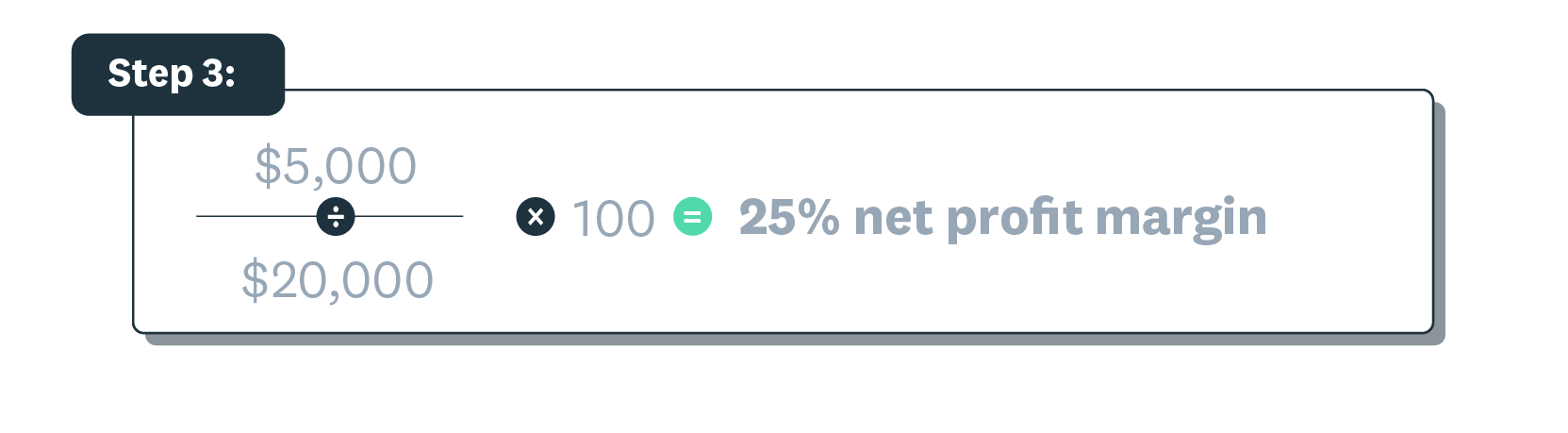
To calculate the net profit margin: $5,000 ÷ $20,000 × 100 = 25%. This means the business keeps 25 cents of every dollar earned as profit after all costs.
What is a good net profit margin?
A "good" net profit margin depends on your industry and business model. Service businesses often have higher margins than retail or manufacturing due to lower direct costs.
As a general guide, net profit margins around 5% are considered low, approximately 10% is average, and 20% or higher is strong. However, these benchmarks vary widely by sector. A supermarket with a 2% margin may be performing well, while a consulting firm with the same margin would be struggling.
The most useful comparisons are within your own industry and against your own historical performance. Tracking your margin over time reveals whether your profitability is improving or declining.
Net profit margin vs gross and operating profit margin
Each profit margin measures profitability at a different stage. Understanding all three helps you identify where costs are affecting your bottom line. For more detail on the first of these ratios, see this guide on gross profit margin.
- Gross profit margin: revenue minus cost of goods sold, divided by revenue. It shows profitability before operating costs.
- Operating profit margin: revenue minus COGS and operating expenses, divided by revenue. It reflects profitability before interest and taxes.
- Net profit margin: revenue minus all costs (COGS, operating expenses, interest and taxes), divided by revenue. It shows final profitability after everything.
Why net profit margin matters
Net profit margin is one of the most important profitability ratios for any business. It tells you whether your pricing, cost structure and operations are working together effectively.
This metric informs several key decisions:
- Pricing: whether you can afford to lower prices or need to raise them
- Cost control: where to focus when cutting expenses
- Budgeting: how much you can reinvest in the business
- Funding: lenders and investors often assess net profit margin when evaluating your business
How to improve your net profit margin
Improving your net profit margin means either increasing revenue or reducing costs. Use these strategies to measure and boost your profitability.
- Raise prices strategically where customers perceive strong value
- Reduce cost of goods sold by negotiating with suppliers or finding more efficient production methods
- Cut operating expenses by reviewing recurring costs such as subscriptions, utilities and office space
- Increase sales volume without raising costs proportionally, spreading fixed costs across more units
Limitations of net profit margin
While net profit margin is valuable, it has limitations you should keep in mind.
- One-off gains or losses (such as selling an asset or a lawsuit settlement) can distort your margin for that period
- Net profit does not equal cash flow, so a healthy margin does not guarantee you have cash available
- Margins vary significantly by industry, making cross-industry comparisons misleading
- Businesses with heavy debt or large depreciation charges may show lower margins even if they are operationally efficient
Track your net profit margin with Xero
Xero's financial reports calculate your net profit margin automatically from your accounting data. You can view profitability trends over time and compare periods to spot changes early.
Ready to simplify your financial reporting? Get one month free and see how Xero can help you stay on top of your margins.
FAQs on net profit margin
Here are answers to common questions about net profit margin.
What is a good net profit margin?
It depends on your industry. Restaurants may operate on margins of 3–5%, while software companies often exceed 20%. Compare your margin to similar businesses in your sector.
Can net profit margin be negative?
Yes. A negative net profit margin means your business made a loss for that period, with total costs exceeding revenue.
What is the difference between net profit margin and gross profit margin?
Gross profit margin only deducts cost of goods sold from revenue. Net profit margin deducts all expenses, including operating costs, interest and taxes, giving a fuller picture of profitability.
How do I find net profit on my income statement?
Net profit appears at the bottom of your profit and loss statement after all expenses have been subtracted from revenue. It is sometimes labelled "net income" or "bottom line".
Why is my net profit margin low?
Common causes include high operating expenses, low pricing, rising cost of goods sold, or heavy interest payments. Review each cost category to identify where you are losing margin.