Operating profit
Learn what operating profit is, how to calculate it, and how it differs from gross and net profit.
Published Wednesday 12 August 2026
Table of contents

How to calculate operating profit
Key takeaways
- Operating profit is what your business earns from core trading after operating expenses and depreciation, but before loan interest and tax.
- It is also known as operating income or EBIT, and it sits between gross profit and net profit on your income statement.
- The formula is gross profit minus operating expenses minus depreciation, and operating profit margin expresses this as a percentage of revenue.
- Tracking operating profit shows how efficiently your day-to-day operations run, separate from financing and tax decisions.
What is operating profit?
Operating profit is the money your business earns from its core trading activities after deducting operating costs, but before paying loan interest or tax. It shows how much profit your day-to-day operations generate, separate from financing decisions or tax obligations.

Operating profit is also known as operating income or EBIT (earnings before interest and tax). You can find it on your income statement, where it sits between gross profit and net profit.
Why operating profit matters
Operating profit isolates the performance of your core business. Because it excludes loan interest and tax, it lets you see whether your operations are profitable on their own terms.
This makes it easier to compare your business against competitors or industry benchmarks, even if you have different financing arrangements. It also helps you make informed decisions about pricing, cost control and operational efficiency.
Handy resources
Advisor directory
You can search for experts in our advisor directory
How to manage your finances and cash flow
Learn about money management for your small business
Financial reporting
Keep track of your performance with accounting reports
For context on South African profit margins, according to the Bureau of Market Research, drawing on Statistics South Africa's Annual Financial Statistics, the average after-tax profit margin across all South African businesses was just 1.3% in 2024, with the trade sector at 1.0%. Note that this is a net profit margin (after tax), not an operating profit margin, but it illustrates how tight margins can be.
Operating profit formula
The formula for calculating operating profit is:
Operating profit = gross profit − operating expenses − depreciation
Gross profit equals your revenue minus the cost of goods sold (COGS), which covers the direct costs of producing or purchasing what you sell. Operating expenses include rent, utilities, wages, marketing and other costs of running the business. Depreciation accounts for the declining value of equipment and other assets over time.
Loan interest and tax are excluded from the calculation. This is why operating profit is called EBIT (earnings before interest and tax).
How to calculate operating profit
Follow these steps to work out your operating profit:
- Calculate your gross profit by subtracting the cost of goods sold from your revenue.
- Add up all your operating expenses, including depreciation. Do not include loan interest payments.
- Subtract your total operating expenses from your gross profit. The result is your operating profit.
Example of an operating profit calculation
Suppose your business sells R20,000 worth of products or services in a month. The direct cost of providing those goods or services is R8,000. This leaves you with a gross profit of R12,000.
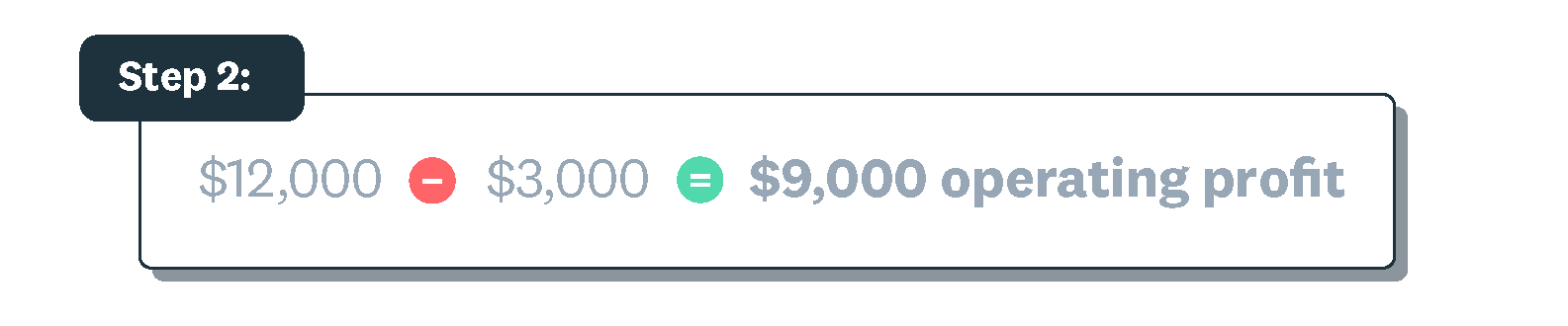
During the same month, you pay R3,000 in operating expenses (rent, electricity and phone). No depreciation applies in this example.
Your operating profit is R12,000 minus R3,000, which equals R9,000.
Notice that loan interest is not included. Operating profit measures the profit your business controls through its operations, which is why it is called EBIT. Interest relates to how you finance the business, not how you run it.
Operating profit vs gross profit vs net profit
These three profit measures each tell you something different about your business finances. Understanding the distinction helps you analyse performance at each stage.
- Gross profit is your revenue minus the cost of goods sold. It shows how much you retain after covering the direct costs of what you sell.
- Operating profit is your gross profit minus operating expenses and depreciation. It excludes loan interest and tax, revealing how well your core operations perform.
- Net profit is what remains after all costs, including loan interest and tax. It represents your bottom line.
A related measure is net operating profit after tax (NOPAT), which adjusts operating profit by removing the tax effect to show after-tax operational performance.
Operating profit margin
Operating profit margin expresses your operating profit as a percentage of revenue. It shows how much of each rand in sales converts into operating profit.
Operating profit margin = (operating profit ÷ revenue) × 100
A higher margin indicates greater efficiency in turning revenue into profit from operations. However, what counts as a good margin varies by industry. Retailers typically operate on thinner margins than professional services firms, for example.
Compare your margin against industry benchmarks to understand where you stand. You can explore related measures like gross profit margin and other profitability ratios to get a fuller picture of your financial health.
How to improve your operating profit
Several practical levers can help you increase your profits at the operating level. Consider these approaches:
- Raise your prices where the market allows, ensuring you stay competitive while improving margins.
- Reduce your cost of goods sold by negotiating better supplier terms or finding more cost-effective materials.
- Cut operating expenses by reviewing rent, utilities and subscriptions for savings opportunities.
- Improve efficiency in your operations so you produce more output with the same resources.
Track your operating profit with Xero
Xero's reporting tools give you a clear view of your operating profit and other key financial metrics. You can pull up your income statement in real time, compare periods and spot trends without sifting through spreadsheets.
Ready to take control of your numbers? Try Xero and get one month free.
FAQs on operating profit
Here are answers to common questions about operating profit.
Is operating profit the same as EBIT?
In most cases, yes. EBIT stands for earnings before interest and tax, which is another name for operating profit, though EBIT can differ slightly when a business has income from outside its core operations.
What is the difference between operating profit and net profit?
Operating profit excludes loan interest and tax, while net profit includes them. Net profit is your final bottom line after all expenses have been paid.
What does operating profit exclude?
Operating profit excludes loan interest payments and income tax. It also excludes non-operating income, such as investment returns or one-off gains from selling assets.
What is a good operating profit margin?
There is no single benchmark because margins vary widely by industry. Compare your margin against similar businesses in your sector to assess whether your operations are running efficiently.
Related terms
Learn more about operating profit
Handy resources
Advisor directory
You can search for experts in our advisor directory
Profit & Loss template
Download Xero’s profit and loss statement template to show how much money you business is making
Financial reporting
Keep track of your performance with accounting reports
Disclaimer
This glossary is for small business owners. The definitions are written with their requirements in mind. More detailed definitions can be found in accounting textbooks or from an accounting professional. Xero does not provide accounting, tax, business or legal advice.