Payroll
A plain-English guide to payroll in the Philippines: tax, SSS, PhilHealth, Pag-IBIG, 13th month pay and DOLE rules.
Published Monday 31 August 2026
Table of contents
Key takeaways
- Payroll in the Philippines covers computing wages, withholding taxes, and remitting mandatory contributions to SSS, PhilHealth and Pag-IBIG.
- Employers withhold income tax on compensation for the Bureau of Internal Revenue, and annual taxable pay of ₱250,000 and below is exempt under the TRAIN law.
- 13th month pay is mandatory for rank-and-file employees and must be paid on or before 24 December.
- Wages must be paid at least twice a month, payslips issued each pay run, and final pay released within 30 days of separation.
What is payroll?
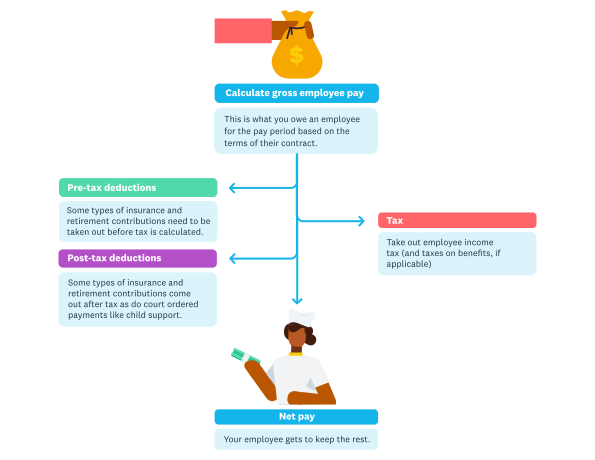
Payroll is what happens each payday and involves sending the right amounts of money to the employee, but also to a number of other locations.
Payroll is the process of calculating, deducting and paying employee wages, plus withholding and remitting taxes and mandatory government contributions. It is how you turn an employee's agreed salary into the net amount that lands in their bank account.
In the Philippines, payroll ties together tax rules, labour law, and social contribution schemes. Getting each pay run right keeps your business compliant and your team paid on time.
How does payroll work in the Philippines?
Payroll runs as a repeating cycle for every pay period: you compute what each employee earns, subtract the lawful deductions, and pay the balance. You then remit the amounts you withheld to the relevant government agencies. If you are hiring your first staff member, this guide to running payroll walks through the basics.
A single pay run in the Philippines usually moves through these stages:
- Compute gross pay, including basic salary and any overtime, night differential or holiday pay
- Withhold income tax on compensation for the Bureau of Internal Revenue
- Deduct the employee share of SSS, PhilHealth and Pag-IBIG contributions
- Remit withheld tax and contributions, together with the employer share, to each agency
- Pay the net amount to your employee and issue a payslip
What is included in payroll?
Payroll accounts for more than basic salary. It brings together every form of pay an employee is entitled to, alongside the deductions you are required to make. Keeping these components organised is a core part of day-to-day bookkeeping.
A typical Philippine payroll includes the following:
- Basic pay for the hours or period worked
- Overtime pay for work beyond normal hours
- Night differential for work during night-shift hours
- Holiday and rest day premiums
- Allowances and other agreed benefits
- 13th month pay accrued over the calendar year
- Statutory deductions for tax and mandatory contributions
Payroll deductions in the Philippines
Deductions are the amounts you subtract from gross pay before an employee is paid. In the Philippines, most deductions are set by law and must be remitted to a government agency on a fixed schedule.
Withholding tax on compensation
Employers withhold income tax from employee salaries and remit it to the Bureau of Internal Revenue using the TRAIN (Tax Reform for Acceleration and Inclusion) law graduated tax table. Annual taxable compensation of ₱250,000 and below is exempt, so lower earners may have no tax withheld.
You report withholding tax to the BIR using set forms. BIR Form 1601-C is the monthly remittance return, while BIR Form 2316 is the annual certificate of compensation payment and tax withheld given to each employee. You also submit an alphalist of employees and the tax withheld from them.
SSS, PhilHealth and Pag-IBIG contributions
Three mandatory contributions are shared between you and your employees, with each side paying a set portion. You deduct the employee share from pay and add your employer share before remitting the total.
- The Social Security System (SSS) total rate is 15% from January 2025, split into 10% for the employer and 5% for the employee
- PhilHealth premium is 5%, with a ₱10,000 income floor and a ₱100,000 ceiling, split equally between employer and employee
- Pag-IBIG (Home Development Mutual Fund) is 2% for the employer and 2% for the employee, up to a maximum of ₱200 each
Other deductions
Beyond tax and mandatory contributions, some employees have further amounts taken from their pay. These are only lawful when authorised in writing or required by law, such as SSS or Pag-IBIG salary loan repayments, insurance premiums, or union dues. You cannot make deductions that an employee has not agreed to or that no law requires.
Government agencies and payroll forms
Running payroll means reporting to several agencies, each with its own returns and deadlines. Knowing which body handles what makes it easier to stay on schedule.
- Bureau of Internal Revenue: collects withholding tax on compensation through BIR Form 1601-C, BIR Form 2316 and the annual alphalist
- Social Security System: administers social insurance contributions and member records
- PhilHealth: administers national health insurance premiums
- Pag-IBIG (Home Development Mutual Fund): administers housing and savings fund contributions
How to set up payroll for the first time
Setting up payroll for the first time is mostly about registering with the right agencies and gathering the details you need before your first pay run. Work through these steps in order.
1. Register with the BIR and contribution agencies
Register as an employer with the Bureau of Internal Revenue, SSS, PhilHealth and Pag-IBIG. This gives you the employer numbers you need to withhold tax and remit contributions.
2. Collect employee information
Gather each employee's Taxpayer Identification Number (TIN) and their SSS, PhilHealth and Pag-IBIG membership numbers. Record their salary, pay rate, and bank details so you can compute and pay wages accurately.
3. Choose how you will run payroll
Decide whether you will process payroll by hand, hand it to an adviser, or use software. If you are weighing up the options, this overview of online payroll explains how a digital approach works.
4. Run and record your first payroll
Compute gross pay, apply tax and contribution deductions, and pay the net amount to your employees. Keep a record of each pay run, issue payslips, and note the remittance deadlines for every agency.
Ways to run payroll
There is more than one way to handle payroll, and the right choice depends on your team size, budget, and how much time you can give it. Here are the main options.
Run payroll manually
You can compute pay, deductions and remittances yourself using spreadsheets. This keeps costs low, but it takes time and leaves more room for error as your headcount grows.
Use an accountant or bookkeeper
An accountant or bookkeeper can run payroll on your behalf and keep you aligned with BIR and DOLE rules. This guide to payroll outsourcing covers what to expect when you hand the work to a professional.
Use payroll software
Payroll software computes pay, deductions and contributions for you and stores the records you need. It can cut manual admin and help you keep pay runs on time as your business grows.
Payroll compliance and legal requirements
Philippine payroll is governed by the Labor Code and rules issued by the Department of Labor and Employment. Meeting these requirements protects your employees and keeps your business compliant.
Minimum wage rates are set regionally by the Regional Tripartite Wages and Productivity Boards, under DOLE and the National Wages and Productivity Commission (NWPC), so there is no single national rate. In Metro Manila (NCR), the daily minimum wage for the non-agriculture sector is ₱755 under Wage Order NCR-27.
Other key obligations to keep in mind include:
- Pay frequency: wages must be paid at least once every two weeks or twice a month, at intervals not exceeding 16 days
- 13th month pay: one-twelfth (1/12) of basic annual salary, mandatory under Presidential Decree No. 851, paid on or before 24 December
- Payslips: give each employee a payslip or pay record for every pay run
- Final pay: released within 30 days of separation under DOLE Labor Advisory No. 06-20
- Certificate of Employment: issued within three days of an employee's request
- Record-keeping: the BIR requires records be kept for 10 years, and DOLE requires employment records be kept for at least three years
Simplify Philippine payroll with Xero
Xero brings pay runs, deductions and payslips together in one place, so you can meet your BIR, SSS, PhilHealth and Pag-IBIG obligations without the manual admin. See how the tools fit your business and get one month free when you choose a plan. That leaves you more time to run your business and less time on the books.
FAQs on payroll
Here are quick answers to common questions about running payroll in the Philippines.
How often should you run payroll in the Philippines?
The Labor Code requires wages to be paid at least once every two weeks or twice a month, at intervals not exceeding 16 days. Many employers settle on two fixed pay dates each month to meet this rule.
Is 13th month pay mandatory?
Yes. Under Presidential Decree No. 851, 13th month pay is mandatory for rank-and-file employees and must be paid on or before 24 December each year.
Is 13th month pay taxable?
13th month pay is tax-exempt up to a ceiling set by the Bureau of Internal Revenue. Any amount above that ceiling is added to your employee's taxable compensation.
Can you run payroll for just one employee?
Yes. The same rules apply even with a single employee, so you still register with the agencies, withhold tax, remit contributions, and issue a payslip.
Related terms
Learn more about payroll
Handy resources
Advisor directory
You can search for experts in our advisor directory
Your guide to hiring
Learn tips for hiring, onboarding and paying an employee, while keeping everyone happy
Payroll with Xero
Learn how Xero can help with your payroll requirements
Disclaimer
This glossary is for small business owners. The definitions are written with their requirements in mind. More detailed definitions can be found in accounting textbooks or from an accounting professional. Xero does not provide accounting, tax, business or legal advice.