Gross profit vs net profit
Gross profit subtracts direct costs from revenue. Net profit subtracts every cost, including interest and tax.
Published Wednesday 30 September 2026
Table of contents
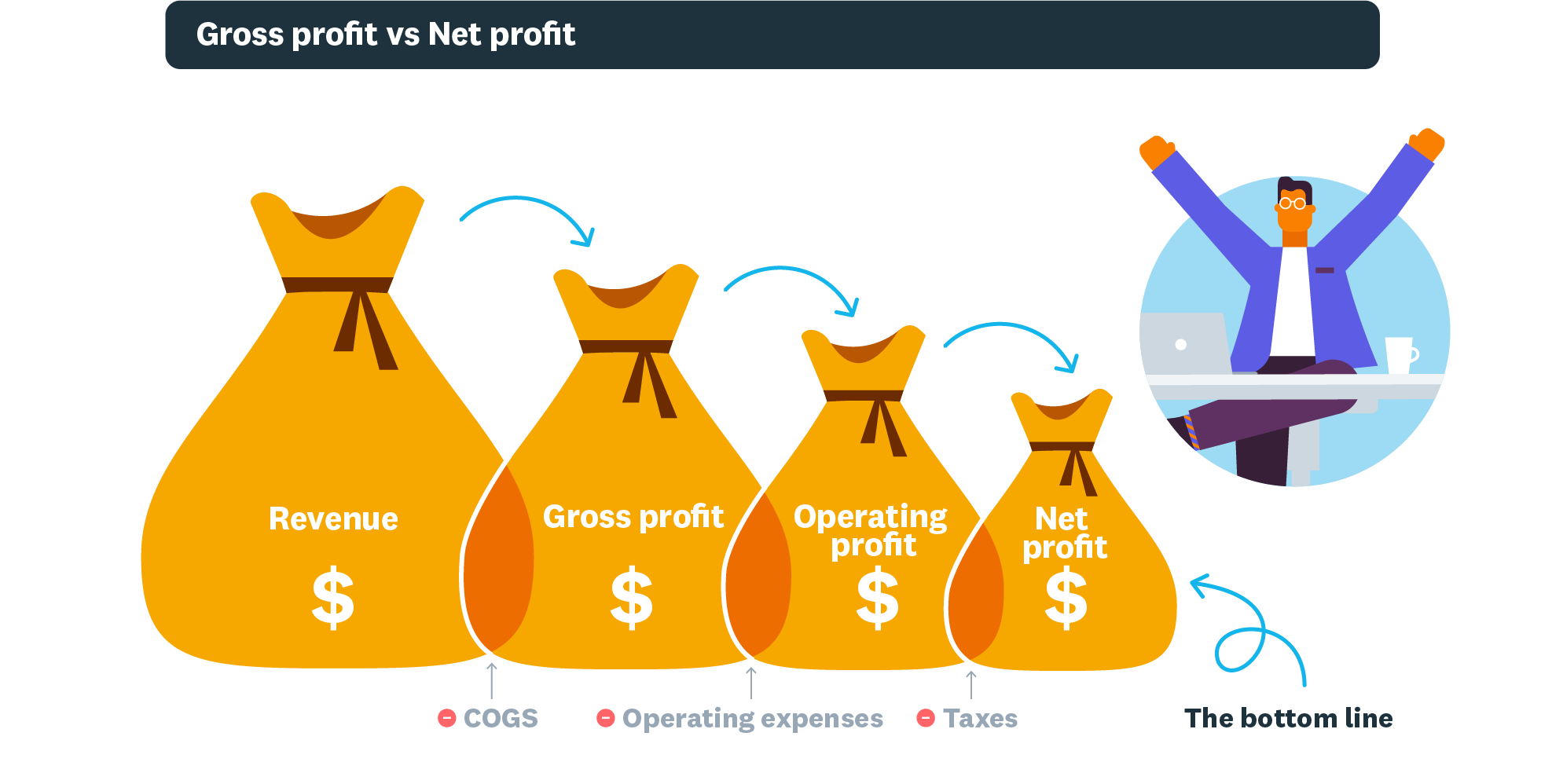
The difference between gross profit and net profit is operating expenses and taxes
Key takeaways
- Gross profit vs net profit comes down to which costs you subtract. Gross profit removes only direct costs, while net profit also removes overheads, interest and tax.
- Operating profit sits between the two figures. It shows what your day-to-day trading earns before interest and tax.
- In Ireland, companies pay corporation tax on taxable profits and sole traders pay tax on their net profits. Capital allowances take the place of accounting depreciation when you work out tax.
- Tracking both margins helps you set prices and control costs. A profit and loss report shows both figures in one place.
What is gross profit?
Gross profit is the money left from your sales after you pay the direct costs of making or delivering what you sell. It shows whether each sale earns enough to cover your other costs.
These direct costs are known as cost of goods sold (COGS). They include stock for a shop, flour and butter for a bakery, parts for a repair business, or hands-on labour for a service provider.
Gross profit leaves out the wider costs of running your business, such as rent, utilities, marketing and insurance. A healthy gross profit is a strong start, and net profit then tells you whether the whole business pays its way.
Gross profit formula
Working out gross profit takes one subtraction. The Corporate Finance Institute’s definition (CFI) sets it out like this:
Gross profit = Revenue – Cost of goods sold (COGS)
Say you run a small bakery in Galway. In a given month, your sales bring in €25,000, and your COGS for flour, butter, packaging and baking staff wages comes to €10,000.
Your gross profit for the month is €25,000 – €10,000 = €15,000. That €15,000 is what you have to cover every other cost, with anything left over becoming net profit.
What is net profit?
Net profit is what’s left after you subtract every business cost from your revenue: COGS, operating expenses, interest and tax. It’s often called your bottom line because it sits on the last line of your profit and loss statement.
CFI’s net income guide notes that net profit also goes by the name net income. Only the interest on a business loan counts as an expense; repaying the loan principal reduces what you owe on your balance sheet instead.
Lenders and investors study net profit closely, and it’s the starting point for working out the taxable profit Revenue charges tax on. If it’s positive, you’re earning more than you spend; if it’s negative, you’re trading at a loss.
Net profit formula
Net profit builds on gross profit by taking away every remaining cost. Here’s the formula, with interest and tax shown as separate lines:
Net profit = Revenue – COGS – Operating expenses – Interest – Tax
Your Galway bakery made a gross profit of €15,000 this month. Now take away its other monthly costs:
- Rent: €3,000
- Utilities: €500
- Marketing: €800
- Insurance: €400
- Admin wages: €4,000
- Loan interest: €600
- Tax: €1,200
Those costs add up to €10,500, so your net profit is €15,000 – €10,500 = €4,500. The gap between the two figures shows how much of your gross profit goes on running the business.
Key differences between gross profit and net profit
Both figures come from the same profit and loss statement, and each answers a different question. Here’s how they compare:
- Gross profit measures how efficiently you make or deliver what you sell, while net profit measures profitability after every cost
- Gross profit subtracts only COGS, while net profit also subtracts operating expenses, interest and tax
- Gross profit shows whether your prices cover production costs, while net profit shows whether the whole business makes money
- Gross profit appears partway down the statement, while net profit sits at the bottom
A third figure, operating profit, sits between the two.
Operating profit: the figure between gross and net
Operating profit is what your business earns from day-to-day trading, before interest and tax. It shows how well you control running costs once direct costs are covered.
Brex’s guide to profit margins gives the formula as:
Operating profit = Revenue – COGS – Operating expenses
For the Galway bakery, operating expenses, or overheads, are rent, utilities, marketing, insurance and admin wages, totalling €8,700. Operating profit is €15,000 – €8,700 = €6,300, and taking away €600 interest and €1,200 tax leaves €4,500 net profit.
You may also see a related measure, earnings before interest, tax, depreciation and amortisation (EBITDA). It takes operating profit a step further by adding back depreciation and amortisation.
Why gross profit and net profit both matter for your business
Each figure points you to a different kind of decision, and together they help you measure profitability across the business. Gross profit guides pricing and supplier choices, while net profit tells you whether your business model holds up.
If gross profit shrinks, check whether supplier prices have risen or your sales mix has shifted towards lower-margin products. A high gross profit with a low net profit means running costs and finance costs are using up most of what each sale earns.
A café paying high city-centre rent is a good example: strong margins on every coffee, with rent absorbing much of the gross profit. Watching both figures shows you exactly where the money goes.
Lenders and investors look at both figures when you apply for a loan or funding. Gross profit shows the strength of your core offer, and net profit shows whether the whole operation is sound. The Department of Finance’s SME Credit Demand Survey for 2025 found 76% of small and medium-sized enterprises reported making a profit during 2025, up from 73% in 2024.
How to calculate gross and net profit
You can work out both figures in five steps using your own numbers. Pick a period, such as a month or a quarter, and use it throughout.
1. Add up your total revenue
Start with all the income your business earned in the period, including sales and any other business income. If you’re unsure what revenue means for your business, get clear on that first.
2. Calculate your cost of goods sold
Add up the direct costs of producing or delivering what you sell, such as raw materials, direct labour, packaging and delivery. Some businesses call this figure cost of sales, and the method is the same.
3. Subtract COGS from revenue to get gross profit
The result is what’s left before operating expenses. If it’s low or negative, look at your prices and production costs first.
4. Add up all remaining expenses
List everything else, including rent, utilities, marketing, insurance, non-production wages, loan interest, depreciation and tax.
5. Subtract total expenses from revenue to get net profit
This final figure is what your business earned after every cost. Subtracting the step 4 total from your gross profit gives you the same answer.
In Xero, your profit and loss report shows revenue, COGS, expenses, gross profit and net profit automatically. That saves you working through the steps by hand each month.
Gross profit margin vs net profit margin
Profit margins turn your profit figures into percentages, which makes it easier to compare periods or businesses of different sizes. They’re sometimes called the gross profit ratio and net profit ratio.
Gross profit margin = (Gross profit ÷ Revenue) × 100
For the Galway bakery, (€15,000 ÷ €25,000) × 100 = 60%. That means 60 cent of every euro in sales is available to cover the rest of your costs.
Net profit margin = (Net profit ÷ Revenue) × 100
For the bakery, (€4,500 ÷ €25,000) × 100 = 18%. So 18 cent of every euro is profit after all costs.
Margins vary widely by industry. For comparison, NYU Stern’s January 2026 margin data gives these averages for US publicly traded companies:
- General retail companies average a 33.18% gross margin and a 5.61% net margin
- Restaurants average a 32.24% gross margin and a 9.37% net margin
- Software companies average a 71.72% gross margin and a 25.49% net margin
- Engineering and construction firms average a 15.46% gross margin and a 5.94% net margin
- The total market averages a 37.76% gross margin and a 9.74% net margin
These are large listed US businesses, so margins for Irish small businesses may differ. As a general guide, Brex’s rule of thumb, from the same guide, treats a 5% net margin as low, 10% as healthy and 20% as high.
On that scale, the bakery’s 18% net margin sits towards the top. Your own margins over time are often the most useful benchmark, so learn how to calculate and improve profit margins for your type of business.
How gross and net profit affect your tax in Ireland
Tax in Ireland is charged on profit, so your net profit is the starting point for your tax bill. How you’re taxed depends on whether you trade as a limited company or as a sole trader.
Companies pay corporation tax on their taxable profits. Revenue sets out two corporation tax rates: 12.5% for trading income and 25% for non-trading income, such as rental and investment income.
If you’re a sole trader, you pay Income Tax, Pay Related Social Insurance (PRSI) and the Universal Social Charge (USC) on your net profits. Citizens Information’s tax guide explains that you file an Income Tax Return (Form 11) through the Revenue Online Service (ROS).
Your taxable profit can differ from the net profit in your accounts. For tax, you claim capital allowances instead of accounting depreciation, at 12.5% a year over eight years for plant and machinery.
For example, a €8,000 oven would give the bakery a €1,000 allowance each year for eight years. Rates and rules can change, so talk to an accountant about how they apply to your business.
How to improve your gross profit
To lift gross profit, focus on what you earn per sale or what each sale costs you to produce. These steps can help:
- Review your prices whenever supplier costs rise, so your margin keeps pace with your COGS
- Ask suppliers for bulk discounts, or compare quotes from other suppliers
- Cut waste and spoilage with tighter stock control
- Find faster ways to make or deliver your product while keeping quality high
- Shift your sales mix towards the products or services with the best margins
Small gains on each sale add up across a year of trading.
How to improve your net profit
Net profit takes in many more costs, so improvements usually come from several small changes. These ideas can help you increase profits across the business:
- Review subscriptions and recurring costs, and cancel anything you rarely use
- Automate invoicing and bank reconciliation to cut admin time
- Check your expenses monthly instead of waiting for the end of the financial year
- Work with an accountant to claim every allowable expense, using Revenue’s guidance on capital allowances as a starting point
- Grow sales to existing customers without adding matching costs
Each change on its own may look modest, and together they can move your bottom line.
Track your profitability with Xero
Gross profit tells you whether your prices work, and net profit tells you whether your business does. Watching both each month helps you act early and plan ahead with a clear view of your numbers.
Xero brings your sales and costs together in easy-to-read reports, with bank feeds keeping the figures up to date. Try Xero today and get one month free.
FAQs on gross profit vs net profit
Here are quick answers to common questions about gross profit and net profit.
Can gross profit be higher than net profit?
Yes, gross profit is almost always higher, because net profit also deducts overheads, interest and tax. The two only match if a business has no costs beyond COGS.
Why is it called gross profit?
“Gross” means the whole amount before deductions, so gross profit is your profit before overheads, interest and tax come out. “Net” means what remains after those deductions, which is why net profit is the final figure.
Does gross profit include wages?
Wages for staff who make your product or deliver your service sit in COGS, so they reduce gross profit. Wages for admin, sales or management staff are operating expenses and only reduce net profit.
Do you pay tax on gross or net profit in Ireland?
You pay tax on taxable profit, which starts from your net profit before tax and is then adjusted for items such as capital allowances. Gross profit is only a step along the way.
What is a good gross profit margin?
In NYU Stern’s January 2026 data for US publicly traded companies, average gross margins run from 15.46% in engineering and construction to 71.72% in software. This guide to gross profit margin shows how to track yours over time.
What is a good net profit margin?
Brex’s rule of thumb calls 10% healthy, which is close to the 9.74% total market average in NYU Stern’s January 2026 US data. Check your own figure with this net profit margin calculator.
Is net profit the same as net income?
Yes, net profit and net income usually mean the same thing. You may also see it called net earnings or the bottom line.
Can gross profit be negative?
Yes, if your COGS is higher than your revenue, gross profit turns negative. That means each sale costs more to produce than it earns, so review your prices and direct costs quickly.
Related terms
Learn more about gross profit vs net profit
Handy resources
Advisor directory
You can search for experts in our advisor directory
Xero Small Business Guides
Discover resources to help you do better business
Financial reporting
Keep track of your performance with accounting reports
Disclaimer
This glossary is for small business owners. The definitions are written with their requirements in mind. More detailed definitions can be found in accounting textbooks or from an accounting professional. Xero does not provide accounting, tax, business or legal advice.