Margin vs markup
Learn how margin and markup differ, how to calculate and convert them, and how to price for profit in Ireland.
Published Wednesday 30 September 2026
Table of contents
Key takeaways
- Margin is profit as a percentage of your selling price, while markup is profit as a percentage of your cost
- The same euro profit always gives a higher markup than margin, so a 50% markup equals a 33.3% margin
- To hit a target margin, divide cost by (1 − margin), or convert it with markup = margin ÷ (1 − margin)
- If you're VAT-registered, work out both figures on VAT-exclusive prices, because the VAT you charge belongs to Revenue
What is margin?
Margin is the share of your selling price that's left as profit after you pay for the goods you sold. It's often called gross profit margin, because it's your gross profit shown as a percentage of revenue.
Gross profit is revenue minus cost of goods sold (COGS), which covers direct costs like stock, materials and production labour. Margin tells you how many cents from every euro of sales you keep before overheads.
You can work out margin with these two formulas:
- Gross profit = revenue − COGS
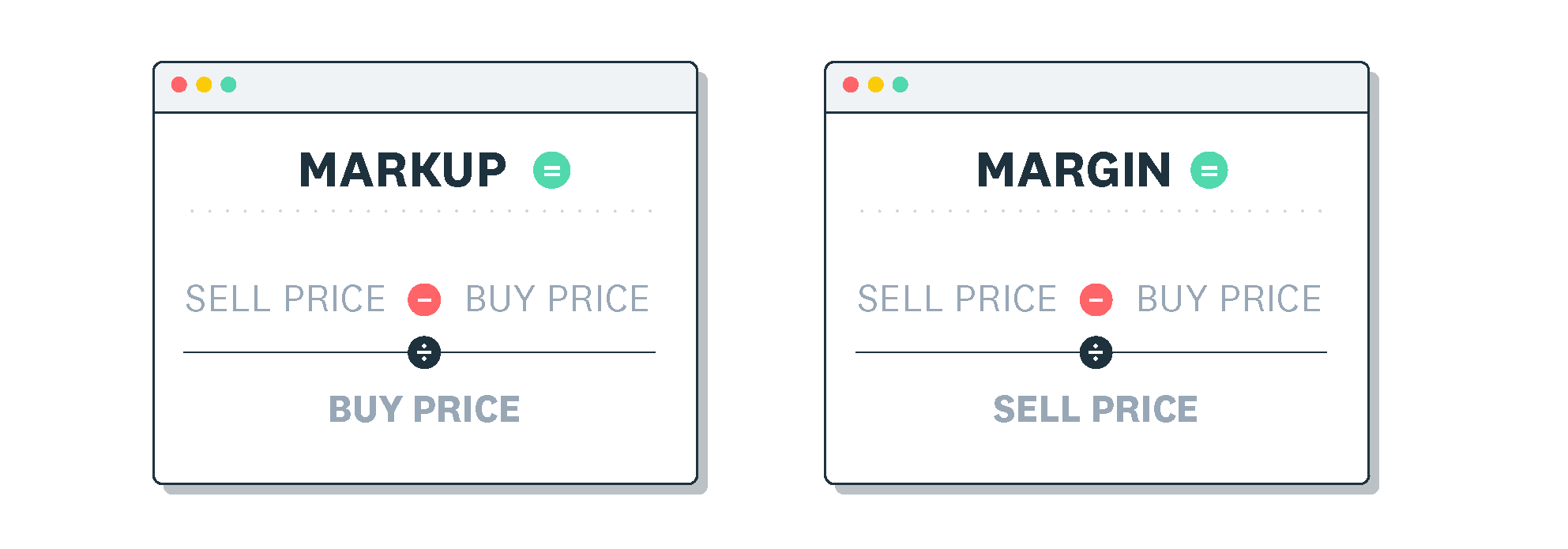
- Margin = (revenue − COGS) ÷ revenue × 100
Say you run a homewares shop and buy a lamp for €100, then sell it for €130. Your gross profit is €30, and your margin is €30 ÷ €130 × 100 = 23.1%.
Margin also feeds your break-even point. It shows how much of each sale goes towards covering your fixed costs.
What is markup?
Markup is the percentage you add on top of cost to reach your selling price. It measures profit against what you paid for the item.
The markup formula uses the same profit figure with cost as the base:
- Markup = (revenue − COGS) ÷ COGS × 100
- Cost multiplier = 1 + markup, so a 30% markup means price = cost × 1.3
Back in the homewares shop, you marked up the product by €30 on a €100 cost. That's a 30% markup, even though your margin on the same sale is 23.1%.
Margin vs markup: what is the difference?
The difference is the base: margin divides profit by the selling price, while markup divides it by cost. The euro profit is identical, so a 30% markup on the lamp equals a 23.1% margin.
Here's how the two measures compare side by side:
- Margin compares profit with revenue, so it always stays below 100%
- Markup compares profit with cost, so it can go well past 100%
- Margin suits reporting, benchmarking and conversations with lenders
- Markup suits pricing individual products and writing quotes
- Markup is always the higher percentage for the same sale
Markup comes out higher because cost is smaller than the selling price whenever you make a profit. Dividing the same profit by a smaller number gives a bigger percentage.
How to calculate margin and markup
Both calculations start with the same two figures: your selling price and your cost. The steps below use an item that sells for €150 and costs you €100.
How to calculate margin
Follow these steps to find the margin on any sale:
- Note the selling price and the cost of the item: €150 and €100
- Subtract the cost from the selling price to get gross profit: €150 − €100 = €50
- Divide gross profit by the selling price: €50 ÷ €150 = 0.333
- Multiply by 100 to get a percentage: 0.333 × 100 = 33.3%
How to calculate markup
The markup steps match the margin steps until you divide, when cost becomes the base:
- Note the selling price and the cost of the item: €150 and €100
- Subtract the cost from the selling price to get gross profit: €150 − €100 = €50
- Divide gross profit by the cost: €50 ÷ €100 = 0.5
- Multiply by 100 to get a percentage: 0.5 × 100 = 50%
So the same €50 profit is a 33.3% margin and a 50% markup.
How to set a price from a target margin or markup
To set a price, start with the profit you want and work backwards from cost. The formula depends on whether your target is a margin or a markup.
Use whichever of these formulas matches your target, with percentages as decimals:
- Price from a target margin = cost ÷ (1 − target margin)
- Price from a target markup = cost × (1 + target markup)
Say a deli owner buys a gift hamper for €60 and wants a 40% margin. The price is €60 ÷ 0.6 = €100, giving €40 of gross profit and a 66.7% markup.
A common slip is adding the 40% target straight onto cost. That gives €60 × 1.4 = €84, which is only a 28.6% margin and €16 less gross profit on every hamper.
Across 500 hampers a year, that gap adds up to €8,000 of gross profit. A markup calculator lets you test prices like this before you quote them.
Markup to margin conversion chart
This chart converts common markups into margins, with the cost multiplier that gets you to each selling price. Multiply your cost by the multiplier to find the price.
- 10% markup equals a 9.1% margin (cost × 1.1)
- 15% markup equals a 13% margin (cost × 1.15)
- 20% markup equals a 16.7% margin (cost × 1.2)
- 25% markup equals a 20% margin (cost × 1.25)
- 30% markup equals a 23.1% margin (cost × 1.3)
- 33.3% markup equals a 25% margin (cost × 1.333)
- 40% markup equals a 28.6% margin (cost × 1.4)
- 50% markup equals a 33.3% margin (cost × 1.5)
- 66.7% markup equals a 40% margin (cost × 1.667)
- 75% markup equals a 42.9% margin (cost × 1.75)
- 100% markup equals a 50% margin (cost × 2)
- 150% markup equals a 60% margin (cost × 2.5)
- 200% markup equals a 66.7% margin (cost × 3)
For figures outside the chart, convert with these formulas, using decimals (so 30% is 0.3):
- Margin = markup ÷ (1 + markup)
- Markup = margin ÷ (1 − margin)
Common margin and markup equivalents
Some pairs come up often enough to memorise. Each pair below describes the same profit on the same sale:
- A 20% margin equals a 25% markup
- A 30% markup equals a 23.1% margin, so a true 30% margin needs a 42.9% markup
- A 40% markup equals a margin of roughly 28.6%
- A 50% margin equals a 100% markup, known as keystone pricing, where you double your cost
When to use margin vs markup
Use markup when you're setting prices and margin when you're reviewing performance. Most owners need both, and the conversion formulas keep them consistent.
When to use markup
Markup is quicker at the point of pricing because you start from what you paid. If a part costs €80 and you add a 50% markup, you charge €120.
That makes markup handy for quotes, trade pricing and adding new stock to your price list. The €120 price gives you a 33.3% margin, which is the figure your reports will show.
When to use margin
Margin is the better measure for reporting because it ties profit to revenue, the top line of your profit and loss statement. Lenders, investors and accountants tend to discuss performance in margins.
Margin also lets you compare months, products and sector averages, since every figure shares the same base.
How discounts affect your margin
A discount comes straight off your gross profit, so it cuts your margin by far more than the headline percentage. Your cost stays the same while your revenue falls.
Take a jacket priced at €130 that costs you €100, giving a 23.1% margin. Here's what a 10% discount does to that sale:
- The price drops by €13 to €117
- Gross profit falls from €30 to €17
- Margin falls from 23.1% to 14.5%
- Gross profit per jacket shrinks by about 43%
To earn the same €30 of gross profit at €117, you'd need to sell about 1.8 jackets for every one you sold at full price. Run these numbers before you plan a sale, especially on lower-margin lines.
Margin, markup and VAT in Ireland
If you're VAT-registered, calculate margin and markup on VAT-exclusive prices. The VAT you charge is money you collect for Revenue, so it doesn't count as your income.
Revenue's list of current VAT rates sets the standard rate at 23%, the reduced rate at 13.5% and the second reduced rate at 9%. The rate you charge depends on what you sell.
Say your net price for a service is €100 and it carries the 23% standard rate. You charge the customer €123, and you still work out your margin and markup on €100.
If you're not VAT-registered, you can't reclaim the VAT on your purchases. In that case, include it in your COGS so your margin reflects what the stock really cost you.
What is a good margin?
A good margin depends on your sector, your costs and how you compete on price. Sector averages give you a starting point for comparison.
Professor Aswath Damodaran's January 2026 margins by sector data at NYU Stern shows these average gross margins:
- General retail at 33.18%
- Special-lines retail at 35.30%
- Grocery and food retail at 26.31%
- Restaurants and dining at 32.24%
- Business and consumer services at 33.38%
- System and application software at 71.72%
These figures are averages for large US listed companies, so margins for Irish small businesses may differ. Use them as a rough guide alongside your own trends over time.
Keystone pricing is another simple benchmark some retailers use. It's a 100% markup, which gives a 50% margin.
Common mistakes when using margin and markup
Most margin and markup errors come from mixing up the two bases. These mistakes are easy to spot once you know what to look for.
Confusing margin with markup
If you add a 30% markup and believe you're earning a 30% margin, you're overestimating profit. Your real margin is 23.1%, so your forecasts will sit above what lands in your accounts.
Assuming equal percentages mean equal profit
A 25% margin on a €100 sale gives €25 of gross profit, because the item costs €75. A 25% markup on an €80 cost gives a €100 sale with €20 of gross profit.
Forgetting overhead costs
Margin and markup only account for COGS, so a healthy gross figure can still hide a loss once rent and wages are paid. Your net profit margin shows what's left after operating expenses, interest and taxes.
Track margin and markup with Xero
Knowing your margin and markup helps you price with confidence and see which products earn their keep. Xero keeps your sales and costs in one place, so the numbers are ready when you need them.
Run real-time financial reports and customise them to show your gross profit. Bank feeds and JAX, Xero's AI financial superagent, keep your figures current by reconciling transactions automatically where there's high confidence.
Pick a plan that suits your business and get one month free.
FAQs on margin vs markup
Here are quick answers to questions small business owners often ask about markup vs margin.
Is a 50% markup the same as a 50% margin?
No. A 50% markup on a €40 cost gives a €60 price and a 33.3% margin, while a 50% margin needs an €80 price.
How much margin is a 40% markup?
A 40% markup gives a margin of about 28.6%, so on a €50 cost you'd charge €70 and keep €20. To reach a true 40% margin on that item, you'd need to charge €83.33.
What's the difference between margin and profit?
Profit is a euro amount, while margin is that profit shown as a percentage of revenue. For example, €2,000 of gross profit on €8,000 of sales is a 25% margin, which lets you compare periods with different sales levels.
Should I use markup or margin for pricing?
Either works, as long as everyone in your business knows which one you mean. A practical approach is to agree a target margin, then turn it into a cost multiplier your team can apply to every new product.
Can margin ever be 100%?
Margin only reaches 100% if an item costs nothing to make or buy. Markup has no ceiling: a €10 item sold for €50 has a 400% markup but an 80% margin.
Related terms
Learn more about margin vs markup
Handy resources
Advisor directory
You can search for experts in our advisor directory
Xero Small Business Guides
Discover resources to help you do better business
Financial reporting
Keep track of your performance with accounting reports
Disclaimer
This glossary is for small business owners. The definitions are written with their requirements in mind. More detailed definitions can be found in accounting textbooks or from an accounting professional. Xero does not provide accounting, tax, business or legal advice.