Break-even point formula
Work out your break-even point with the revenue and volume formulas, plus a step-by-step euro example.
Published Friday 2 October 2026
Table of contents
Key takeaways
- The break-even point is when your total revenue equals your total costs, meaning you're no longer making a loss but haven't yet turned a profit.
- You can calculate break-even as a revenue target (using the revenue formula) or as a number of units or hours to sell (using the volume formula).
- Contribution margin is what each sale contributes toward covering your fixed costs, and it's the key figure in both break-even formulas.
- Knowing your break-even point helps you set realistic sales targets, price your products or services, and understand how far sales can drop before you start losing money.
What is the break-even point?
The break-even point is the level of sales at which your total revenue exactly equals your total costs. At this point, your business isn't making a profit or a loss.
The two break-even point formulas
There are two ways to calculate your break-even point, depending on whether you want to know a monetary target or a quantity target.
- The revenue formula gives you a monetary sales target: the amount in euros you need to bring in to cover all your costs.
- The volume formula gives you the number of units or hours you need to sell to break even.
The volume formula works best when you're selling one product or charging a single hourly rate. If you sell multiple products at different prices, you'll need to apply the volume formula across your sales mix.
Revenue break-even point formula
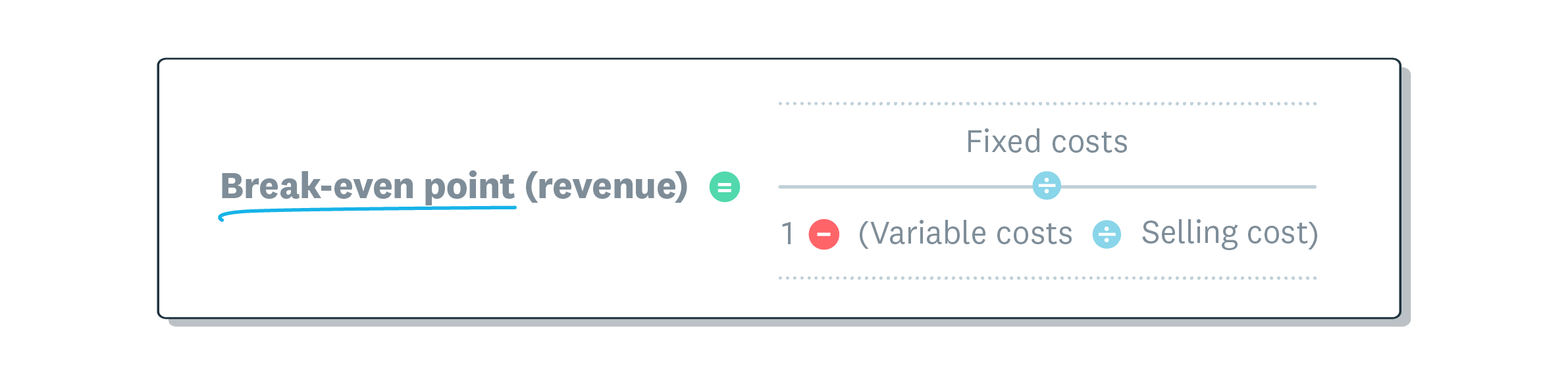
The revenue formula tells you how much money you need to generate in sales to cover your costs. The formula is:
Break-even point (revenue) = fixed costs ÷ (1 − (variable costs ÷ selling price))
The part of the formula that reads "1 − (variable costs ÷ selling price)" is known as the contribution margin ratio.
- Break-even point (revenue): the total sales amount needed to cover all costs.
- Fixed costs: expenses that stay the same regardless of how much you sell, such as rent, insurance and salaries.
- Variable costs: expenses that change based on production or sales volume, such as materials, packaging and shipping.
- Selling price: the amount you charge customers for each unit or hour of service.
Volume break-even point formula
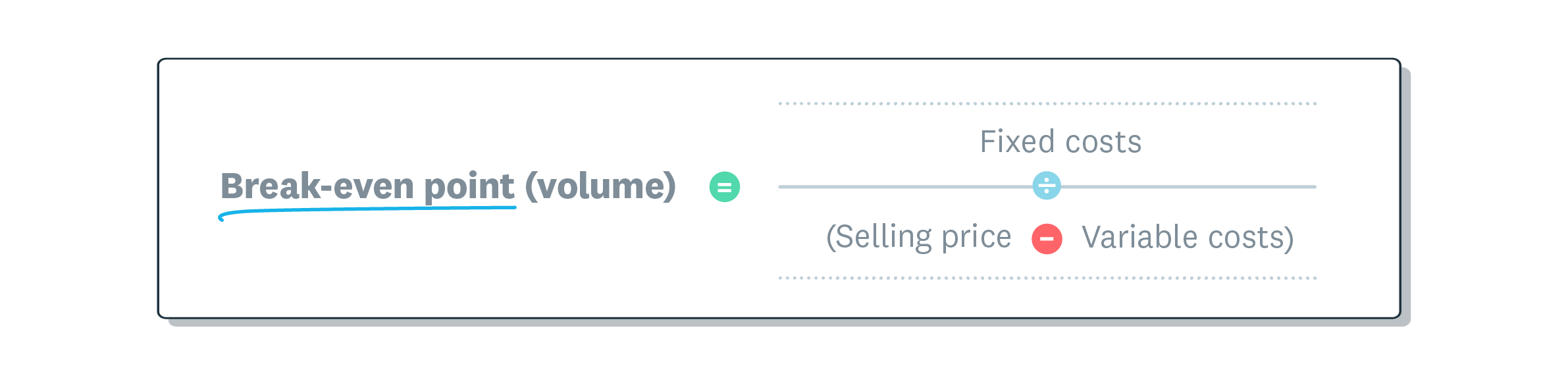
The volume formula tells you how many units you need to sell (or hours you need to work) to cover your costs. The formula is:
Break-even point (volume) = fixed costs ÷ (selling price − variable costs)
Understanding contribution margin
Contribution margin is the amount each sale contributes toward covering your fixed costs. You calculate it by subtracting your variable cost per unit from your selling price.
Contribution margin = selling price − variable cost per unit
Once you've sold enough to cover all your fixed costs, every additional sale contributes directly to profit.
How to work out your break-even point step by step
Once you know your costs and your selling price, you can work out your break-even point in two ways: by the number of units you need to sell, or by the sales revenue you need to bring in. The steps below follow one worked example, a small kombucha brewery, so you can apply the same method to your own numbers.
- Add up your fixed costs for the period. Fixed costs stay the same no matter how much you sell, such as rent and insurance. In this example, the brewery's fixed costs are €6,000 a month.
- Work out your variable cost per unit, the cost of making each item. Here, each bottle of kombucha costs €2 to produce.
- Set your selling price per unit. The brewery sells each bottle for €7.
- Calculate your contribution margin by taking the variable cost away from the selling price: €7 − €2 = €5 per bottle. This is the amount each sale puts towards covering your fixed costs.
- For the volume approach, divide your fixed costs by the contribution margin to find how many units you need to sell: €6,000 ÷ €5 = 1,200 bottles.
- For the sales-value approach, first find your contribution margin ratio by dividing the contribution margin by the selling price: €5 ÷ €7 = 0.714. Then divide your fixed costs by that ratio to get your revenue target: €6,000 ÷ 0.714 = €8,403.
- Check that the two results agree. Multiplying 1,200 bottles by the €7 selling price gives about €8,400, close to your sales-value target of €8,403 (the small difference is rounding).
Example break-even calculations
Here's how the break-even formulas work in practice for two different types of business.
Break-even example for a product-based business
A kombucha brewery has the following monthly figures:
- Fixed costs: €6,000 (rent, utilities, insurance and advertising)
- Variable costs: €2 per bottle
- Selling price: €7 per bottle
Revenue required:
€6,000 ÷ (1 − (€2 ÷ €7)) = €6,000 ÷ 0.714 = €8,403 monthly
Volume required:
€6,000 ÷ (€7 − €2) = €6,000 ÷ €5 = 1,200 bottles monthly
The brewery needs to sell 1,200 bottles (or generate €8,403 in sales) each month to break even.
Break-even example for a service-based business
A graphic designer has the following monthly figures:
- Fixed costs: €2,700 (utilities, hardware leases, software subscriptions, advertising)
- Variable costs: €35 per hour
- Hourly rate: €75
Revenue required:
€2,700 ÷ (1 − (€35 ÷ €75)) = €2,700 ÷ 0.533 = €5,066 monthly
Volume required:
€2,700 ÷ (€75 − €35) = €2,700 ÷ €40 = 67.5 hours monthly
The designer needs to bill 67.5 hours (or generate €5,066 in sales) each month to break even.
How to use break-even analysis
Once you know your break-even point, you can use it to make better decisions across your business. Understanding small business accounting basics helps you apply these insights effectively.
- Setting prices: check whether your current prices cover costs and leave room for profit.
- Setting sales targets: use your break-even figure as a minimum monthly goal.
- Reviewing costs: see how reducing fixed or variable costs lowers the bar you need to clear.
- Planning new products or services: calculate whether a new offering will be profitable before you launch.
- Measuring profitability: compare actual sales against your break-even point to track performance.
- Increasing profits: identify which changes to pricing, costs or volume will have the biggest impact.
Margin of safety
Margin of safety tells you how far your sales can fall before you hit your break-even point. It's a useful buffer that shows how much room you have if sales slow down unexpectedly.
To calculate your margin of safety, you can use the margin of safety formula.
Track your break-even point with Xero
Xero's accounting software gives you real-time visibility into your revenue, costs and profitability, so you can track your progress toward break-even and beyond. Try it yourself and get one month free.
FAQs on the break-even point formula
Here are answers to common questions about calculating and using the break-even point.
What is the break-even point formula?
There are two formulas. The revenue formula is: fixed costs ÷ contribution margin ratio. The volume formula is: fixed costs ÷ contribution margin per unit.
How do you calculate the break-even point in units?
Divide your fixed costs by the contribution margin per unit (selling price minus variable cost per unit). The result is the number of units you need to sell to cover all costs.
Why does contribution margin matter?
Contribution margin shows how much each sale puts toward your fixed costs. A higher contribution margin means you'll reach break-even faster with fewer sales.
What are the limitations of break-even analysis?
Break-even analysis assumes costs and selling prices stay constant, which isn't always realistic. It also doesn't account for changes in demand, competition or seasonal fluctuations.
How do you work out break-even when you sell more than one product?
Calculate a weighted average contribution margin based on your sales mix. Then divide your fixed costs by this weighted average to find your overall break-even point.
Related terms
Learn more about the break-even point formula
Handy resources
Advisor directory
You can search for experts in our advisor directory
How to increase revenue
Find out how businesses grow their sales income.
Stay on top of your numbers with Xero
Accounting software tracks your performance while you sleep.
Disclaimer
This glossary is for small business owners. The definitions are written with their requirements in mind. More detailed definitions can be found in accounting textbooks or from an accounting professional. Xero does not provide accounting, tax, business or legal advice.