How to calculate net profit margin
Learn how to calculate net profit margin and use it to measure your business's true profitability.
Published Monday 17 August 2026
Table of contents

How to calculate net profit margin
Key takeaways


- Net profit margin is the percentage of revenue left as profit after all expenses, including cost of goods sold, operating expenses, interest and taxes.
- To calculate it, divide net profit by revenue and multiply by 100. A 25% margin means you keep $0.25 of every dollar earned.
- The average net profit margin sits at roughly 9–10% across industries, so compare your margin against similar businesses in your own sector.
What is net profit margin?
Net profit margin is the percentage of revenue that remains as profit after you subtract all expenses, including cost of goods sold, operating expenses, interest and taxes. It shows how much of every dollar you earn actually stays in your pocket.
For small business owners, net profit margin is one of the clearest measures of true profitability. A healthy margin means your business can cover its costs, reinvest in growth and weather slow periods. Tracking this number over time helps you spot trends, compare yourself against competitors and make informed decisions about pricing or spending.
Handy resources
Advisor directory
You can search for experts in our advisor directory
Profit & Loss template
Download Xero’s profit and loss statement template to show how much money your business is making
Financial reporting
Keep track of your performance with accounting reports
Disclaimer
This glossary is for small business owners. The definitions are written with their requirements in mind. More detailed definitions can be found in accounting textbooks or from an accounting professional. Xero does not provide accounting, tax, business or legal advice.
Net profit margin formula
The formula for net profit margin is straightforward.
Net profit margin = (Net profit ÷ Revenue) × 100
Net profit is your revenue minus all costs: cost of goods sold, operating expenses, interest and taxes. Revenue is the total amount your business earns from sales before any deductions. The result is expressed as a percentage. For example, a 10% net profit margin means you keep about $0.10 of profit for every $1 of revenue.
How to calculate net profit margin
Calculating net profit margin takes just a few steps. Gather your revenue figure and all expense totals from your income statement, then follow the process below.
- Calculate net profit by subtracting cost of goods sold, operating expenses, interest and taxes from your total revenue.
- Divide net profit by revenue.
- Multiply the result by 100 to express it as a percentage.
Example of a net profit margin calculation
Suppose you run a cleaning business. In a given period, you earn $20,000 in revenue. Your cost of services is $8,000, and your combined operating expenses and taxes come to $7,000.
Gross profit = $20,000 − $8,000 = $12,000
Net profit = $12,000 − $7,000 = $5,000
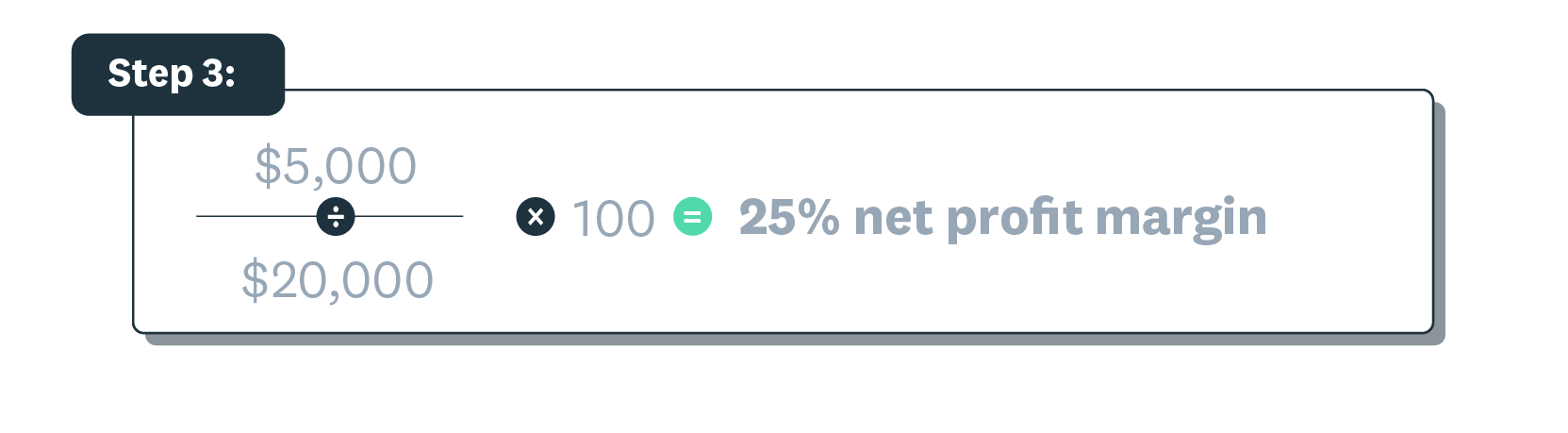
Net profit margin = ($5,000 ÷ $20,000) × 100 = 25%
A 25% net profit margin means you keep $0.25 of every dollar earned after covering all your costs.
What is a good net profit margin?
There's no single "good" net profit margin because it varies widely by industry; across all industries the average net profit margin sits at roughly 9–10%, according to NYU Stern's operating and net margins dataset, while retail and hospitality often run in low single digits and software or professional services run higher. A margin that looks thin in one sector could be excellent in another.
The best benchmark is similar businesses in your own industry. Look at published industry averages or speak with your accountant to understand where you stand. If your margin is below the industry norm, review your pricing, cost structure or efficiency to find opportunities for improvement.
Net profit margin vs gross profit margin
Gross profit margin and net profit margin measure profitability at different stages of your income statement. Understanding the difference helps you pinpoint where costs are eating into your earnings.
- Gross profit margin reflects revenue minus cost of goods sold only. It shows how efficiently you produce or deliver your core product or service.
- Net profit margin accounts for all expenses, including operating costs, interest and taxes. It reveals the profit you actually retain.
- Net profit margin is always lower than gross profit margin because it includes additional costs.
Operating profit margin sits between the two. It subtracts cost of goods sold and operating expenses but excludes interest and taxes, giving you a view of core operational efficiency before financing and tax considerations. Learn how each measure fits together when you measure profitability across your business.
Limitations of net profit margin
Net profit margin is a useful snapshot, but it doesn't tell the whole story. Keep these limitations in mind when analysing your results.
- Industry variation makes cross-industry comparisons misleading. A 5% margin may be strong in grocery retail but weak in consulting.
- One-off items, such as asset sales or large legal costs, can distort the figure for a single period.
- Interest payments affect net profit, so heavily indebted businesses may appear less profitable even if operations are sound.
- A single number hides trends. Reviewing margin over multiple periods reveals whether profitability is improving or declining.
- Net profit margin says nothing about cash flow. A business can be profitable on paper yet struggle to pay bills if revenue is tied up in receivables.
How to improve your net profit margin
Boosting your net profit margin means either increasing revenue or reducing costs, ideally both. Here are practical levers to consider.
- Raise prices strategically where customers perceive enough value to absorb the increase.
- Reduce cost of goods sold by negotiating with suppliers, switching materials or improving production efficiency.
- Cut operating expenses by reviewing subscriptions, renegotiating leases or automating repetitive tasks.
- Improve operational efficiency so you generate more output without adding proportionally more cost.
Track your net profit margin with Xero
Staying on top of your net profit margin is easier when your financial data is accurate and up to date. Xero's reporting tools pull figures directly from your accounts, so you can view profit margins at a glance and spot trends over time. Get one month free and see how clear, real-time reporting helps you make confident decisions for your business.
FAQs on net profit margin
Below are answers to common questions about net profit margin.
How is net profit margin calculated?
Subtract all expenses (cost of goods sold, operating expenses, interest and taxes) from revenue to get net profit, then divide by revenue and multiply by 100. The result is a percentage showing how much profit you retain from each dollar of sales.
What is a good net profit margin?
It depends on your industry. Software and professional services often exceed 15%, while retail and hospitality may operate profitably at 2–5%. Compare your margin against direct competitors for a meaningful benchmark.
What is the difference between net and gross profit margin?
Gross profit margin only subtracts cost of goods sold from revenue, while net profit margin subtracts all expenses, including operating costs, interest and taxes. Net margin is always the lower figure because it accounts for more costs.
How can I improve my net profit margin?
Focus on raising prices where the market allows, lowering your cost of goods sold through supplier negotiations and cutting unnecessary operating expenses. Automating manual tasks can also free up resources and reduce overhead.