Balance sheet
Learn what a balance sheet is, what it shows, and how it reveals what your business owns and owes.
Published Monday 17 August 2026
Table of contents
Key takeaways
- A balance sheet is a snapshot of your business's financial position at a single point in time
- It shows what your business owns (assets), what it owes (liabilities), and the owner's equity left over
- The accounting equation always holds: assets equal liabilities plus owner's equity
- Read it alongside the profit and loss statement and cash flow statement for a complete picture of your finances
Balance sheet definition
A balance sheet is a financial report that summarises your business's financial position at a specific point in time, showing what you own (assets), what you owe (liabilities), and what's left over for the owner (equity). It's also called a statement of financial position.
What a balance sheet tells you
A balance sheet shows the value of everything your business owns, including cash and property, compared to everything it owes. It also shows owner's equity and retained earnings. By comparing balance sheets over time, you can see whether your business has gained or lost value.
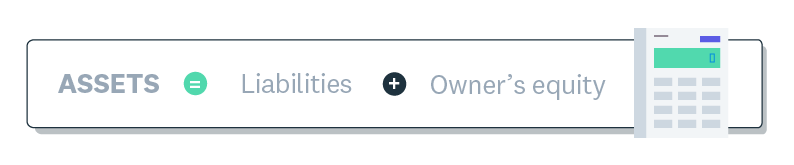
The accounting equation
The balance sheet reveals whether your business is solvent, meaning it can pay its debts as they come due. Understanding solvency and liquidity helps you make better financial decisions. Business owners, lenders, and potential investors all use balance sheets to assess financial health and make decisions about funding or partnerships.
The parts of a balance sheet
Every balance sheet has three main parts that work together to show your financial position.
Assets are divided into current assets (cash, accounts receivable, inventory) that convert to cash within a year, and non-current assets (equipment, property, vehicles) held longer term. Liabilities follow the same split: current liabilities (accounts payable, short-term loans) are due within a year, while non-current liabilities (long-term loans, mortgages) extend beyond. Owner's equity represents the owner's stake in the business after subtracting liabilities from assets.
Common line items include:
- Cash, accounts receivable, and inventory (current assets)
- Equipment, vehicles, and property (non-current assets)
- Accounts payable and short-term loans (current liabilities)
- Long-term loans and mortgages (non-current liabilities)
- Capital contributions and retained earnings (owner's equity)
The accounting equation
The accounting equation is the foundation of every balance sheet: assets equal liabilities plus owner's equity. This equation must always balance, which is why it's called a balance sheet.
If your balance sheet doesn't balance, the cause is usually incorrect or missing data. Common errors include transactions recorded in the wrong account, duplicate entries, or missing transactions. Retained earnings, which represent accumulated profits kept in the business, form part of owner's equity and must be calculated correctly for the equation to work.
A simple balance sheet example
Consider a sole trader with total assets of $50,000 and total liabilities of $20,000. The accounting equation shows that owner's equity must be $30,000, because $50,000 equals $20,000 plus $30,000.
Here's how the numbers break down:
- Cash: $10,000
- Inventory: $15,000
- Equipment: $25,000
- Total assets: $50,000
- Accounts payable: $5,000
- Bank loan: $15,000
- Total liabilities: $20,000
- Owner's equity: $30,000
You can use a free balance sheet template to create your own statement and practise applying the accounting equation.
How to read a balance sheet
Two ratios help you interpret a balance sheet quickly.
The current ratio divides current assets by current liabilities to measure liquidity. A ratio above 1 suggests the business can cover its short-term debts, while a ratio below 1 may signal cash flow problems.
The debt-to-equity ratio divides total liabilities by owner's equity to measure leverage. A higher ratio means more debt relative to ownership, which increases financial risk. A lower ratio suggests the business relies more on owner funding than borrowed money.
Balance sheet vs other financial statements
The balance sheet works alongside the profit and loss statement and the cash flow statement to give you a complete picture of your finances. While the profit and loss statement and cash flow statement cover activity over a period (such as a month or year), the balance sheet is a point-in-time snapshot. Together, these financial statements show what your business earned, how cash moved, and what you own and owe at a specific date.
Track your balance sheet with Xero
Xero accounting software can help you produce balance sheets and other financial reports automatically from your everyday transactions. Instead of building spreadsheets manually, you get an up-to-date view of your financial position whenever you need it. To see how Xero can help your business, get one month free.
FAQs on balance sheet
Here are answers to common questions about balance sheets.
What is a balance sheet in simple words?
A balance sheet is a one-page summary of what your business owns, what it owes, and what belongs to the owner. Think of it as a financial photograph taken on a single day.
What is on a balance sheet?
A balance sheet lists assets (cash, equipment, inventory), liabilities (loans, bills owed), and owner's equity (the owner's stake). These three sections must add up according to the accounting equation.
Does a balance sheet always balance?
Yes, a correctly prepared balance sheet always balances because assets must equal liabilities plus owner's equity. If it doesn't balance, there's an error in the data that needs correcting.
How often should you prepare a balance sheet?
Most small businesses prepare a balance sheet monthly or quarterly for internal review, and at least annually for tax and compliance purposes. More frequent balance sheets help you spot trends and issues earlier.
What is the difference between a balance sheet and an income statement?
A balance sheet shows your financial position at a single point in time, while an income statement (also called a profit and loss statement) shows revenue and expenses over a period. The income statement explains how profits changed; the balance sheet shows where those profits ended up.
Related terms
Learn more about balance sheet
Handy resources
Advisor directory
You can search for experts in our advisor directory
Xero Small Business Guides
Discover resources to help you do better business
Financial reporting
Keep track of your performance with accounting reports
Disclaimer
This glossary is for small business owners. The definitions are written with their requirements in mind. More detailed definitions can be found in accounting textbooks or from an accounting professional. Xero does not provide accounting, tax, business or legal advice.