Profit
Learn what profit is, the three types, and how to calculate it for your Hong Kong business.
Published Thursday 6 August 2026
Table of contents
Key takeaways
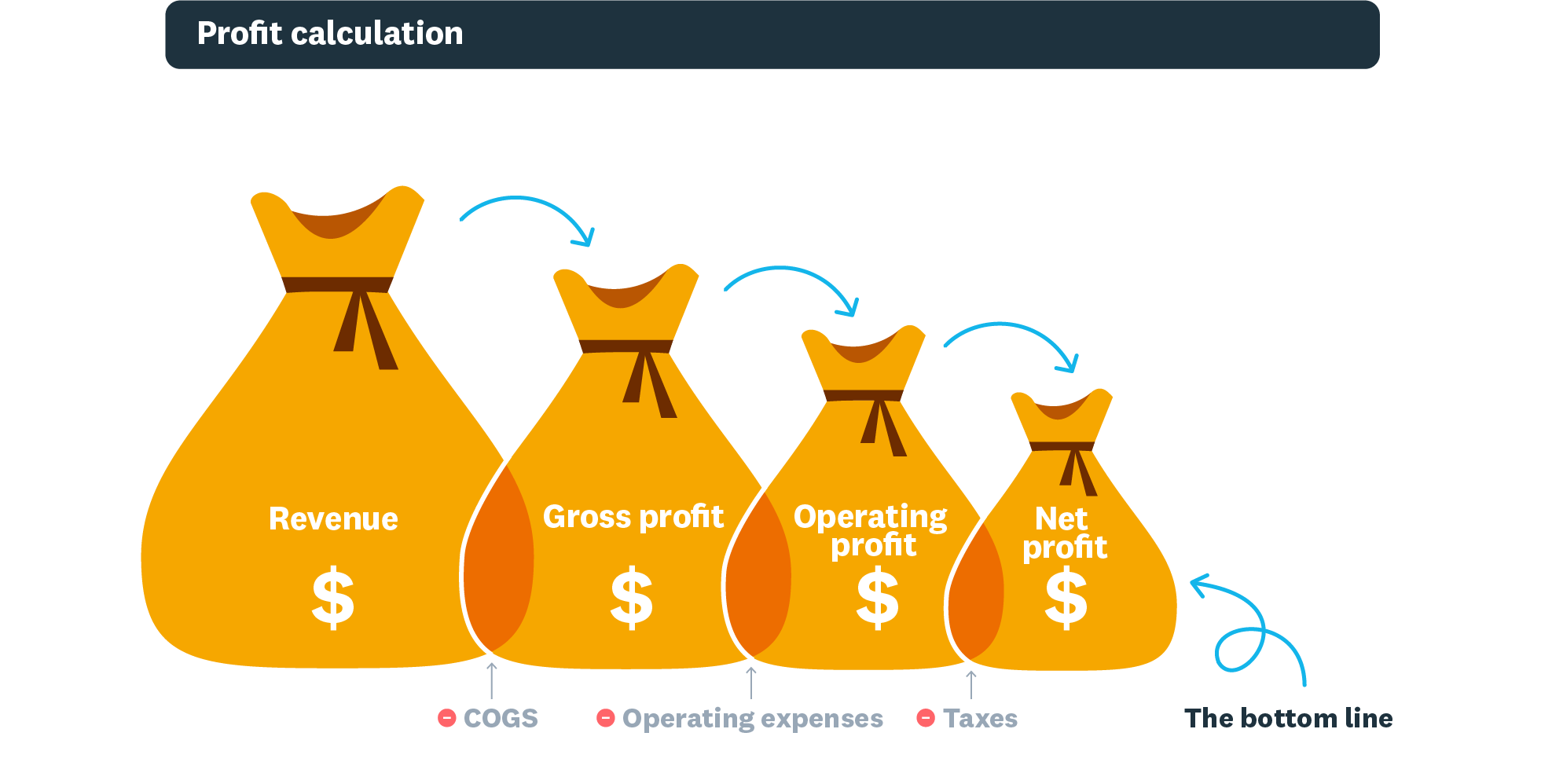
There are three types of profit. Net profit is what you get to keep.
- Profit is the money your business keeps after subtracting all expenses from revenue.
- There are three types of profit: gross profit (revenue minus cost of goods sold), operating profit (gross profit minus operating expenses) and net profit (operating profit minus interest and tax).
- Tracking profit helps you reinvest in growth, attract funding and keep your business sustainable.
- You can improve profit by increasing revenue or reducing costs.
What is profit?
Profit is the money a business keeps after subtracting all its expenses from its revenue. If your business earns HK$100,000 in sales and spends HK$80,000 on costs, your profit is HK$20,000.
Profit shows whether your business is financially healthy. A positive profit means you're earning more than you spend, while a loss means expenses exceed revenue.
How is profit calculated?
Profit is calculated using a simple formula: profit = revenue − expenses. You can learn more about how to calculate profit in different contexts.
For example, if your Hong Kong retail shop earns HK$500,000 in revenue and has HK$350,000 in total expenses, your profit is HK$150,000.
The three types of profit
Businesses track profit at different stages to understand where money is being made or lost. Each type of profit tells you something different about your financial performance, and understanding profit margin at each level helps you make better decisions.
Gross profit
Gross profit is your revenue minus the cost of goods sold. It shows how much you earn from selling products or services before accounting for other business expenses.
The formula is: gross profit = revenue − cost of goods sold.
For example, if your business earns HK$200,000 in revenue and the cost of goods sold is HK$120,000, your gross profit is HK$80,000. Your gross profit margin shows this figure as a percentage of revenue.
Operating profit
Operating profit is your gross profit minus operating expenses such as rent, salaries and utilities. It reflects how much you earn from your core business activities.
The formula is: operating profit = gross profit − operating expenses.
For example, if your gross profit is HK$80,000 and your operating expenses are HK$30,000, your operating profit is HK$50,000.
Net profit
Net profit is your operating profit minus interest and tax. It represents the final amount your business keeps after all costs.
The formula is: net profit = operating profit − interest and tax.
For example, if your operating profit is HK$50,000 and you pay HK$8,000 in interest and tax, your net profit is HK$42,000.
Profit vs revenue
Revenue is the total money your business earns from sales before any expenses are deducted. It sits at the top line of your financial statements. Profit is what remains after you subtract all expenses from revenue, placing it at the bottom line.
Income can be a broader term that sometimes includes money from sources beyond core business sales, such as investments or asset sales. In everyday use, people often use "income" and "revenue" interchangeably, but profit always refers to earnings after expenses.
Why profit matters for your business
Profit determines whether your business can grow, survive and thrive. Without profit, you can't reinvest in new equipment, hire staff or expand your offerings. Tracking profit over time helps you measure your profitability and spot trends.
Investors and lenders look at your profit when deciding whether to provide funding. A business with consistent profit is more attractive because it demonstrates the ability to generate returns. Monitoring profitability ratios can help you present a stronger case.
Profit also keeps your business sustainable. It provides a buffer for unexpected costs, seasonal slowdowns or economic uncertainty. Without profit, you rely on external funding or debt to stay afloat.
How to improve your profit
There are two main ways to improve profit: increase revenue or reduce costs. Most businesses benefit from working on both.
- Raise prices where the market allows
- Sell more to existing customers through upselling or cross-selling
- Find new customers or enter new markets
- Negotiate better rates with suppliers
- Cut unnecessary expenses and reduce waste
- Improve operational efficiency to lower labour costs
Track your profit with Xero
Xero gives you a real-time view of your profit so you can make informed decisions about your business. With automated bank feeds and clear financial reports, you can see exactly where your money is going. To try it for yourself, get one month free.
FAQs on profit
Here are answers to common questions about profit.
What is the difference between profit and revenue?
Revenue is the total money earned from sales before any deductions. Profit is what remains after subtracting all expenses from that revenue.
How do you calculate profit?
Subtract your total expenses from your total revenue. The result is your profit, which can be positive (a gain) or negative (a loss).
What is the difference between gross profit and net profit?
Gross profit is revenue minus cost of goods sold, while net profit is what remains after deducting all expenses including operating costs, interest and tax.
How is profit taxed in Hong Kong?
Businesses in Hong Kong pay profits tax to the Inland Revenue Department on assessable profits earned in the territory. The tax applies to profits arising from a trade, profession or business carried on in Hong Kong.
Related terms
Learn more about profit
Handy resources
Advisor directory
You can search for experts in our advisor directory
Financial reporting
Keep track of your performance with accounting reports
Disclaimer
This glossary is for small business owners. The definitions are written with their requirements in mind. More detailed definitions can be found in accounting textbooks or from an accounting professional. Xero does not provide accounting, tax, business or legal advice.