Recession proofing your business: 8 smart ways to prepare
Learn recession proofing tactics to protect cash flow, keep customers, and grow your business with confidence.
Written by Lena Hanna—Trusted CPA Guidance on Accounting and Tax. Read Lena's full bio
Published Wednesday 1 April 2026
Table of contents
Key takeaways
- Build an emergency cash reserve covering three to six months of operating expenses to protect against sales downturns and delayed customer payments during economic uncertainty.
- Monitor profit margins and cash flow position rather than just revenue, as rising costs can squeeze profitability even when sales appear stable during inflationary periods.
- Communicate proactively with banks, suppliers, and customers about payment flexibility or pricing changes before problems arise, as transparency builds trust and creates more options during difficult periods.
- Use economic slowdowns strategically to train staff, fix operational problems, and improve efficiency while competitors may be cutting back on these investments.
What is recession-proofing?
Recession-proofing is about taking proactive steps to make your business more resilient to economic downturns. It involves strengthening your finances, adapting your operations, and finding opportunities so you can navigate uncertainty with confidence and come out stronger.
What's the difference between a slowdown and a recession?
A slowdown occurs when consumer spending levels off. A recession happens when spending declines for six months or more.
The formal definition from the National Bureau of Economic Research (NBER) notes it is a significant decline in economic activity spread across the economy that lasts more than a few months.
Slowdowns and recessions are natural parts of the economic cycle. Marc Cowling, professor of economics and productivity at Oxford Brookes University, notes there are generally more ups than downs.
"Recessions, for example, are felt for about 12–18 months, then they're followed by a two-year recovery, a four-year boom, a year of overheating, and then a new recession."
What happens during a slowdown?
During a slowdown, your business typically experiences a predictable chain of events. The first symptom is a drop in sales, which then affects revenue, profits, and cash flow. An analysis confirms that decreased demand is the top reason why companies struggle during a recession.
Xero economist Louise Southall explains the sequence:
- Sales decline: Customers spend less, so sales go down
- Revenue pressure: Revenues may initially hold if you raise prices, but eventually stop growing as quickly as expenses
- Profit squeeze: When expenses outpace revenue growth, profits take a hit
Specialist small business consultant Grant Anderson says dwindling profits then hit cash flow.
"Money dries up and businesses tighten their belts. They start cutting costs, carrying less inventory, and limiting payroll where they can."
Why inflation complicates recessions
Inflation complicates recessions because your costs stay high even as your sales decline. This creates a temporary squeeze where you face both problems at once.
Mark Koziel, president of Allinial Global (an accounting association), says the good news is that slowdowns eventually cool off inflation.
"Declining sales allow under-pressure supply chains to catch up with demand and alleviate prices."
But he warns it could be a wild ride.
"Sales have to drop before prices will, so businesses will feel the twin effects of shrinking sales and inflationary prices for a while."
How to prepare your business for a recession
Recession-proofing means taking deliberate steps to protect your business from economic downturns. While no strategy guarantees immunity, the right preparation can help you survive and even thrive.
Cowling notes that exporters often fare better because they spread risk across multiple economies. For most businesses, it's about navigating the cycle strategically.
Here are eight expert-backed tactics to protect your business:
Build your emergency cash reserves
Having cash on hand is one of the best ways to protect your business. It gives you a buffer to cover expenses like rent and payroll if sales slow down. Aim to have enough cash to cover three to six months of operating expenses, a critical goal given that research shows nearly four in 10 small businesses have less than one month's worth of operating expenses on hand.
- Calculate how much you need
- Set up automatic transfers
- Create a separate emergency account
- Resist the urge to spend reserves on growth
Prepare for a sales downturn
A sales downturn happens when customers reduce spending and become more price-conscious. This shift often works against small businesses as buyers drift toward larger chains offering lower prices.
"Covid reintroduced people to small businesses but it might have been short lived," observes Cowling. "Customers are drifting back to the big chains that can offer lower prices."
How to protect your business against declining sales
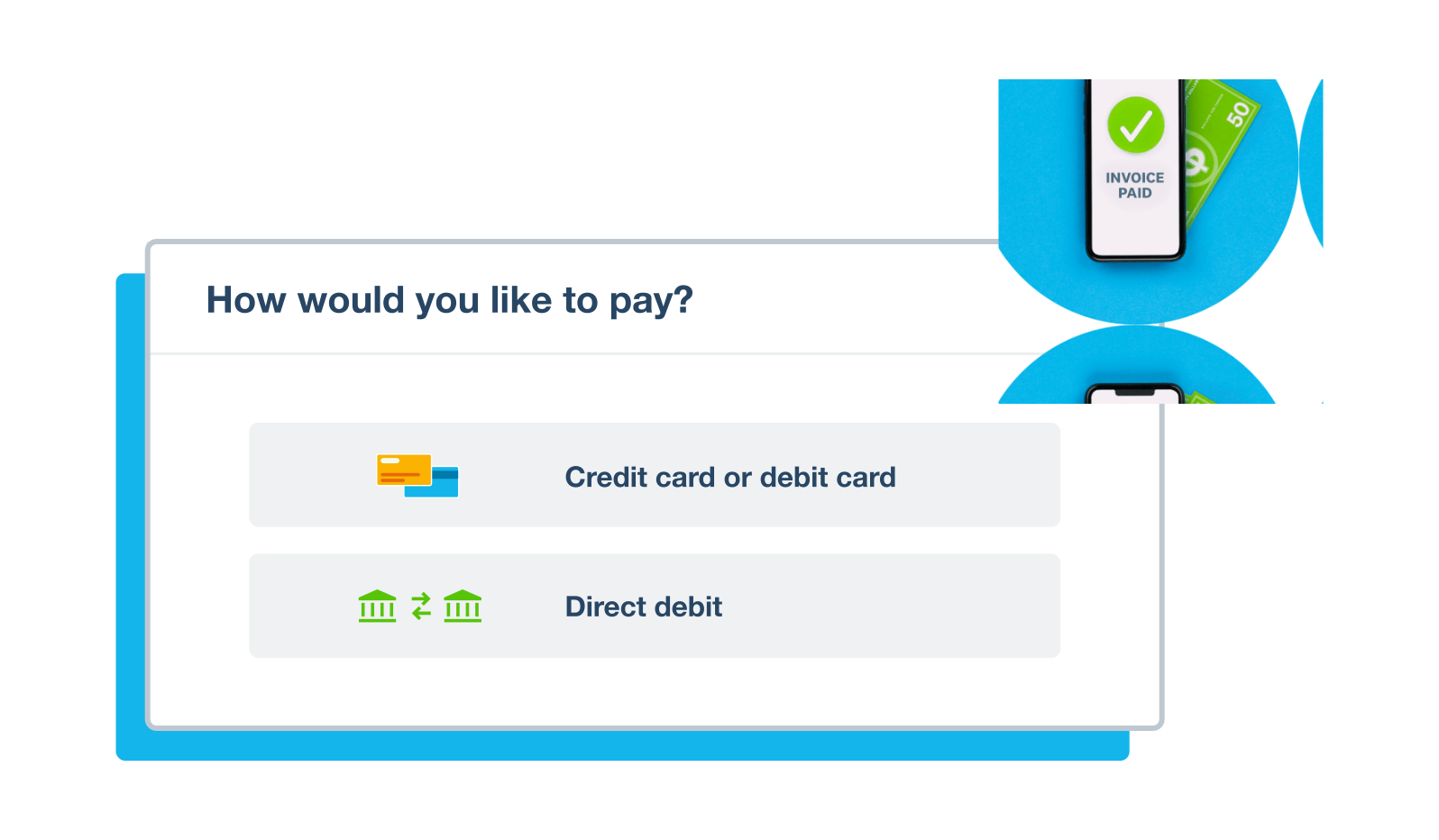
Online invoices allow customers to click straight through and pay instantly, which can reduce wait times for the vendor.
- Match supply to current demand: Southall advises supplying goods and services at the level of current demand, not what demand used to be. Avoid blanket cuts to all products and services as they won't be affected equally.
- Watch for unexpected opportunities: Small luxury items like chocolate actually boomed during the 2008 financial crisis because they were affordable indulgences. Look for similar patterns in your business.
- Lean on customer loyalty: Koziel says small businesses built goodwill with local communities during the pandemic. Trade on that loyalty now by introducing locals packages or customer appreciation days. "Small business customers are incredibly loyal and they will respond."
Diversify your revenue streams
Relying on a single product or customer segment can be risky during a downturn. Look for ways to diversify what you offer and who you sell to. This helps spread your risk and can open up new income sources when your primary ones are under pressure.
- Identify adjacent services or products
- Explore new customer segments
- Consider subscription or recurring revenue models
- Test small before scaling
Cope with delayed payments
Delayed payments are one of the most common recession challenges. When the economy tightens, customers take longer to pay their invoices, which then affects your ability to pay your own bills.
Xero data shows this pattern clearly:
- 11% increase in payment wait times after the 2018 US-China trade tensions
- 15% increase in payment wait times after the first Covid outbreak
Southall notes the problem is self-perpetuating.
"A business that's paid late will then struggle to pay their bills on time, and so the problem spreads quickly."
How to protect your business against delayed payments
- Send invoices immediately: The payment clock doesn't start until you send the bill. Get invoices out quickly to minimise wait times.
- Track payment times: Monitor how long it takes to get paid and take action if things start to slip.
- Chase overdue invoices: Koziel advises seeking payment on overdue invoices promptly. "If you start to suffer delays from your customers then seek similar relief from the people you owe. It's not uncommon to ask suppliers for more time to pay."
- Offer online payment options: Southall says Xero data shows you can reduce wait times by issuing invoices with instant online payment options.
- Automate payment reminders: Use apps to automatically issue payment reminders when invoices are overdue.
Online invoices allow customers to click straight through and pay instantly, which can reduce wait times for the vendor.
Work through cash flow crunches
A cash flow crunch happens when you don't have enough money coming in to cover your outgoing expenses. This is often the most immediate threat during a recession.
"Most small businesses only hold enough cash to run for two to three months," says Cowling. Supporting data shows the challenge is widespread, with fewer than 40% of established firms and less than 20% of younger businesses managing to carry 3–12 months of cash. "So when their sales take a 10% dive, and then their customers start paying late, the cash situation gets really difficult really fast."
Poor cash flow affects your ability to pay:
- employees
- suppliers
- utilities
- loan repayments
How to protect your business against cash flow problems
- Create a cash flow forecast: Plot inbound and outbound payments on a calendar to predict what will be in the bank at any given time. Use software to automate this, or try a free cash flow forecast template.
- Track who owes what: Keep records of unpaid invoices and upcoming bills. If payments slow down, talk to suppliers and lenders about extending deadlines. Anderson says: "They will feel better about extending your credit if you can give them specific reasons why."
- Match production to demand: Use sales forecasting to spot shifting demand and avoid overinvesting in inventory, transport, or staff. Southall advises: "Don't keep doing what you always did. Respond to the changing market."
- Keep debt flexible: Resist the urge to pay down debts faster than normal. Anderson warns: "If you put spare cash against your debts and then suddenly need that money back, you'll have to apply for a new loan. The lender may not give it."
- Review spending carefully: Cut discretionary spending first and ask staff for ideas. Anderson cautions: "I've seen people cut off the muscle with the fat."
Adjust to inflation
Rising costs persist even after sales start to decline. Input costs like inventory and energy stay high, creating a squeeze on your margins.
Traditionally, businesses might lay off workers to reduce costs. But Cowling says that approach doesn't make sense in the current environment.
"Employees have been so hard to find and the recession will be over in 12 months, maybe 18; so why would a business lay people off unless they really had no other option?"
With costs staying elevated, you need to focus on monitoring the right metrics and adjusting your pricing strategy.
How to protect your business against rising costs
Track profitability, not just revenue. Small businesses often check sales or revenue to gauge performance, but Southall warns this approach fails during inflation.
"In normal times, those numbers are a good proxy for profits. But it breaks down when costs and volumes are changing so much. You need to go directly to the profitability measures."
Key metrics to monitor during inflation:
- gross profit margin
- net profit margin
- cost of goods sold
- operating expenses as a percentage of revenue
If you don't already have an accountant or bookkeeper, now might be a good time to get one. Many will produce monthly reports tracking margins and profits for a flat fee.
Handle the squeeze on margins
Margin squeeze occurs when your costs rise faster than you can raise prices. Many businesses absorb part of cost increases to avoid losing customers, but this approach has limits.
"A small business might see their costs go up 30% and they feel that pain immediately," says Cowling. "But they know they can't pass the whole lot on to customers or sales will tank. So they put prices up 10% and take two-thirds of the hit."
While absorbing costs protects sales in the short term, it eventually becomes unsustainable. At some point, you need to raise prices or cut costs.
How to protect your business against tighter margins
- Set the right price increase the first time: Southall advises making one meaningful increase rather than multiple small ones. "Businesses need to right-size that increase so they're not going back to their customers three months later with more bad news."
- Communicate clearly: Koziel notes that customers understand inflation is happening. "Just be clear in your communication. It's the same if you're removing services because, for example, you can't find staff. Be open and honest."
- Trust customer loyalty: Loyal customers will still want to support you if you're transparent about why prices are changing.
Cut costs strategically
When cash is tight, it's tempting to cut costs everywhere. But cutting too deeply in the wrong places, like marketing or staff development, can hurt your business long-term. Instead, focus on trimming non-essential spending while protecting what drives growth.
- Audit all recurring subscriptions and services
- Renegotiate contracts with suppliers
- Reduce discretionary spending first
- Avoid cutting marketing entirely
- Consider flexible staffing options before layoffs
Manage debt and finance
Access to finance tightens during recessions because the assets securing your loans lose value. Underscoring this, a survey of small business owners seeking capital found that for one in four applicants, funding was difficult to obtain.
Koziel explains the consequences:
"You may no longer have enough security against your existing loans. And your scope for new lending will shrink or disappear altogether."
This means you need to proactively manage your banking relationships before problems arise.
How to handle finance in a recession
- Request flexibility early: Banks have seen dozens of recessions and expect to adjust terms during downturns. Don't be afraid to ask for flexibility, but come prepared with a sound financial strategy.
- Discuss security changes: Koziel advises: "If you plan to run inventory low (and your loans are usually secured by inventory) then you need to work out how that looks with your lender."
- Share problems proactively: Anderson recommends being open about difficulties. "If your cash flow forecast shows certain payments are at risk, share that information early. Lenders will have much more confidence that you'll make good if they see you're forward looking and proactive."
Beyond managing finances, your workforce strategy also needs attention during economic uncertainty.
Find and retain employees during a downturn
Labour shortages persist even during economic slowdowns, which is unusual. At the peak of recent labour market tightness, for example, there were twice as many job vacancies as unemployed workers. Traditionally, businesses lay workers off during recessions, but this time many are holding onto staff.
Southall explains the shift:
"Businesses have worked so hard to recruit staff that they're going to be very reluctant to shed them at the first sign of a downturn. They may cut back on hours, but wholesale redundancies seem unlikely at this stage."
This creates both challenges and opportunities. High employment supports consumer spending and may shorten the recession. But Koziel notes it's also a constraint.
"Customers are walking into half-full restaurants and being told they can't be seated because there aren't enough staff. It limits a business's capacity to generate revenue."
Recruitment opportunities during a downturn
While unemployment stays low, worker income will likely drop in real terms as wage raises fail to match inflation. For instance, data from 2021 to 2023 showed that while average weekly earnings grew, real weekly earnings fell by 6.2% after accounting for inflation. This creates hiring opportunities for small businesses.
Cowling explains: "Wage raises won't match inflation and some employees will find their hours cut. Their spending power will decline which means now is a good time to poach them."
Koziel predicts a redistribution of workers from larger businesses to smaller ones:
- Larger businesses may lay off staff: "Those medium and larger sized businesses may still go with the knee jerk reaction of laying people off. It's a fast way to cut costs."
- Smaller businesses can benefit: "That will give smaller players a chance to find much-needed help."
- Hiring can increase sales: "A business that has been understaffed hasn't been able to meet demand for months anyway. But if they can suddenly hire extra people and increase their capacity, they may actually find that sales go up."
Once you've addressed the immediate challenges, you can use this checklist to stay on track.
Recession-proofing your business checklist
Use this quick reference guide to stay on track during economic uncertainty.
Metrics to watch
- debtor days (average time to get paid)
- cash flow position
- profit (not just revenue)
- profit margins
Actions to consider
- adjusting your prices appropriately
- using downtime effectively
- trimming your budget without gutting it
- adjusting inventory levels
- allocating staff more efficiently
Conversations to have
- customers about price or service changes
- banks about loan security and payments
- employees about waste they see in the business
- employees about hours and flexibility
For next time
Build a cash reserve. If you're searching for recession-proofing advice now, you may be too late for this step. But a bigger emergency fund will help you weather the next downturn.
While navigating these challenges is essential, downturns also present genuine opportunities for growth.
How a slowdown can create opportunity
Recessions also present opportunities for growth. Slowdowns present genuine opportunities to strengthen your business. Here are five upsides to focus on.
Time to think strategically
Cowling notes: "In a boom, you don't have time to do everything the way you might like. Everything is very immediate and often rushed. Slowdowns give you time to sort stuff out and reorganise the business to work better."
Opportunity to train your team
Koziel adds: "Small businesses get busy so quickly that they often just hire people without ever really training them properly. A slowdown is a chance to set the business up so future employees can succeed."
Chance to fix legacy problems
Cowling explains: "Businesses always have a backlog of stuff to do, like fixing machinery or updating databases. There's heaps of work to do during the next few months. It's a chance to address legacy problems."
Lower costs for growth
Anderson observes: "Some owners – especially those nearing retirement – will opt to sell or close their business. You may be able to acquire customers, equipment, or premises at a lower cost than during a boom."
Improved efficiency
Southall concludes: "Those businesses that survive downturns are also usually the most productive. They improve processes or use new technologies to become more efficient so while slowdowns can be painful, they often help businesses come back stronger."
FAQs on recession-proofing your business
Here are answers to common questions about protecting your business during economic uncertainty.
How long do recessions typically last?
Most recessions last 12–18 months, followed by a recovery period of about two years. The key is to plan for at least 18 months of adjusted operations.
What's the first thing I should do if I think a recession is coming?
Build your cash reserves immediately. Most small businesses only hold enough cash for two to three months, so increasing this buffer should be your top priority.
How do I know if I'm cutting costs too deeply?
If you're cutting activities that directly generate revenue or retain customers, you've gone too far. Focus on discretionary spending first and ask your staff to identify waste before making deeper cuts.
Is it too late to recession-proof my business if we're already in a downturn?
You can always improve your position. Focus on cash flow management, payment collection, and cost control. These actions help whether you're preparing for a recession or already in one.
Should I stop all marketing during a recession?
No. Customers become more price-conscious during recessions, but they still buy. Maintain marketing that builds customer loyalty and highlights your value. Small businesses that stay visible often gain market share when competitors go quiet.
Disclaimer
Xero does not provide accounting, tax, business or legal advice. This guide has been provided for information purposes only. You should consult your own professional advisors for advice directly relating to your business or before taking action in relation to any of the content provided.
Start using Xero for free
Access Xero features for 30 days, then decide which plan best suits your business.