What is profit?
Learn what profit is, how to calculate it, and why tracking it helps your business grow.
Published Wednesday 12 August 2026
Table of contents
Key takeaways
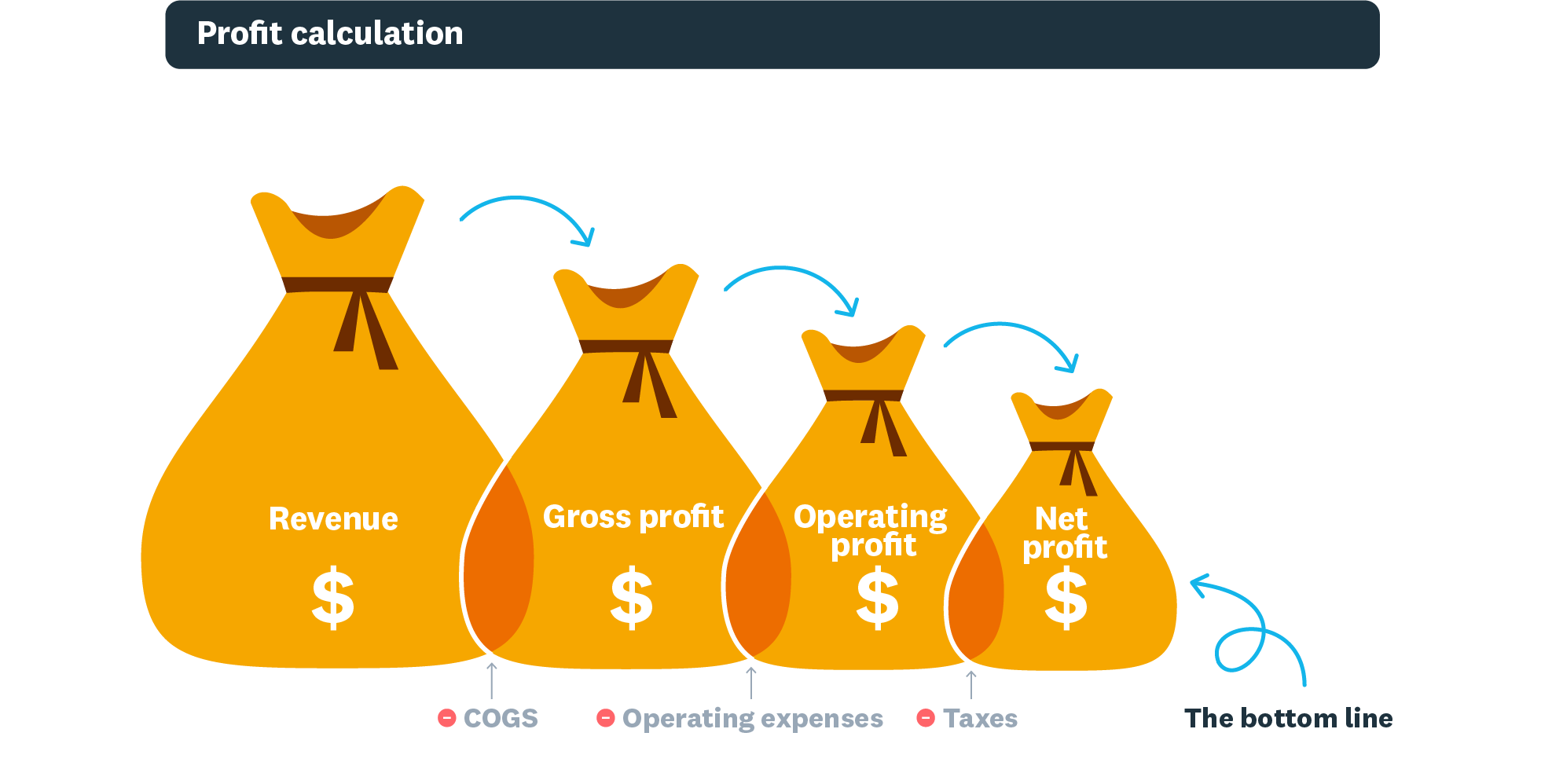
There are three types of profit. Net profit is what you get to keep.
- Profit is the money left over after you subtract all your business expenses from your total revenue.
- The three main types are gross profit, operating profit and net profit, each measuring a different stage of your earnings.
- The basic profit formula is total revenue minus total expenses.
- South African businesses often work on thin margins, so tracking profit regularly helps you spot trends early and make confident decisions.
What is profit?
Profit is the money your business keeps after paying all its expenses. In simple terms, profit equals revenue minus expenses.
When your business sells products or services, you earn revenue. From that revenue, you pay for costs like stock, wages, rent and utilities. What remains after covering these costs is your profit. A positive profit means your business earns more than it spends, while a negative profit (a loss) means expenses are higher than revenue.
How to calculate profit
The basic formula for calculating profit is straightforward.
Profit = total revenue − total expenses
For example, imagine a small bakery in Johannesburg earns R200,000 in revenue over a year. If total expenses (ingredients, wages, rent, utilities and other costs) come to R150,000, the bakery's profit is R50,000.
To see where your business stands, you can run financial reports that show revenue, expenses and profit at a glance.
Types of profit
Businesses track profit at different stages to understand where money is made and where it goes. The three main types are gross profit, operating profit and net profit.
Gross profit
Gross profit measures what remains after subtracting the direct cost of goods sold from revenue.
Gross profit = revenue − cost of goods sold
If a retailer earns R100,000 in sales and pays R60,000 for stock, gross profit is R40,000.
Operating profit
Operating profit shows what your business earns from its core activities after covering both cost of goods sold and operating expenses like rent, wages and utilities.
Operating profit = gross profit − operating expenses
If that retailer's gross profit is R40,000 and operating expenses total R25,000, operating profit is R15,000.
Net profit
Net profit is the amount left after deducting all remaining costs, including interest and tax. This figure appears on your profit and loss statement and represents your true bottom line.
Net profit = operating profit − interest − tax
If the retailer pays R2,000 in interest and R3,000 in tax, net profit is R10,000.
Profit vs revenue
Revenue is the total money your business earns from sales before any expenses are deducted. Profit is what remains after subtracting costs. A business can have high revenue and still make little profit if its expenses are just as high.
Timing also affects these figures. When you recognise income and expenses depends on whether you use cash vs accrual accounting, which can change how profit appears in a given period.
Profit vs profitability
Profit is a Rand amount, the actual money left after expenses. Profitability is a ratio or percentage that measures how efficiently your business turns revenue into profit. Two businesses might both make R50,000 in profit, but if one needed R500,000 in revenue while the other needed only R200,000, the second business is more profitable.
What is a profit margin?
A profit margin expresses profit as a percentage of revenue. It shows how much of every Rand earned your business keeps as profit.
There are different types of margin: gross margin, operating margin and net margin. Each one corresponds to the type of profit it measures. A higher margin means your business converts more of its sales into profit.
To work out your profit margin, divide profit by revenue and multiply by 100.
Why profit matters for your business
Profit funds growth, cushions your business against unexpected costs, and pays you as the owner. Consistent profit gives you room to reinvest in equipment, hire staff, and build a financial buffer for quieter months.
Profit margins in South Africa are tight: according to Statistics South Africa's Annual Financial Statistics, as analysed by the Bureau of Market Research, the average after-tax profit margin across all South African businesses was just 1.3% in 2024.
With margins this slim, keeping a close eye on your numbers pays off. Regular tracking helps you spot trends early and act while your options are still open. For practical steps, see our guide on managing your finances and cash flow.
How to increase profit
Improving profit comes down to earning more, spending less, or both. Here are three strategies to consider.
Increase revenue
Look for ways to bring in more sales without a matching rise in costs. You could review your pricing, attract new customers, or encourage existing customers to buy more often or spend more per transaction.
Reduce your costs
Review your expenses regularly. Negotiate better terms with suppliers, cancel subscriptions you no longer use, and keep spending lean. Accurate records make this easier, so keeping accurate books is a worthwhile habit.
Review your product mix
Not all products or services earn the same margin. Focus on what sells well and delivers good profit. Consider dropping low-margin items that take up time and resources without strong returns.
Simplify profit tracking with Xero
Knowing your profit means knowing where your business stands. With Xero, you can view real-time reports, track expenses and monitor your margins from anywhere. To see your numbers more clearly, you can get one month free and start tracking profit with confidence.
FAQs on profit
Here are answers to common questions about profit and how it applies to your business.
What is the formula for profit?
Profit equals total revenue minus total expenses. The same idea applies to gross, operating and net profit, though each one uses a different set of expenses.
What's the difference between gross, operating and net profit?
Gross profit subtracts only the cost of goods sold from revenue. Operating profit also deducts operating expenses like rent and wages. Net profit subtracts all remaining costs, including interest and tax, to give your final bottom line.
Is profit the same as revenue?
No. Revenue is the total money earned from sales before any expenses. Profit is what remains after you subtract costs from that revenue.
How is business profit taxed in South Africa?
Companies pay income tax to SARS on their taxable profit. The rate and rules depend on your business structure, so it helps to consult an accountant or check the latest SARS guidance.
What is a good profit margin?
A good margin depends on your industry, since some sectors run on much thinner margins than others. Compare your margin to typical figures for your sector and aim to improve it over time.
Related terms
Learn more about profit
Handy resources
Advisor directory
You can search for experts in our advisor directory
How to manage your finances and cash flow
Learn about money management for your small business
Financial reporting
Keep track of your performance with accounting reports
Disclaimer
This glossary is for small business owners. The definitions are written with their requirements in mind. More detailed definitions can be found in accounting textbooks or from an accounting professional. Xero does not provide accounting, tax, business or legal advice.