Gross profit vs net profit
Understand gross profit vs net profit: definitions, formulas, a worked example and what each tells you.
Published Wednesday 12 August 2026
Table of contents
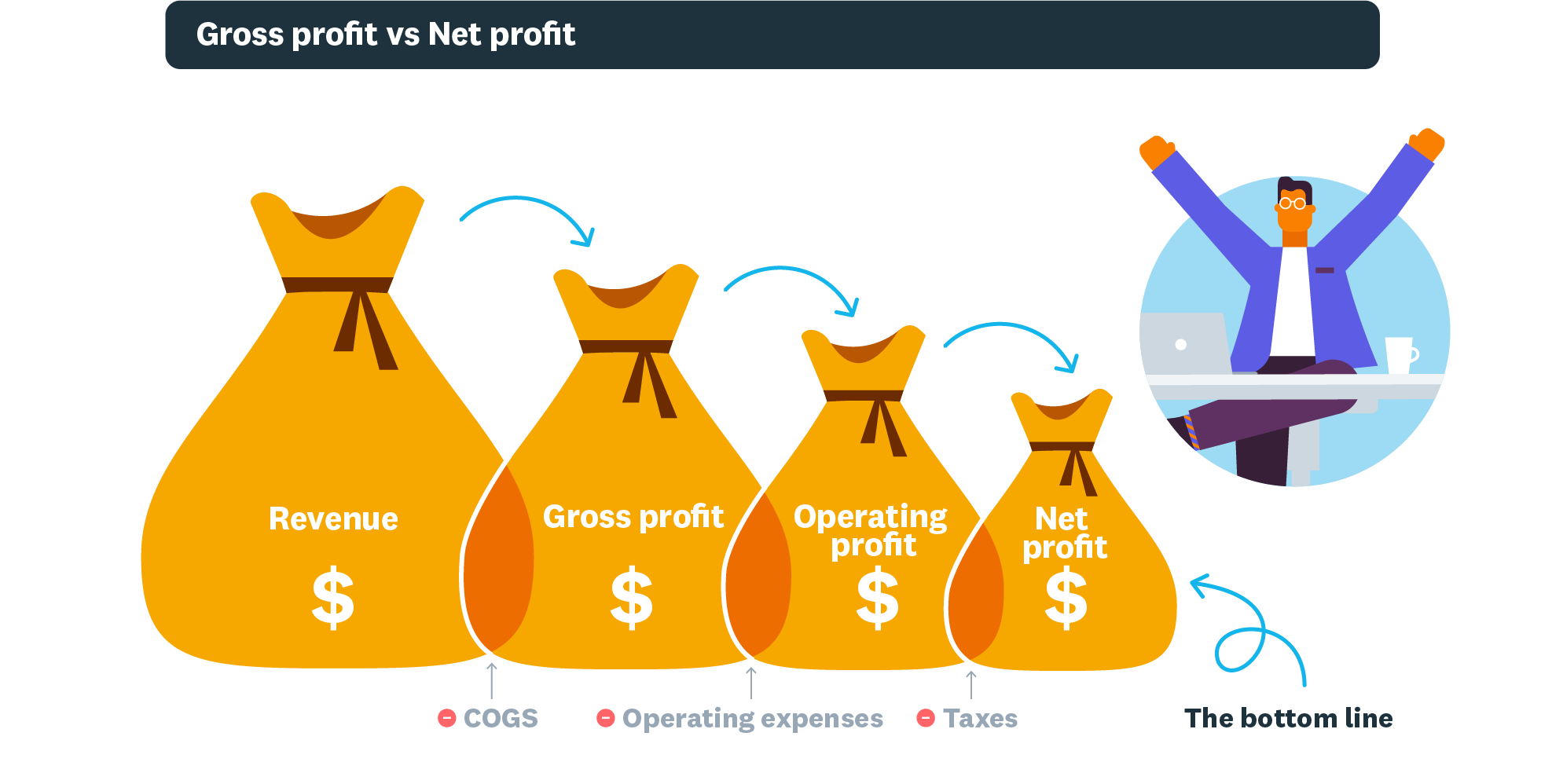
The difference between gross profit and net profit is operating expenses and taxes
Key takeaways
- Gross profit is your revenue minus the cost of sales, showing what you keep after covering direct costs of goods or services sold.
- Net profit is what remains after subtracting all other operating expenses, interest and tax from gross profit.
- A healthy gross profit doesn't guarantee net profit, as high overheads, interest or tax can erode it entirely.
- Net profit is the true bottom line used to judge your business's overall financial health.
Understanding the difference between gross profit and net profit is essential for measuring your business's financial performance.
What is gross profit?
Gross profit is your revenue minus your cost of goods sold (also called cost of sales). It represents the money left over after covering the direct costs of producing or delivering your goods or services.
The formula is: Gross profit = revenue − cost of sales.
Cost of sales includes expenses directly tied to production, such as raw materials and direct labour. Gross profit is what funds everything else in your business, from rent and salaries to marketing and taxes.
Once you know your gross profit, you can calculate what you actually keep after all remaining costs.
What is net profit?
Net profit is the amount remaining after you subtract all other operating expenses, interest and tax from your gross profit. It's often called the "bottom line" because it appears at the bottom of your income statement.
The formula is: Net profit = gross profit − all other operating expenses, interest and tax.
Operating expenses include rent, general salaries, utilities and marketing. Net profit shows what you can reinvest in your business or distribute to owners.
Now that you understand both figures, here's how they compare.
Gross profit vs net profit: the key differences
Gross profit and net profit measure profitability at different stages of your income statement.
- Gross profit subtracts only the cost of sales from revenue; net profit subtracts all remaining expenses, interest and tax.
- Gross profit appears near the top of your income statement; net profit is the bottom line.
- Gross profit shows whether your pricing covers production costs; net profit shows whether your business is profitable overall.
- A business can have strong gross profit but weak or negative net profit if operating costs are high.
Knowing how to calculate each figure helps you track your margins over time.
How to calculate gross profit and net profit
Here's a worked example using rand figures.
- Revenue: R500,000
- Cost of sales: R300,000
- Gross profit: R500,000 − R300,000 = R200,000
- Other operating expenses: R120,000
- Interest: R10,000
- Tax: R20,000
- Net profit: R200,000 − R120,000 − R10,000 − R20,000 = R50,000
Expressing these figures as percentages gives you profit margins, which are useful for benchmarking.
Gross profit margin vs net profit margin
Profit margins show profitability as a percentage of revenue, making it easier to compare performance over time or against industry benchmarks.
Gross profit margin = (gross profit ÷ revenue) × 100. Using the example above: (R200,000 ÷ R500,000) × 100 = 40%.
Net profit margin = (net profit ÷ revenue) × 100. Using the same example: (R50,000 ÷ R500,000) × 100 = 10%.
South African net profit margins are tight – according to Statistics South Africa's Annual Financial Statistics, as analysed by the Bureau of Market Research, the average after-tax profit margin across all South African businesses was just 1.3% in 2024.
Understanding the gap between gross and net profit helps you identify where money is going.
Why the difference matters
A business can look healthy at the gross profit level but struggle at the bottom line. Here's why that matters.
- High operating costs, interest or tax can consume your gross profit entirely.
- Net profit is what you actually keep and can reinvest or distribute.
- Tracking both figures helps you measure profitability at each stage of your income statement.
- Improving gross profit without controlling overheads won't improve your bottom line.
Accounting software can help you monitor both figures without manual calculations.
See your gross and net profit clearly with Xero
Xero's financial reports show your gross profit and net profit side by side, updated in real time as transactions flow through. You can spot margin changes quickly and make confident decisions. To try it for your business, get one month free.
Below are answers to common questions about gross profit and net profit.
FAQs on gross profit vs net profit
Here are answers to questions small business owners often ask about these two profit measures.
Is tax paid on gross profit or net profit?
In South Africa, businesses are taxed on their taxable income, which is derived from net profit after allowable deductions set out in the SARS tax guide for small businesses. Tax is not calculated on gross profit or revenue.
Can a business have high gross profit but low net profit?
Yes. High operating costs, interest payments or tax obligations can significantly reduce net profit even when gross profit is strong.
Does gross profit include wages?
Only wages that form part of the cost of sales, such as production or service-delivery labour. General salaries for administrative or sales staff are operating expenses and sit below gross profit on the income statement.
Which is more important, gross profit or net profit?
Both matter. Gross profit indicates whether your pricing covers production costs, while net profit shows whether your business is viable overall after all expenses.
Related terms
Learn more about gross profit vs net profit
Handy resources
Advisor directory
You can search for experts in our advisor directory
Xero Small Business Guides
Discover resources to help you do better business
Financial reporting
Keep track of your performance with accounting reports
Disclaimer
This glossary is for small business owners. The definitions are written with their requirements in mind. More detailed definitions can be found in accounting textbooks or from an accounting professional. Xero does not provide accounting, tax, business or legal advice.