Break-even point formula
Learn how to calculate the break-even point for your business using simple formulas with South African rand examples.
November 2023 | Published by Xero
Published Wednesday 12 August 2026
Table of contents
Key takeaways
- The break-even point is where total revenue equals total costs, meaning your business makes neither a profit nor a loss.
- You can calculate break-even as a rand value (revenue needed) or as a volume (units or hours needed to cover costs).
- Contribution margin, the amount each sale contributes toward fixed costs, is the key factor in both formulas.
- Lowering your break-even point through pricing adjustments or cost reductions gives your business a wider margin of safety.
What is the break-even point?
The break-even point is where your total revenue equals your total costs, leaving you with zero profit and zero loss. It's the minimum sales threshold your business must reach before it starts generating profit.
Knowing your break-even point helps you set realistic sales targets and pricing strategies. It's a key milestone on the path to profitability, giving you a clear benchmark to measure your business performance against.
The two break-even point formulas
There are two ways to calculate your break-even point, depending on what you need to know. The revenue version tells you the rand value of sales required, while the volume version tells you how many units or billable hours you need to sell.
- Revenue break-even: calculates the total rand amount in sales you need to cover all costs
- Volume break-even: calculates the number of units or hours you need to sell to cover all costs
Revenue break-even point formula
The revenue break-even formula shows you how much money you need to bring in to cover your costs. Use this version when you want to set a sales target in rand terms.
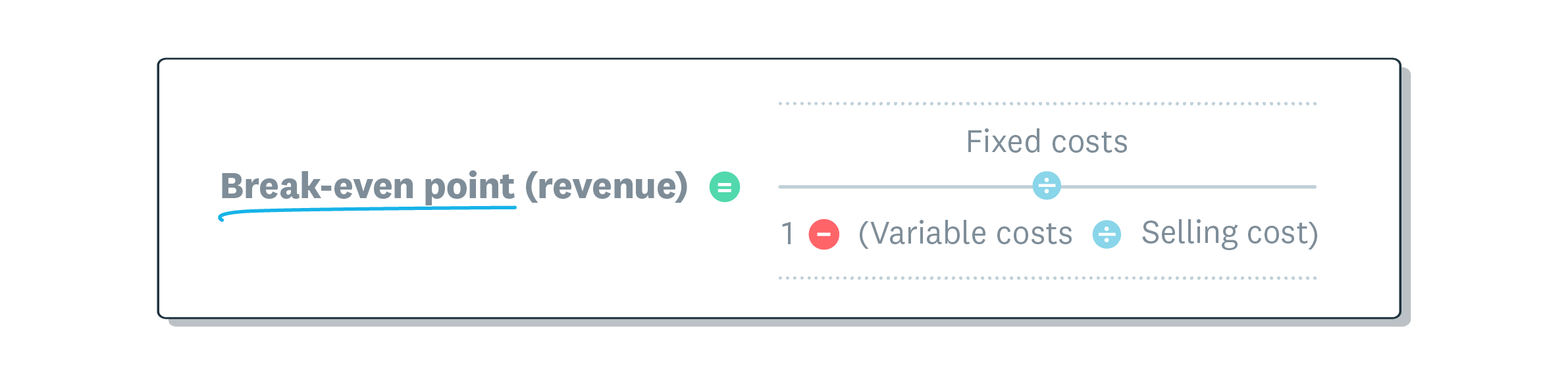
Break-even point (revenue) = Fixed costs / (1 – (Variable costs / Selling price))
- Break-even point (revenue): the rand value of sales required to reach profitability
- Fixed costs: expenses that stay the same regardless of output, such as rent, insurance and salaries
- Variable costs: expenses that change with production volume, such as raw materials, packaging and hourly wages
- Selling price: the amount you charge customers for each unit or service
Volume break-even point formula
The volume break-even formula tells you how many units you need to sell, or billable hours you need to work, to cover your costs. This version is useful when planning production or scheduling client work.
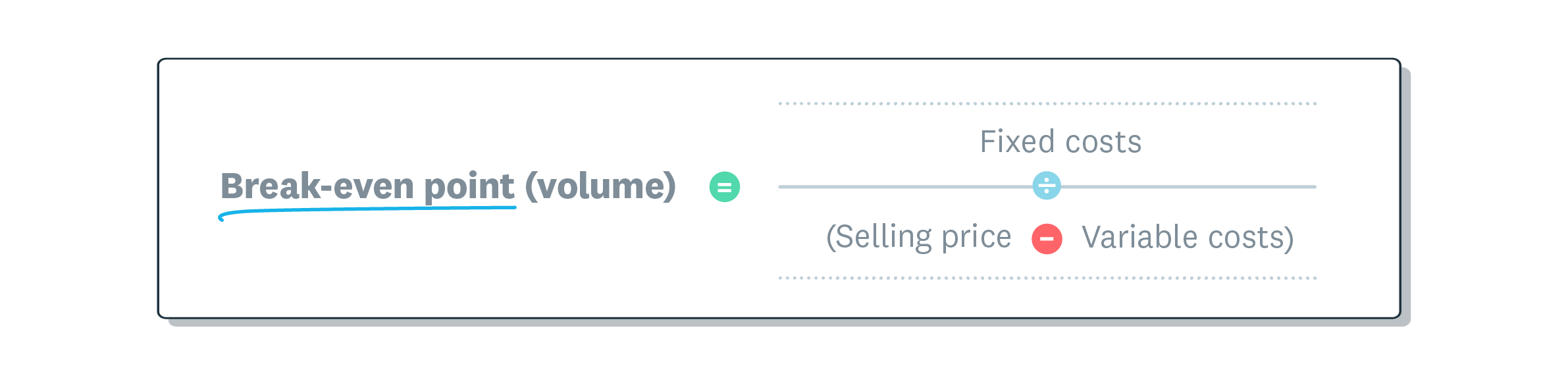
Break-even point (units) = Fixed costs / (Selling price – Variable costs)
The denominator (selling price minus variable costs) is your contribution margin per unit. Dividing your fixed costs by this amount gives you the exact number of sales needed to break even.
Contribution margin and the break-even point
Contribution margin is the selling price per unit minus the variable cost per unit. It represents the portion of each sale that contributes toward covering your fixed costs.
Once you've sold enough to cover all fixed costs, each additional sale's contribution margin becomes profit. This is why contribution margin appears as the denominator in the volume break-even formula. Understanding your marginal cost helps you see how each extra unit affects your overall profitability.
Break-even calculation examples
Seeing the formulas in action makes them easier to apply to your own business. Here are two examples using South African rand.
Break-even example for a product-based business
A kombucha brewery has fixed monthly costs of R6,000 (rent, utilities, insurance and advertising). Variable costs are R2 per bottle. Each bottle sells for R7.
Revenue required = R6,000 / (1 – (2 / 7)) = R6,000 / 0.714 = R8,403
The brewery must bring in R8,403 in monthly sales to break even.
Volume required = R6,000 / (7 – 2) = R6,000 / 5 = 1,200
The brewery must sell 1,200 bottles per month to cover its costs.
Break-even example for a service-based business
A graphic designer has fixed monthly costs of R2,700 (utilities, hardware leases, software subscriptions and advertising). Variable costs are R35 per hour for a contractor. Clients are charged R75 per hour.
Revenue required = R2,700 / (1 – (35 / 75)) = R2,700 / 0.533 = R5,064
The designer must earn R5,064 in monthly revenue to break even.
Volume required = R2,700 / (75 – 35) = R2,700 / 40 = 67.5
The designer must bill 67.5 hours per month to cover costs.
Why the break-even point matters for your business
Knowing your break-even point gives you a foundation for pricing decisions, sales planning and growth strategies. It shows you exactly how much revenue you need before your business becomes profitable.
Thin margins make this milestone harder to reach in South Africa. According to the Bureau of Market Research, drawing on Statistics South Africa's Annual Financial Statistics, the average after-tax profit margin across all South African businesses in 2024 was just 1.3%.
Break-even analysis also helps you forecast cash flow more accurately. When you understand where your costs sit relative to your revenue, you can plan for slower months and make informed decisions about expansion.
How to lower your break-even point
A lower break-even point means you reach profitability sooner and have a greater margin of safety against downturns. There are three main levers you can adjust.
- Raise your selling price: even a small increase improves your contribution margin and reduces the number of sales needed
- Cut fixed costs: renegotiate rent, switch to more affordable software or reduce overheads where possible
- Reduce variable costs: source cheaper materials, streamline production or improve efficiency to lower per-unit costs
Each of these changes can help you grow your sales more profitably by widening the gap between revenue and costs.
Track your break-even point with Xero
Xero's reporting tools help you monitor your costs and revenue in real time, so you always know where you stand relative to your break-even point. You can track fixed and variable expenses, review profit margins and spot trends before they become problems. To see how Xero can support your business finances, get one month free.
FAQs on the break-even point
Here are answers to common questions about calculating and using the break-even point.
What is the break-even point formula?
The break-even point formula divides your fixed costs by your contribution margin. For revenue, use: Fixed costs / (1 – (Variable costs / Selling price)). For volume, use: Fixed costs / (Selling price – Variable costs).
What is contribution margin?
Contribution margin is the selling price minus the variable cost per unit. It shows how much each sale contributes toward covering fixed costs, and becomes profit once those costs are fully covered.
What is the difference between fixed and variable costs?
Fixed costs remain constant regardless of how much you produce or sell, such as rent and insurance. Variable costs change with output, such as raw materials and shipping.
How can you lower your break-even point?
You can lower your break-even point by raising prices, reducing fixed costs or cutting variable costs. Any of these changes widens your contribution margin and reduces the sales volume needed to cover expenses.
Related terms
Learn more about the break-even point
Handy resources
Advisor directory
You can search for experts in our advisor directory
How to increase revenue
Find out how businesses grow their sales income.
Stay on top of your numbers with Xero
Accounting software tracks your performance while you sleep.
Disclaimer
This glossary is for small business owners. The definitions are written with their requirements in mind. More detailed definitions can be found in accounting textbooks or from an accounting professional. Xero does not provide accounting, tax, business or legal advice.