Profit
Learn what profit is, how to calculate it, and how gross, operating and net profit differ.
Published Wednesday 30 September 2026
Table of contents
Key takeaways
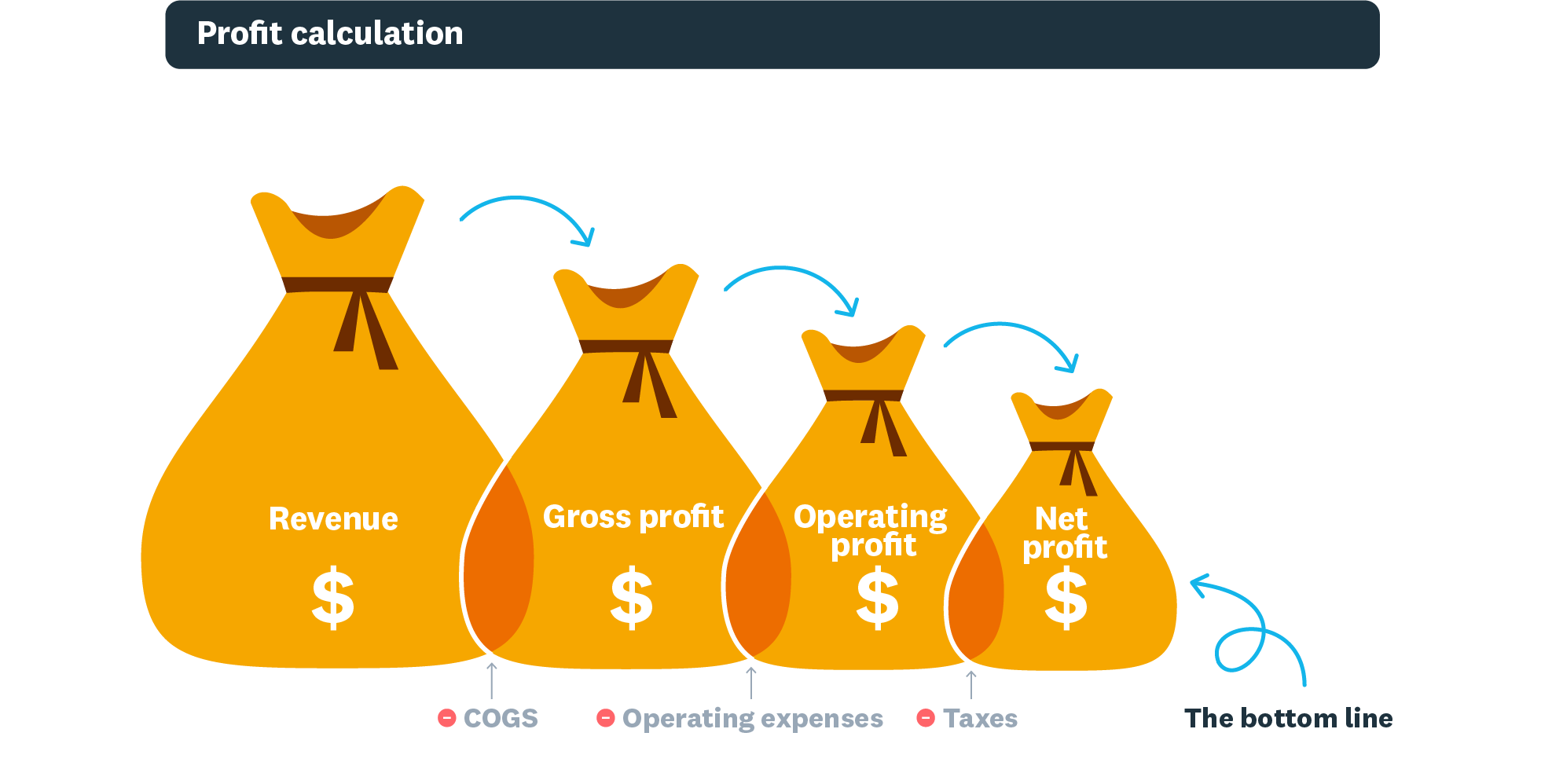
There are three types of profit. Net profit is what you get to keep.
- Profit is the money your business keeps after paying its expenses. You work it out by subtracting total expenses from total revenue.
- Gross, operating and net profit each remove another layer of costs. Net profit is what you keep once interest and tax are paid.
- A business can be profitable on paper and still run short of cash. Late customer payments and loan repayments can drain your bank balance while profit looks healthy.
- A profit and loss statement is the main way to track profit over time. Knowing your break-even point and how your costs behave helps you set prices and plan growth.
What is profit?
Profit is the money your business has left after you’ve paid all your business expenses. If your costs are higher than your revenue, you make a loss instead.
Say Aisyah runs a small café in Penang. In March, the café brings in RM30,000 from sales, and she spends RM22,000 on ingredients, rent, wages and utilities. Her profit for the month is RM8,000, which she can put back into the café or pay out to herself.
How to calculate profit
Calculating profit comes down to one formula, and it works for any period you choose:
Profit = total revenue – total expenses
Follow these steps to work out your profit:
- Choose the period you want to measure, such as a month or financial year
- Add up your total revenue from selling goods and services in that period
- Add up your total expenses, including the direct cost of what you sell, running costs, interest and tax
- Subtract your total expenses from your total revenue
- Check the result: a positive number is a profit and a negative number is a loss
Here’s how it works for a furniture workshop in Johor Bahru over one financial year. It earns RM240,000 in revenue and spends RM192,400: RM100,000 on timber and materials, RM80,000 on running costs, RM4,000 on loan interest and RM8,400 on tax.
Profit = RM240,000 – RM192,400 = RM47,600
That RM47,600 is what the owner keeps for the year. The next section breaks the same figures down by type of profit.
Types of profit
Profit is usually measured at three levels, and each one removes another layer of costs. Together they show whether your business can make money, whether it’s making money and how much you keep after tax.
Gross profit
Gross profit is the biggest of the three figures. It’s what’s left after paying the direct costs of what you sell. A healthy gross profit figure tells you the business is capable of making money.
Gross profit = revenue – cost of goods sold (COGS)
COGS covers direct costs such as raw materials, stock and production labour. For the workshop, gross profit is RM240,000 – RM100,000 = RM140,000.
Operating profit
Operating profit comes next. It also subtracts everyday running costs, such as rent, utilities, phone bills and wages. It shows whether your business is making money from its core work.
Operating profit = gross profit – operating expenses
The workshop’s operating profit is RM140,000 – RM80,000 = RM60,000. It leaves out interest and tax, so it’s handy for comparing your day-to-day performance across periods.
Net profit
Net profit comes last, and it’s the figure you get to keep. It’s what remains once interest on loans and tax are also deducted, so it shows how much your business makes after taxes.
Net profit = operating profit – interest and tax
The workshop’s net profit is RM60,000 – RM4,000 – RM8,400 = RM47,600. It matches the result from the simple profit formula, because both methods deduct the same costs.
Profit vs revenue
Revenue and profit are easy to mix up because both describe money coming into your business. Your sales revenue is the total you earn from sales before any costs come out. Profit is what’s left after those costs.
Revenue is often called the top line of your profit and loss statement, and net profit is the bottom line. Two businesses with the same revenue can earn very different profits. Aisyah’s café takes RM30,000 in March and makes RM8,000, while a café next door with the same sales and higher rent might make RM3,000.
Tracking both figures shows you whether growing sales is also growing the money you keep.
Profit vs cash flow
Profit shows whether you earned more than you spent over a period. Cash flow tracks money moving in and out of your bank account. The two often differ, because your accounts record sales and costs when they happen, which isn’t always when cash changes hands.
This means you can be profitable on paper but short of cash. It usually happens when:
- customers pay late, so the sale counts towards profit before the cash arrives
- you buy stock in bulk, so cash leaves now but its cost reaches profit only as you sell it
- you repay a loan, which cuts your cash while only the interest counts as an expense
- you buy equipment, which takes cash upfront while its cost is spread over several years
Say the Johor Bahru workshop invoices a hotel RM40,000 in June, and the hotel pays in August. June’s profit looks strong, but the owner still needs cash to cover wages and timber that month.
Why profit matters for your business
Profit keeps your business running and gives you choices. It pays for new equipment and staff, and it builds a cash buffer for slow months.
Lenders and investors also look at your profit when deciding whether to back your business. Tracking your profit margin, which is profit as a percentage of revenue, lets you compare performance over time as sales rise and fall.
If you run one of Malaysia’s small and medium enterprises (SMEs), tax is one reason your net profit sits below your operating profit. PwC Worldwide Tax Summaries sets out the current rates.
For year of assessment 2026, qualifying Malaysian SMEs pay 15% tax on the first RM150,000 of chargeable income, 17% on the next RM450,000 and 24% on the rest. Knowing your likely profit ahead of time helps you set aside cash for your tax bill.
How to track and improve profit
Tracking profit regularly shows you what’s working and where costs are creeping up. Start with the right report, then learn how your costs behave.
A profit and loss statement (P&L) lists your revenue, costs and profit for a set period. Reviewing it every month helps you spot trends early, such as a supplier price rise eating into your gross profit.
Your costs fall into two groups. Fixed costs, such as rent and insurance, stay the same whatever you sell. Variable costs, such as materials and packaging, rise and fall with your sales.
Your break-even point is where revenue equals total costs, so profit is zero. To find it in units, divide your fixed costs by the gap between your price and your variable cost per unit:
Break-even units = fixed costs ÷ (price per unit – variable cost per unit)
Say the workshop’s monthly fixed costs are RM6,000, and each chair sells for RM500 with RM300 in variable costs. It breaks even at 30 chairs a month, and every chair after that adds RM200 to profit.
Once you know your numbers, you can start lifting them. These practical changes can improve your profit:
- Review your prices regularly so they keep pace with supplier and wage costs
- Negotiate bulk discounts or better terms with suppliers to lower your COGS
- Cancel unused subscriptions and trim overheads you can do without
- Focus sales effort on your highest-margin products and services
- Track stock closely to cut waste and shrinkage
Track your profit with Xero
Profit tells you whether your business earns more than it spends, and checking it often lets you act before small issues grow. Xero keeps your numbers current, so you can see where you stand whenever you need to.
Automated bank feeds bring your transactions into Xero, and real-time financial reports show your revenue, costs and profit at a glance. You can also invite your accountant or bookkeeper to work from the same up-to-date figures.
Try Xero today and get one month free to start tracking your profit with confidence.
FAQs on profit
Here are quick answers to common questions about profit.
What is profit in business?
It’s the surplus left once a business covers every cost for a period. Company owners can reinvest it or pay part of it out to shareholders as dividends.
Can a business be profitable but run out of cash?
Yes, if cash leaves the business faster than customers pay. A cash flow forecast alongside your P&L shows when a shortfall is coming, so you can arrange funding or chase payments early.
What’s the difference between gross profit and net profit?
Gross profit only deducts the direct cost of what you sell, while net profit deducts every cost, including overheads, interest and tax. A strong gross profit with a weak net profit usually means your overheads are the place to look for savings.
What is a break-even point?
It’s the sales level where revenue exactly covers your costs, leaving zero profit. Recalculate it whenever prices or costs change, and before launching a product or hiring, to see how much more you’ll need to sell.
Is profit the same as income?
They’re different measures. Income is all the money your business earns from every source before deductions, while profit is what remains after you subtract your expenses.
Related terms
Learn more about profit
Handy resources
Advisor directory
You can search for experts in our advisor directory
How to manage your finances and cash flow
Learn about money management for your small business
Financial reporting
Keep track of your performance with accounting reports
Disclaimer
This glossary is for small business owners. The definitions are written with their requirements in mind. More detailed definitions can be found in accounting textbooks or from an accounting professional. Xero does not provide accounting, tax, business or legal advice.