The difference between bookkeeping and accounting
Bookkeeping records your numbers; accounting explains them. Here's how the two roles differ.
Published Friday 24 July 2026
Table of contents
Key takeaways
- Bookkeeping records and organises your daily financial transactions, while accounting interprets that data to guide business decisions.
- Bookkeeping is the first stage of the accounting process, so the two roles work together rather than compete.
- Many small businesses start with a bookkeeper, then add an accountant as revenue grows past around RM500,000 or decisions get more complex.
- In Malaysia, only members of the Malaysian Institute of Accountants (MIA) may practise as accountants, registering as a Chartered Accountant Malaysia, C.A.(M).
Bookkeeping vs accounting
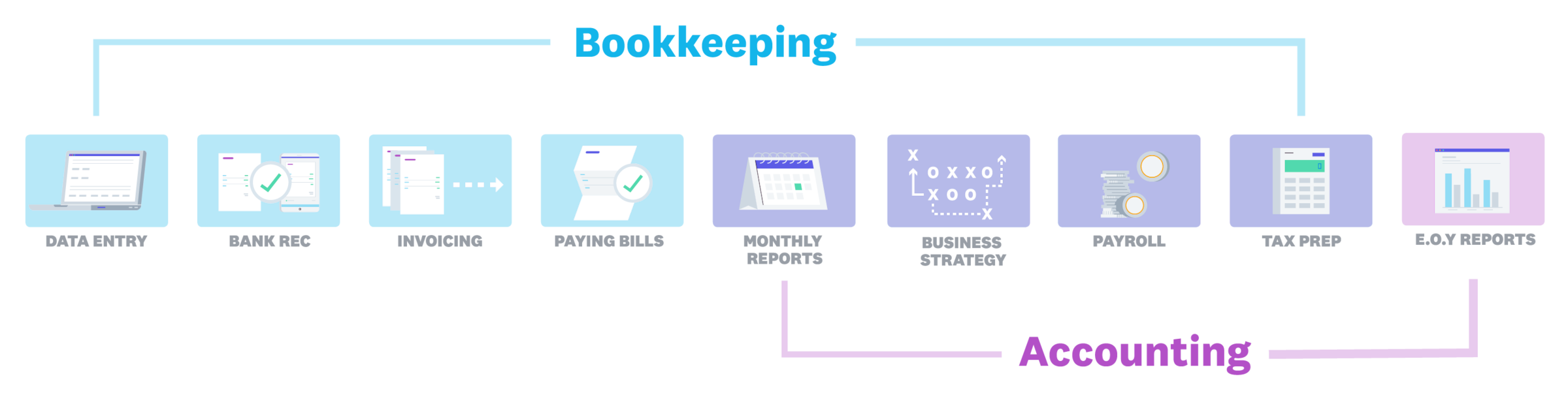
Bookkeeping is the day-to-day recording and organising of your financial transactions. Accounting is the analysis and reporting of that data to give you insight and advice.
The core difference comes down to what each role does with your numbers.
- Bookkeeping records and organises every financial transaction as it happens.
- Accounting analyses those records to explain what they mean for your business.
- Bookkeepers keep your books accurate, up to date, and ready to use.
- Accountants turn accurate books into reports, tax filings, and strategic advice.
Both roles matter, but they support your business at different stages of the same process.
What bookkeepers do
Bookkeepers keep your day-to-day finances accurate and organised. Their work falls into daily and monthly routines.
Day to day, bookkeepers focus on:
- managing accounts payable and receivable
- processing invoices and payments
- handling bank reconciliation to keep records accurate
Each month, they also handle:
- preparing financial reports for you to review
- running payroll for employees
- organising preliminary tax documentation
Many bookkeepers use double-entry bookkeeping to keep every entry balanced, and some flag trends in your performance along the way.
What accountants do
Accountants take the records bookkeepers produce and turn them into insight. If you want a fuller picture of what an accountant does, their focus is analysis, compliance, and advice.
Common accounting services include:
- preparing official financial statements
- filing tax returns and managing tax compliance
- forecasting cash flow and analysing performance
- advising on business decisions and growth
Financial statements sit at the heart of this work, and each one tells you something different.
- The income statement shows whether you made a profit over a set period.
- The balance sheet shows what you own and owe at a single point in time.
- The cash flow statement shows how cash moved in and out of your business.
Some accounting firms offer bookkeeping too, so you can manage everything in one place.
Difference between accountants vs bookkeepers
The line between the two roles has blurred as software takes over routine tasks, but real differences remain. They mostly come down to training, scope, and the decisions each role supports.
- Bookkeepers train through certificates or diplomas and focus on accurate records.
- Accountants hold a recognised degree and a professional qualification, and focus on analysis and advice.
- In Malaysia, only members of the Malaysian Institute of Accountants (MIA) may practise as accountants, which shapes both scope and fees.
Many businesses use both: a bookkeeper for daily management and an accountant for planning and tax. That way you get full support without paying for services you don't need.
When to hire a bookkeeper vs accountant
The right first hire depends on how much time your books take and how complex your finances are. Here's a simple way to decide.
Consider a bookkeeper when you:
- have regular transactions that need organising
- spend more than 5 hours a week on record-keeping
- need help with invoicing and paying bills
- want monthly reports to track performance
Consider an accountant when you:
- need strategic advice for big decisions
- face complex tax or multiple revenue streams
- are planning expansion, investment, or loans
- want detailed analysis and forecasting
Consider both when you:
- have annual revenue above around RM500,000 as a rough guide
- operate across multiple locations
- need daily management and strategic planning
- want to focus fully on running the business
Most small businesses start with a bookkeeper and add an accountant as their small business accounting needs grow. When you're ready, you can find an advisor who fits your business.
Education and qualifications required
Knowing how each professional qualifies helps you match the right support to your budget. Requirements differ a lot between the two roles.
Bookkeepers usually build skills through:
- on-the-job training with bookkeeping software
- a certificate or diploma in bookkeeping or accounting
- professional certification from a recognised training provider
- 1 to 3 years of practical experience
Accountants in Malaysia typically hold:
- a recognised degree in accounting or a related field
- a professional qualification such as ACCA, CIMA, or MICPA
- registration as a Chartered Accountant Malaysia, C.A.(M), with the MIA
- 2 to 5 years of professional experience
The MIA regulates the profession nationally under the Accountants Act 1967. Only MIA members may practise as accountants, so this qualification matters when you choose one.
Higher qualifications usually mean higher fees and a wider range of services. Pick a professional whose skills match what your business actually needs.
Simplify your bookkeeping and accounting with Xero
Good books and clear insight shouldn't cost you hours of manual admin. Xero brings your bookkeeping and accounting into one place, so recording transactions, reconciling accounts, and running reports takes less time.
You can see where your business stands in real time and share the same clear numbers with your accountant or bookkeeper. Keep your finances organised and see the difference for yourself when you get one month free.
FAQs on bookkeeping vs accounting
Here are answers to some frequently asked questions about bookkeeping vs accounting.
Can a bookkeeper handle my accounting needs?
A bookkeeper can manage your records, invoicing, and basic reporting. For tax planning, financial analysis, and strategic advice, you'll usually need an accountant.
What can an accountant do that a bookkeeper can't?
Accountants prepare official financial statements, handle complex tax matters, and advise on major decisions. In Malaysia, only MIA members may practise as accountants and offer these regulated services.
Can a bookkeeper become an accountant?
Yes, a bookkeeper can qualify as an accountant. They complete a recognised degree and a professional programme such as ACCA, then register as a Chartered Accountant Malaysia, C.A.(M), with the MIA.
Is accounting software like Xero considered bookkeeping or accounting?
Accounting software supports both: it records transactions and reconciles accounts for bookkeeping, and it helps analyse finances and prepare reports for accounting. It works alongside professional expertise rather than replacing it.
Which is more cost-effective for small businesses?
Bookkeepers usually charge less per hour, so they're cost-effective for day-to-day management. Add an accountant when strategic advice will save or earn you more than it costs.
When should I upgrade from a bookkeeper to an accountant?
Consider an accountant when annual revenue climbs past around RM500,000, decisions get more complex, or tax needs grow. Many businesses keep both, using each role for what it does best.
Related Terms
Learn more about bookkeeping and accounting
Handy resources
Advisor directory
You can search for experts in our advisor directory
Xero dashboard
See your key information on the business dashboard
Free business templates
From invoices to business plans, get every document you need to run a smarter business
Disclaimer
This glossary is for small business owners. The definitions are written with their requirements in mind. More detailed definitions can be found in accounting textbooks or from an accounting professional. Xero does not provide accounting, tax, business or legal advice.