Online business ideas: choose and test the right one
Discover online business ideas that fit your skills, start lean, and scale fast.

Written by Lena Hanna—Trusted CPA Guidance on Accounting and Tax. Read Lena's full bio
Published Thursday 2 April 2026
Table of contents
Key takeaways
- Match your online business idea to your existing skills and available budget, as starting with what you already know reduces the learning curve and helps you deliver value faster while keeping startup costs manageable.
- Validate your business idea before fully committing by researching your target market, testing with a minimum viable product, and gathering customer feedback to avoid the 42% failure rate caused by lack of market demand.
- Differentiate your business from big brands by building an authentic personal story into your product and branding, as customers will pay more for genuine, personalised experiences that large corporations can't replicate.
- Focus on niche markets rather than broad audiences, since the internet connects you with customers worldwide who share specific interests, making specialised products easier to find and sell online than in local markets.
Benefits of starting an online business
Starting an online business offers advantages that traditional businesses often can't match. You can launch with minimal upfront costs, work from anywhere, and reach customers globally.
Key benefits include:
- Lower startup costs: Many online businesses require little more than a laptop and internet connection
- Work flexibly: Set your own hours and work from any location
- Scale easily: Digital products and services can reach unlimited customers without proportional cost increases
- Reach globally: Sell to customers anywhere in the world, not just your local area
- Test faster: Launch quickly, gather feedback, and adjust your approach without major investment
These advantages make online businesses accessible if you want more control over your work and income.
Factors to consider when choosing an online business idea
Choosing the right online business idea depends on matching opportunities to your situation. Consider these factors before committing to an idea.
Your skills and experience
Start with what you already know. Your existing skills reduce the learning curve and help you deliver value faster. Consider skills from your job, hobbies, or education that could translate into a product or service.
Startup budget and costs
Startup costs vary widely between online business types. Service businesses often require minimal investment. In fact, research shows a third of businesses start with less than $5,000. Product-based businesses may need inventory or manufacturing funds. Be realistic about what you can afford to invest before seeing returns.
Time commitment
How much time can you dedicate? Some online businesses suit part-time work alongside a job, while others require full-time attention. Match your choice to your available hours.
Personal interests and passions
Businesses built around genuine interests are easier to sustain long-term. You'll spend significant time on this work, so choose something you find engaging.
Market demand
Market demand determines whether customers will pay for your product or service. It's a critical factor: 42% of failed startups cite no market need as a key reason for closing. Research competitors, search trends, and customer reviews to validate that people are actively looking for what you plan to offer.
Where to find online business ideas and inspiration
Finding online business ideas starts with researching what's already working. Here are sources to spark your thinking:
- Online marketplaces: Check trending items on Amazon, Etsy, eBay, Google Shopping, Facebook Marketplace, and AliExpress
- Social media platforms: Search hashtags on Instagram, Facebook, and Pinterest for your areas of interest
- Crowdfunding sites: Browse Indiegogo and Kickstarter to see what ideas are gaining traction
- App stores: Review top sellers and new releases to identify problems being solved
- Video and podcast platforms: Watch and listen to what creators are selling and discussing
What type of online business could you set up?
Online businesses fall into four main categories. Understanding these types helps you match your skills to the right model:
- Retail: Sell products through an online shop or marketplace
- Services: Provide services remotely, such as training, teaching, consulting, or managing
- Apps and SaaS: Create software or apps for sale or subscription
- Content and media: Produce content that earns through sales, subscriptions, sponsorships, or advertising
Online retail business ideas
According to a Xero e-commerce survey (January 2021), the most common online retail categories globally include:
- Fashion and clothing makes up 25% of online small businesses
- Electronics makes up 21% of online small businesses
- Hair and beauty makes up 18% of online small businesses
- Groceries and food, toys and crafts, health each make up 17%
These categories remain popular because they have consistent demand and suit various business models.
Make something yourself: Turn a hobby or skill into a product. Photography skills can become prints, cards, or calendars. Crafting skills can become niche products, and even dog jumpers have a market.
Get something made: Work with contract manufacturers to produce your product idea. You can customise existing products or design something from scratch. Small batch production is often more affordable than expected.
Resell products: Buy products from suppliers and resell them through your store. Differentiate yourself with strong branding or targeted marketing to stand out from competitors selling similar items.
Try dropshipping:Dropshipping is a retail model where you sell products without holding inventory. Customers order from your store, and your supplier ships directly to them. This approach suits people with strong marketing skills and limited capital.
How to compete with big brands
To compete with big brands, you need to differentiate, not compete on price. Your authentic story and personal touch can win customers even at higher prices.
Marc McKeown of FortBrave recommends building your brand around what makes you unique.
"Put as much of your own story into your product and branding as you can," he says. "Customers will gravitate to you because of your authentic story, even if they have to pay a little bit more."
"Differentiate yourself from the corporate experience. Package products nicely and put a personal note in. Amazon can't compete with that."
This personal approach can even earn you social media exposure through customer unboxing videos.
Niche down
Niche businesses often perform better online than broad ones. The internet connects you with customers worldwide who share specific interests, even if your local market is too small.
According to McKeown, online shopping has enabled niche businesses to thrive. "It's much easier to find out-of-the-ordinary products online than to traipse around town for it, so that's what people do."
Online services business ideas
Online service businesses let you sell your expertise remotely. Consider what skills from your current job could become a standalone service: administration skills suit virtual assistant work, and teaching skills suit online tutoring.
Start with what you know
You'll likely start with one or two foundation clients and grow through referrals.
Olivia Park of Olivia Park Coaching shows how online services can scale. She moved her personal training business online after relocating from Taiwan to South Korea.
Her social media content grew in popularity, allowing her to launch group programs alongside one-to-one training.
"It's allowed me to create more products with different tiers of service," she says. "Some people are happy to do the online courses on their own. Others ask for customised routines. And others want one-to-one time."
The result: you can deliver twice as much service online as with in-person training alone.
Referrals drive online service growth
Word of mouth works the same way for you online as it does offline. Michael Yared of Echobind, a fully online app development agency, confirms that referrals remain their biggest source of new work.
"We spun off with one anchor client and built up from there," he says. "It was tough for the first couple of years because we never knew if the projects would keep coming. But we just kept asking for referrals."
Echobind eventually grew to 40 fully remote staff.
Online app and software business ideas
App and Software as a Service (SaaS) businesses create software that automates tasks for consumers or businesses. These products can scale to millions of users, creating significant revenue potential.
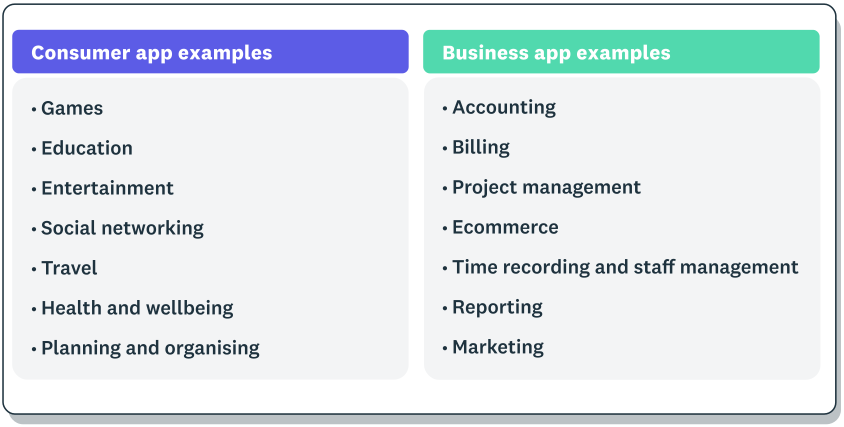
Apps fall into two main categories:
- Consumer apps: Games, productivity tools, lifestyle apps, and more. App stores contain dozens of categories
- Business apps: Tools that integrate with platforms like Xero to handle specific tasks, from gym billing to farm analytics
With thousands of apps competing for attention, marketing is essential to your success.
Online content and media business ideas
Content and media businesses earn revenue through advertising, sponsorships, subscriptions, or affiliate marketing. Income potential varies widely: most creators earn modestly, while a few build significant businesses.
Common content formats include:
- YouTube videos: Create gaming and how-to content to attract subscribers and sponsorships
- Podcasts: Generate income through sponsorships, subscriptions, or listener support
- Blogs: Monetise through advertising or affiliate marketing, where you earn commission for referring sales
Success depends on a compelling niche, consistent marketing, and often a strong personal brand. This market is competitive, so treat it as a long-term investment.
How to validate your online business idea
Validating your business idea before fully committing reduces financial risk and increases your chances of success. Fixing a product issue after release can be up to 100 times more costly than addressing it in the design phase. Test demand before investing significant time or money.
Follow these steps to validate your idea:
- Research your target market: Identify who would buy your product or service and understand their needs
- Test with a minimum viable product (MVP): Create a simple version to gauge interest before building the full offering
- Gather customer feedback: Ask potential customers what they think and what they'd pay
- Assess demand and competition: Check search trends, competitor activity, and market size
- Calculate basic financials: Estimate costs, pricing, and potential profit to confirm viability
Validating your idea doesn't guarantee success, but it helps you avoid investing in ideas with limited potential.
Turn your online business idea into reality
Modern technology lets you run an online business from anywhere: your spare room, a co-working space, or while travelling. The flexibility is real, but success requires planning. Start by choosing an idea that matches your skills and budget, validate it with potential customers, and build from there. Take the first step today to turn your online business idea into a thriving reality.
Ready to start your online business?
Whether you're selling products, offering services, or creating content, the right tools can help you manage your business effectively. Xero's accounting software gives you the financial insights you need to grow your online business with confidence.
FAQs on online business ideas
Here are answers to common questions about starting an online business.
What is the best business to start online?
The best online business depends on your skills, budget, and time. Service-based businesses like consulting or freelancing have low startup costs. Product-based businesses require more investment but can scale effectively.
Disclaimer
Xero does not provide accounting, tax, business or legal advice. This guide has been provided for information purposes only. You should consult your own professional advisors for advice directly relating to your business or before taking action in relation to any of the content provided.
Start using Xero for free
Access Xero features for 30 days, then decide which plan best suits your business.