The difference between bookkeeping and accounting
Bookkeeping records your day-to-day finances; accounting turns those records into advice and insight.
Published Friday 24 July 2026
Table of contents
Key takeaways
- Bookkeepers record and organise your day-to-day transactions, while accountants analyse that data to give you strategic advice.
- Bookkeepers often need no formal qualification, while accountants usually hold a degree plus a professional qualification from a body such as Chartered Accountants Ireland.
- Many small businesses start with a bookkeeper for daily admin and add an accountant for tax, Revenue filings, and advisory work as they grow.
- Accountants generally cost more per hour than bookkeepers, so match the role to the task to keep your fees in line with your needs.
Bookkeeping vs accounting
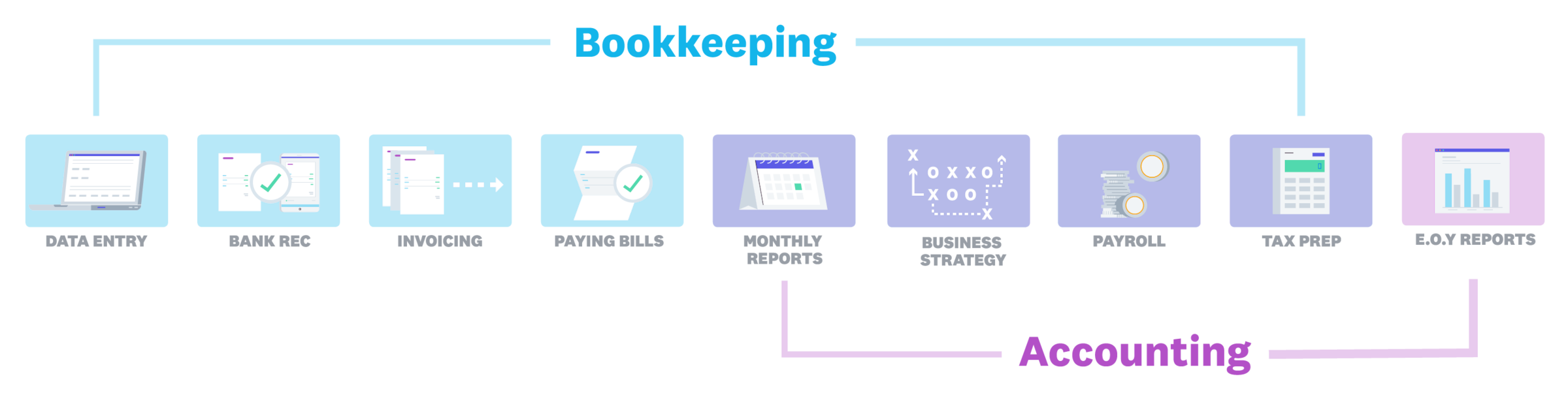
Bookkeeping is the day-to-day recording and organising of your financial transactions. Accounting is the analysis, interpretation, and reporting of that financial data to guide business decisions.
The two roles work in sequence. Bookkeepers capture accurate records, and accountants turn those records into insight, tax filings, and advice. You often need both to keep your finances in order and to plan ahead. If you want a plain-English overview first, this guide on why you need an accountant or bookkeeper is a good place to start.
What bookkeepers do
Bookkeepers handle the daily record-keeping that keeps your business organised and ready for reporting. Their work makes sure every transaction is captured accurately and on time.
Typical bookkeeping tasks include:
- Recording and categorising business transactions
- Managing money you owe and money owed to you
- Processing and sending invoices, and following up on payments
- Reconciling bank transactions to keep records accurate
- Preparing VAT return information and monthly summaries
Some bookkeepers also flag trends in your numbers and prepare reports that help you track performance. Keeping on top of your invoicing process is often where a bookkeeper saves you the most time.
What accountants do
Accountants interpret your financial data to provide advice, reporting, and tax support. They usually hold a degree and a professional qualification, which lets them take on more complex work.
Common accounting services include:
- Preparing financial statements such as the profit and loss account and balance sheet
- Filing tax returns and managing compliance with Revenue
- Producing forecasts and analysing business performance
- Advising on budgeting, growth, and funding decisions
- Preparing for and supporting a statutory audit
Some accounting firms also offer bookkeeping, so you can keep both services in one place.
Similarities between bookkeeping and accounting
Bookkeeping and accounting are closely linked and share the same starting point: accurate financial records. Both roles work from the same underlying data, so the line between them can blur in a small business.
Key things the two roles have in common are:
- Working from the same set of transactions and the general ledger
- Relying on the double-entry method to keep the books balanced
- Needing strong attention to detail and numeracy
- Helping you stay organised and compliant with Revenue
Because both roles depend on clean records, the quality of your bookkeeping shapes how useful your accounting can be. You can read more about how the two fit together in this guide to bookkeeping and accounting.
The difference between bookkeepers and accountants
The main difference is scope: bookkeepers record and maintain your financial data, while accountants analyse it and advise on it. That difference also shows up in qualifications and cost.
The clearest distinctions are:
- Qualifications: bookkeepers often need no formal qualification, while accountants usually hold a degree and a professional qualification
- Scope: bookkeepers focus on accurate records and routine reporting, while accountants handle analysis, tax, and advisory work
- Cost: accountants generally charge more per hour, reflecting their training and the complexity of their work
Many small businesses use a bookkeeper for day-to-day management and an accountant for planning and tax, so they get full support without paying for services they do not need.
Education and qualifications in Ireland
Qualifications differ sharply between the two roles in Ireland. Understanding them helps you judge who is right for your business and budget.
Accountants typically qualify through a professional body, such as:
- Chartered Accountants Ireland, awarding the ACA qualification
- ACCA, the Association of Chartered Certified Accountants
- CPA Ireland, the Institute of Certified Public Accountants
- CIMA, the Chartered Institute of Management Accountants
Bookkeepers often need no formal qualification, though many take a certificate to build their skills. The accounting technician route sits between the two and is administered by Accounting Technicians Ireland (ATI), which is a popular entry point into the profession. When you are ready to appoint someone, the Xero advisor directory lists qualified accountants and bookkeepers near you.
When to hire a bookkeeper, an accountant, or both
The right choice depends on how much financial work you have and how complex it is. Most businesses start small and add support as they grow.
Hire a bookkeeper when you:
- Spend more than 5 hours a week on financial admin
- Have regular transactions that need organising
- Want help with invoicing and paying bills
- Need monthly reports to track performance
Hire an accountant when you:
- Need advice on major business decisions
- Have complex tax affairs or several income streams
- Are planning to expand, invest, or borrow
- Want detailed analysis and forecasting
Consider both when your annual turnover passes €500,000, you operate across several locations, or you want to focus on running the business rather than the books. For a wider view of setting up your finances, see this guide to small business accounting.
How much do a bookkeeper and accountant cost
Fees vary by experience, location, and the work involved, so it helps to think in terms of value rather than a single rate. As a rule, accountants cost more per hour than bookkeepers because of their qualifications and advisory work.
To keep costs in proportion:
- Use a bookkeeper for routine, high-volume tasks such as data entry and reconciliation
- Use an accountant for tax, compliance, and strategic advice
- Combine both so you pay accountant rates only for higher-value work
Matching each role to the right task keeps your spend efficient while your finances stay well managed.
Simplify your bookkeeping and accounting with Xero
Whether you work with a bookkeeper, an accountant, or both, clean and connected records make everyone's job easier. Xero can help by bringing your day-to-day money work together in one place, so your books stay tidy and your advisor has what they need.
See how Xero can help simplify bookkeeping and accounting for your business, and get one month free.
FAQs on bookkeeping vs accounting
Here are answers to frequently asked questions about bookkeeping vs accounting for Irish small businesses.
Do I need a bookkeeper or an accountant?
Choose a bookkeeper if you mainly need help keeping accurate day-to-day records. Add an accountant when you need tax filings, Revenue compliance, or strategic advice.
Can a bookkeeper file my VAT returns?
A bookkeeper records your day-to-day transactions and can prepare VAT return information, but filing complex returns and giving tax advice is usually the role of an accountant.
Can a bookkeeper call themselves an accountant?
A bookkeeper can offer bookkeeping services without a formal qualification, but professional accountant titles are tied to bodies such as Chartered Accountants Ireland, ACCA, and CPA Ireland. Using those titles without membership is not appropriate.
Do accountants do bookkeeping?
Many accountants and accounting firms offer bookkeeping alongside their other services. This lets you keep record-keeping and advisory work with the same provider.
How much do a bookkeeper and accountant cost?
Fees depend on experience and the work involved, though accountants generally charge more per hour than bookkeepers. Using a bookkeeper for routine tasks and an accountant for advisory work keeps your costs efficient.
Related terms
Learn more about bookkeeping and accounting
Handy resources
Advisor directory
You can search for experts in our advisor directory
Xero dashboard
See your key information on the business dashboard
Free business templates
From invoices to business plans, get every document you need to run a smarter business.
Disclaimer
This glossary is for small business owners. The definitions are written with their requirements in mind. More detailed definitions can be found in accounting textbooks or from an accounting professional. Xero does not provide accounting, tax, business or legal advice.