Gross profit margin: what it is and how to calculate it
Learn how to calculate gross profit margin, what a good margin looks like and how it differs from net margin.
Written by Lena Hanna—Trusted CPA Guidance on Accounting and Tax. Read Lena's full bio
Published Tuesday 6 October 2026
Table of contents
Key takeaways
- Gross profit margin is the share of revenue left after cost of goods sold (COGS). Divide gross profit by revenue and multiply by 100.
- Check your margin monthly to spot trends early. A falling margin often points to rising supplier costs or pricing pressure.
- Negotiate better supplier rates and cut waste to lower your direct costs. Raise prices gradually, adding value that justifies each increase.
- Your ideal margin depends on your industry, so compare against similar businesses. NYU Stern’s January 2026 average for US listed companies, 37.76%, is one reference point.
What is gross profit margin?
Gross profit margin is the percentage of sales revenue you keep after subtracting the direct costs of producing your goods or services. It shows how efficiently your business turns sales into profit before operating expenses like rent and utilities.
A higher gross profit margin means you keep more from each sale to cover overheads and build net profit. Think of it as the part of every ₱100 sale that’s left once you’ve paid for what went into it.
Why gross profit margin matters for your business
Gross profit margin shows whether your core business model is sustainable. It guides your pricing and hiring decisions by showing how much profit each sale brings in.
Here’s what tracking your gross profit margin can tell you:
- Pricing effectiveness: whether your prices cover costs and leave room for profit
- Cost control: how efficiently you manage production or service delivery expenses
- Growth readiness: whether you can afford to hire staff or invest in new equipment
- Early warning signs: whether rising costs or pricing pressure are eating into profit
For example, a retailer that sees its margin slip from 45% to 38% over three months might trace it to a supplier price increase. Catching it early gives the owner time to renegotiate or find another supplier.
Gross profit margin vs gross profit
Gross profit is a peso amount: the money left after subtracting direct costs from revenue. Gross profit margin expresses that same figure as a percentage of revenue.
For example, if your business earns ₱100,000 in revenue with ₱60,000 in direct costs, the two figures look like this:
- Gross profit: ₱40,000
- Gross profit margin: 40%
People often shorten gross profit margin to ‘gross margin’. Both terms mean the same thing.
How to calculate gross profit margin
To calculate gross profit margin, subtract COGS from revenue, divide the result by revenue and multiply by 100. The sections below cover the formula, the steps, two worked examples and the mistakes to avoid.

Gross profit margin formula
Use this formula to find your gross profit margin:
Gross profit margin = ((Revenue − COGS) ÷ Revenue) × 100
In plain terms, it tells you what percentage of each sale is left after paying for what you sold.
How to calculate gross profit margin step by step
Follow these four steps, using figures from the same period, such as one month or one quarter:
- Find total revenue for the period on your profit and loss statement.
- Work out COGS for the same period, including direct costs such as materials and direct labour. Your profit and loss statement may list this as cost of sales.
- Subtract COGS from revenue to get gross profit.
- Divide gross profit by revenue and multiply by 100. The result tells you how many centavos you keep from each ₱1 of sales.
Gross profit margin example calculation
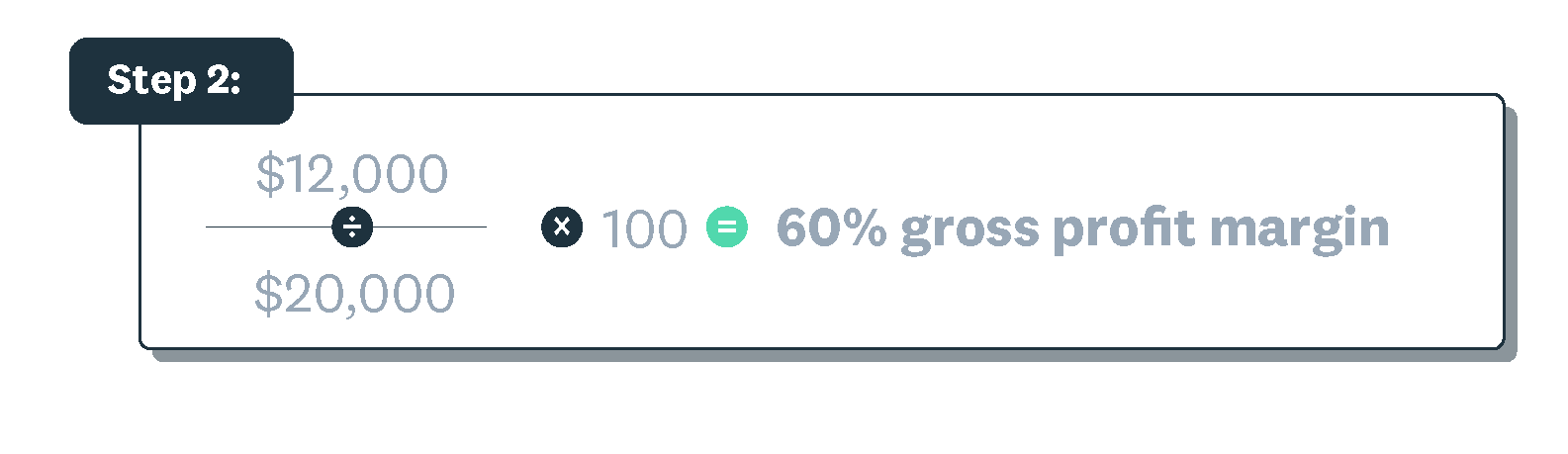
These two examples show the formula at work for a service business and a product business. Start with a cleaning business that earns ₱200,000 in revenue and spends ₱80,000 on direct costs, such as cleaning supplies and cleaners’ wages:
- Revenue: ₱200,000
- COGS: ₱80,000
- Gross profit: ₱200,000 − ₱80,000 = ₱120,000
- Gross profit margin: (₱120,000 ÷ ₱200,000) × 100 = 60%
The cleaning business keeps ₱0.60 of every ₱1 of sales after covering direct costs.

A sari-sari store works out COGS from its inventory: beginning inventory plus purchases, minus ending inventory. It starts the period with ₱50,000 of stock, buys ₱150,000 more and ends with ₱40,000 on the shelves:
- COGS: ₱50,000 + ₱150,000 − ₱40,000 = ₱160,000
- Revenue: ₱250,000
- Gross profit: ₱250,000 − ₱160,000 = ₱90,000
- Gross profit margin: (₱90,000 ÷ ₱250,000) × 100 = 36%
The store keeps ₱0.36 of every ₱1 of sales. Retailers usually run thinner margins than service businesses because stock makes up most of the cost of each sale.
Avoid common calculation mistakes
Your margin is only as accurate as your COGS figure. Watch for these common errors:
- Missing direct costs: include materials and direct labour, meaning wages for people who make your products or deliver your services. Indirect labour, such as admin staff, belongs in operating expenses.
- Including operating expenses: leave out rent and admin salaries, which belong in operating profit.
- Using old figures: update COGS whenever supplier prices change.
- Skipping inventory adjustments: count beginning and ending inventory if you sell products.
Your accountant can help you confirm which costs belong in your COGS calculation.
What is a good gross profit margin?
A good gross profit margin is one that covers your operating costs and still leaves a net profit. The right level depends on your industry, so there’s no single target for every business.
As a reference point, New York University’s Stern School of Business (NYU Stern) publishes average margins by industry. Its January 2026 data puts the average gross margin for US listed companies at 37.76%, or 34.39% excluding financial firms.
Whatever your industry, your target margin needs to be high enough to cover:
- operating expenses, such as rent and salaries
- loan repayments and interest
- taxes
- profit to reinvest or pay yourself
Factors affecting your margins
Your margin depends on internal factors you control and external ones you respond to. You can influence these internal factors:
- Pricing strategy: higher prices lift margins but can reduce sales volume.
- Supplier relationships: better rates or new suppliers lower your COGS.
- Operational efficiency: leaner processes cut waste and direct labour costs.
- Product mix: selling more high-margin items raises your overall margin.
You’ll need to plan around these external factors:
- Industry norms: software and hotel businesses tend to run higher gross margins than retail or construction.
- Regional costs: labour and rent vary by location.
- Market competition: competitive pressure can push prices down.
- Economic conditions: inflation raises supplier costs, and a slowdown cuts customer spending.
- Demand shifts: changing customer preferences affect pricing power and sales volume.
Knowing which factors you can influence helps you focus your improvement efforts where they’ll count most.
Benchmarking your gross profit margin
Benchmarking means comparing your margin with similar businesses to see how you’re performing. For the fairest comparison, match businesses on:
- industry
- business model
- size, measured by revenue or number of employees
- region
For local benchmarks, ask your accountant or bookkeeper, or check with your industry association. Business surveys from the Philippine Statistics Authority are another source of comparison data for your sector.
Industry benchmarks for gross profit margin
Average gross margins vary widely by industry. The NYU Stern January 2026 figures below are averages for US publicly listed companies, so Philippine small-business margins may differ.
These industries average more than 30%:
- Software (system and application): 71.72%
- Hotel/gaming: 60.85%
- Apparel: 56.88%
- Business and consumer services: 33.38%
- Retail (general): 33.18%
- Restaurant/dining: 32.24%
These industries average less than 30%:
- Retail (grocery and food): 26.31%
- Food processing: 23.23%
- Engineering/construction: 15.46%
- Auto and truck: 10.41%
Use these figures to see where your industry sits, then compare with local businesses of a similar size.
When to reassess your gross profit margin
Review your margin more often when your costs or market change. Watch for these triggers:
- Supplier price changes: higher material or labour costs cut directly into margins.
- New competitors: competitive pressure may call for pricing changes.
- Missed targets: a falling margin often explains weaker results.
- Business expansion: new products or locations can carry different margins.
- Economic shifts: inflation and changing customer behaviour affect costs and pricing power.
Monthly reviews help you spot changes early. Quarterly deep-dives let you study trends and adjust your strategy.
Analysing gross profit margin for business insights
Gross profit margin analysis compares your margins across products, services, time periods or business segments to show what’s working and what needs attention. It works best alongside other profitability ratios.
Regular analysis helps you:
- find which products or services earn the highest margins
- spot cost increases early and protect your profit
- decide whether to raise prices or cut costs
- monitor business health over months or years
Interpreting gross profit margin trends
Track your margin monthly or quarterly to see patterns in performance. Here’s what common trends can point to:
- Declining margins: rising supplier costs or pricing pressure from competitors
- Seasonal dips: normal swings in industries with busy and quiet periods
- Improving margins: price increases taking effect or a shift toward higher-margin products
- Inconsistent margins: possible gaps in inventory records or cost tracking
Compare your trends with industry benchmarks to see whether changes are specific to your business or part of wider market conditions.
Gross profit margin compared with other metrics
Gross profit margin measures profitability at the production level, and it’s one of several ways to measure profit margin. Operating and net profit margins subtract more costs, so reading them together gives you a fuller view of your finances.
Gross profit margin vs operating profit margin
Operating profit margin measures profitability after subtracting both COGS and operating expenses, such as rent and marketing. It shows how efficiently your business runs day to day.
Operating profit margin = (Operating profit ÷ Revenue) × 100
The key difference is that gross profit margin subtracts only direct costs, while operating profit margin also takes off the overheads of running your business.
Gross profit margin vs net profit margin
Net profit margin measures profitability after all expenses, including interest and tax on top of operating costs. It’s your bottom-line profit as a percentage of revenue. Net margin is usually lower than gross margin, unless non-operating income, such as a gain from selling equipment, covers the extra costs.
As a rule of thumb, Brex’s profit margin guide puts a 5% net margin at the low end, 10% as healthy and 20% as high.
How to use each metric
Each margin answers a different question about your business:
- Gross profit margin: check your pricing and production efficiency.
- Operating profit margin: assess how well you manage overheads.
- Net profit margin:measure overall business health and long-term sustainability.
- All margins together: see where profit goes between the sale and the bottom line.
If your gross margin improves while operating and net margins fall, rising overhead costs are the likely cause.
How to improve gross profit margin
You improve gross profit margin by earning more per sale or spending less to deliver it. A higher margin leaves more money for overheads and growth, which makes it one of the most direct ways to increase profits.
Adjust your prices
Pricing has a direct effect on your gross profit margin. Consider these approaches:
- Raise prices gradually: small, regular increases are often easier for customers to accept than one large jump.
- Add value: better quality or faster delivery can support higher prices.
- Segment your pricing: offer basic and premium tiers for different customers.
- Review competitor pricing: check that your prices reflect your market position.
Test price changes on a small scale first so you can measure how customers respond.
Reduce your cost of goods sold
Lowering direct costs improves your margin without changing your prices. Focus on these areas:
- Negotiate with suppliers: ask for volume discounts or longer payment terms.
- Compare suppliers: get new quotes regularly to keep prices competitive.
- Reduce waste: track materials and minimise spoilage and overproduction.
- Optimise inventory: overstocking ties up cash, and stockouts can mean costly rush orders.
- Review labour efficiency: match direct labour hours to production needs.
Small savings add up. For example, a business with ₱1,000,000 in annual COGS that cuts those costs by 5% adds ₱50,000 to its gross profit.
Streamline your operations
Efficient operations cut the time and resources it takes to deliver your products or services, which lifts your margin. Try these approaches:
- Automate repetitive tasks: use software for invoicing and inventory tracking to save labour time.
- Improve production processes: find bottlenecks and remove unnecessary steps.
- Train your team: skilled employees work faster and make fewer costly errors.
- Track time and resources: see where time and money go so you can spot improvements.
Accounting software like Xero helps you track costs and spot margin changes in real time.
Track your gross profit margin with Xero
Your gross profit margin shows how much each sale really earns, so keeping it current helps you price with confidence. Tracking it is simpler when your sales and costs update automatically. With Xero, you can:
- see up-to-date margins from any device
- track month-to-month changes with built-in reports
- compare margins by product or service to find your most profitable offerings
- ask JAX, Xero’s AI financial superagent, for quick answers on trends in your numbers
Know which sales earn the most and act on changes sooner when you get one month free on a Xero plan.
FAQs on gross profit margin
Here are answers to common questions about gross profit margin, including how it compares with net profit margin.
What does a 40% gross profit margin mean?
It means your business keeps ₱0.40 from every ₱1 of sales after paying direct costs. The other ₱0.60 goes to your cost of goods sold.
Can gross profit margin be negative?
Yes. A negative gross profit margin means your direct costs are higher than your revenue, so you lose money on every sale before operating expenses.
What’s the difference between gross margin and markup?
Gross margin is profit as a percentage of the selling price, while markup is profit as a percentage of cost. A product that costs ₱60 and sells for ₱100 has a 40% gross margin but a 67% markup.
What’s the difference between gross profit margin and net profit margin?
Gross profit margin subtracts only direct costs (COGS) from revenue. Net profit margin subtracts all expenses: COGS, overheads, interest and tax.
Can a business have a high gross margin but a low net margin?
Yes, because overheads such as rent, salaries, marketing and utilities, plus interest and tax, can absorb a strong gross profit. For example, ₱500,000 revenue less ₱200,000 COGS is a 60% gross margin, but ₱275,000 in other expenses leaves ₱25,000, a 5% net margin.
Which is more important, gross or net profit margin?
Both matter. Use gross margin to check your pricing and direct costs, and net margin to see whether the business is profitable overall.
Disclaimer
Xero does not provide accounting, tax, business or legal advice. This guide has been provided for information purposes only. You should consult your own professional advisors for advice directly relating to your business or before taking action in relation to any of the content provided.