What is dropshipping? How it works and how to start
Dropshipping lets you sell products online without buying stock upfront. Here's how to get started.
Written by Lena Hanna—Trusted CPA Guidance on Accounting and Tax. Read Lena's full bio
Published Wednesday 15 April 2026
Table of contents
Key takeaways
- Vet suppliers carefully before listing their products — order samples, test their response times, and confirm their return policies, because any quality or shipping failures will fall on you in your customers' eyes.
- Price your products by accounting for all costs upfront, including platform fees, transaction charges, and marketing spend, so your margins stay healthy rather than shrinking after the sale.
- Choose a niche with less competition rather than chasing popular, saturated markets — fewer sellers competing on price means better margins and a stronger chance of building a loyal customer base.
- Expect several months before you see consistent profits, so track your numbers from day one and treat early sales as data for refining your product range and marketing rather than a measure of failure.
What is dropshipping?
Dropshipping is a sales method where you sell products online without holding inventory. When a customer places an order, your supplier ships the product directly to them.
You never touch the stock. Instead, you focus on running your store, marketing your products, and processing orders while your supplier handles storage and shipping.
The dropshipping market is growing fast, with global revenue expected to reach US$476 billion by 2026, according to Statista. Startup costs are low and it's easy to get started, but competition is fierce and profit margins are often tight.
How does dropshipping work?
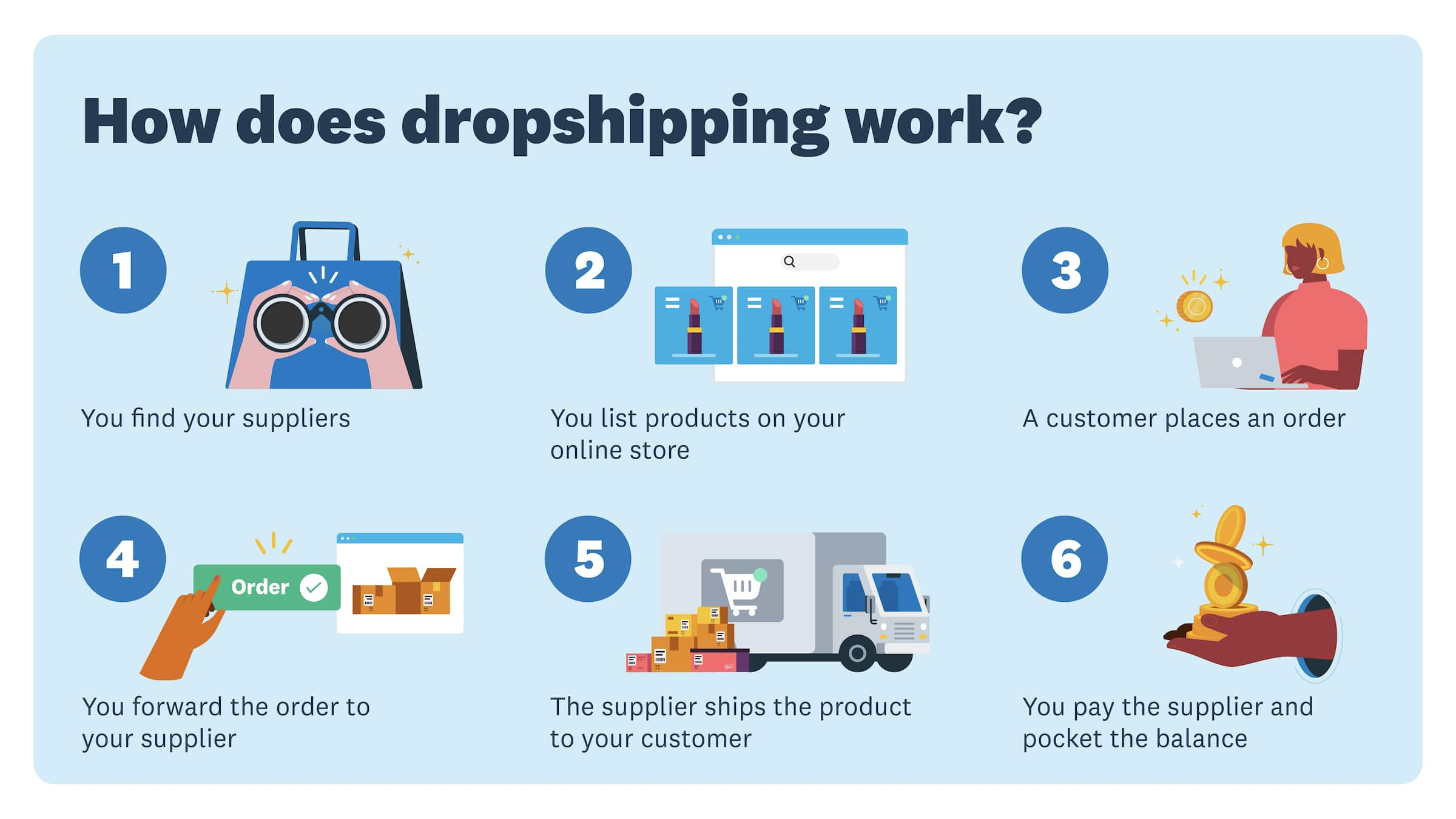
The dropshipping process follows a simple sequence from supplier to customer. Here's how each step works.
Step 1: You find your suppliers
Finding the right suppliers is your first step. Look for partners who offer quality products, competitive prices, and reliable shipping.
Set clear terms upfront for pricing, return policies, and restocking fees. The clearer your agreement, the fewer misunderstandings later on.
Look for suppliers who offer:
- White-labelling: They add your branding to products and packaging so customers see your store, not theirs
- Automated integrations: Dedicated dashboards, store connections, or partner-specific systems that streamline ordering
Step 2: You list products on your online store
Add products with detailed descriptions, high-quality images, and accurate specs. Your supplier may provide these, or you can create branded versions.
Set prices carefully by factoring in your markup for profit margins. Customers compare prices online in seconds, so stay competitive.
Account for hidden costs like platform fees and transaction charges when calculating your final price.
Step 3: A customer places an order
When a customer orders something, the payment is made directly to you, the dropshipper. You're now in charge of the transaction, so it's your responsibility to manage refunds and resolve disputes.
Step 4: You forward the order to your supplier
Send the order details to your supplier, including the customer's address, product specifications (size, colour, and so on), and any special requests.
Step 5: The supplier ships the product to your customer
The supplier packages and ships the product directly to your customer.
Step 6: You pay the supplier and pocket the balance
Pay the supplier the agreed wholesale cost and any shipping fees. The difference between what the customer paid and your costs is your profit.
Dropshipping versus traditional retail
Dropshipping and traditional retail differ in ways that affect how you manage risk, capital, and day-to-day operations. Dropshipping and traditional retail differ in three key ways:
- Inventory management: Dropshippers never hold stock, while traditional retailers must store and manage inventory securely
- Initial costs: Dropshippers avoid upfront costs for inventory and storage, lowering startup expenses significantly
- Operational risks: Dropshippers eliminate unsold stock risk but depend on suppliers for quality and shipping speed
Some products work better with dropshipping than traditional retail:
- Niche products: Test eco-friendly cleaning supplies or vegan skincare without committing to large stock orders
- High-value items: Sell designer bags or luxury watches without buying inventory upfront or paying for secure storage
- Trendy or seasonal items: Offer fashion accessories, heated blankets, or Christmas ornaments without risking unsold stock
Is dropshipping profitable?
Yes, dropshipping can be profitable, but margins are typically lower than in traditional retail. You earn a profit on each sale after accounting for product costs, platform fees, and marketing expenses.
Your profitability depends on several factors:
- Niche selection: Less competitive niches often have better margins because fewer sellers are competing on price
- Supplier pricing: Better wholesale rates improve your profit on each sale
- Marketing efficiency: Lower customer acquisition costs mean more of each sale stays in your pocket
- Average order value: Higher-priced items can offset tight percentage margins
Many dropshippers don't see consistent profits in their first few months while they test products and refine their marketing. Building a profitable store takes time and consistent effort.
Dropshipping pros and cons
Like any business model, dropshipping has real advantages and genuine trade-offs. Weigh these factors before you start.
Dropshipping benefits
Dropshipping appeals to new and experienced business owners for several reasons.
- Scalability: Outsourcing inventory and logistics to suppliers frees you to focus on expanding your product range, marketing, and customer service
- Run your business from anywhere: With no physical storefront or warehouse, all you need is an internet connection to monitor sales, process orders, and coordinate with suppliers
- Lower costs: You pay suppliers only after making a sale, eliminating large upfront inventory investments. Without warehousing or storage expenses, overhead stays low. This helps your business become profitable faster, even with limited startup funds
- Improved cash flow: You pay suppliers only after customers pay you, so your funds aren't tied up in unsold inventory
- Lower environmental impact: With less waste from unsold stock and fewer steps to transport goods, dropshipping offers a more sustainable approach for eco-conscious entrepreneurs
Dropshipping drawbacks
Dropshipping has drawbacks too.
- Complex shipping arrangements: Working with multiple suppliers makes it hard to give customers exact delivery times. Items from the same order may arrive separately, and international orders can bring delays and fees that hurt your reputation
- Lower profit margins: Buying items one at a time means you miss out on bulk discounts. Some suppliers charge extra for processing smaller orders. Tight margins leave less budget for marketing and growth
- Intense competition: Low barriers to entry attract many sellers who compete fiercely, leading to price wars that squeeze margins further. Standing out requires a unique offering, strong branding, and exceptional customer service
- Depending on suppliers: Customers hold you responsible for inconsistent quality, shipping delays, poor communication, and damaged packaging, even when suppliers are at fault
- Limited branding: Building a strong brand is harder when suppliers don't offer white-labelling. Customers who buy from your branded store may receive orders in generic packaging, creating a disconnect
Dropshipping business models
Dropshipping business models vary based on how you source and fulfil products. Choose the model that fits your goals and how much risk you can tolerate.
- Wholesale dropshipping: Partner with wholesalers who stock wide product ranges and ship directly to your customers. This lets you test different products with minimal risk
- Print on demand: Produce items like t-shirts, mugs, and phone cases only after customers order them. You can test custom designs without investing in big print runs, though shipping times may be longer
- Retail dropshipping: Source products from retailers like Amazon and ship them to customers. You get access to a huge range of products, but profit margins are tighter since you buy at retail prices. This works best for testing demand or exploiting price differences
How much does it cost to start dropshipping?
Starting a dropshipping business requires some upfront investment, but you can launch on a tight budget. Investing more in marketing early on usually speeds up growth.
Common startup costs include:
- Domain name: An annual fee for your website address
- Ecommerce platform: A monthly subscription for hosting your store
- Store theme: Free themes are available, or you can pay for a premium design
- Apps and plugins: Monthly fees for tools that add functionality to your store
- Initial marketing budget: Funds for advertising to attract your first customers
Ongoing monthly costs depend on your platform fees and marketing spend. As your store grows, you may invest more in advertising and premium tools. Tracking these expenses from day one helps you understand your true profit margins.
How to find dropshipping suppliers
Finding reliable suppliers is one of the most important steps in building a successful dropshipping business. Your supplier's quality, pricing, and shipping speed directly affect your customer experience and profit margins.
Look for dropshipping suppliers in these places:
- Supplier directories: Platforms like Spocket, Modalyst, and DSers connect you with vetted suppliers and let you import products directly to your store
- Wholesale marketplaces: Large online marketplaces offer extensive product catalogues across many categories
- Direct outreach: Contact manufacturers or distributors in your niche directly to negotiate better terms
- Trade shows: Meet suppliers in person and evaluate product quality firsthand before committing
When vetting suppliers, check these criteria:
- Product quality: Order samples before listing products in your store
- Shipping times: Confirm average delivery times to your target markets
- How they communicate: Test how quickly they respond to enquiries before you commit
- Return policies: Understand who handles returns and refunds when something goes wrong
- Minimum orders: Some suppliers require minimum purchase quantities per order
Watch for these red flags when evaluating a supplier:
- No sample availability: Reliable suppliers let you test products before you list them
- Vague shipping estimates: Unclear timelines often mean delays for your customers
- Poor reviews: Check supplier ratings on directories and forums before signing up
- Upfront membership fees: Legitimate suppliers typically let you work with them without charging membership fees
How to start dropshipping
Starting a dropshipping business requires careful planning, but the process is straightforward.
Find your market niche
Choose a niche that matches your interests and meets market demand. Use tools like Google Trends to spot growing trends, and search Amazon or eBay for in-demand products.
Selling unique, hard-to-find items helps you stand out from competitors.
Choose reliable suppliers
Look for suppliers with a strong reputation, competitive prices, and reliable shipping. Check their minimum order requirements, packaging quality, and dispatch times.
Platforms like Spocket, Modalyst, and DSers connect your store with supplier catalogues. These platforms let you:
- browse supplier catalogues
- import products with auto-filled descriptions and images
- customise product details to match your brand voice
Create your online store
Build a user-friendly store where customers can browse and buy products:
- Choose a platform like WooCommerce, Shopify, BigCommerce, or Wix
- Pick a payment processor such as Stripe or PayPal
- Add products with detailed descriptions, clear images, and accurate specs
- Incorporate your branding into the site design for a cohesive look
Plan your marketing strategy
Effective marketing grows your dropshipping business. Use these tactics:
- Set up social media profiles: Choose platforms that match your audience, like TikTok for younger customers, and post regularly to showcase products
- Run digital advertising: Use pay-per-click (PPC) campaigns on Google, Facebook, and Instagram to reach your ideal customers
- Encourage customer reviews: Offer small discounts for reviews and display positive feedback on your website to build trust
Top five dropshipping tips
Dropshipping rewards flexibility and agility, but success requires attention to detail.
- Know your customer. Cater to your customers' specific needs to earn their loyalty. Aim to be the store they think of first when they need products in your niche.
- Be trustworthy and responsive. Answer enquiries promptly, maintain clear return policies, and handle complaints professionally. Customers who trust you become repeat buyers.
- Work with quality suppliers. Request samples, monitor customer feedback, and confirm suppliers resolve issues quickly. Since you don't handle inventory directly, your supplier's quality becomes your quality.
- Stay organised. Keep accurate financial records, manage your cash flow, and stay current on your taxes to keep operations running smoothly.
- Stay passionate. Customers appreciate store owners who are enthusiastic about their products. Passion also keeps you motivated and committed during tough times.
Streamline your dropshipping business with Xero
Managing the finances behind a dropshipping business is much easier with the right tools. Xero's accounting software integrates with ecommerce platforms, tracks your expenses automatically, and gives you a clear view of your cash flow.
Ready to simplify your dropshipping accounting? Get one month free and see how Xero helps you stay on top of your finances. When you're ready to grow, explore more tools in the Xero App Store.
FAQs on dropshipping
Still have questions about starting your dropshipping business?
Can I start dropshipping with no money?
You'll need some funds to start. While startup costs are low, you'll need to cover essentials like a domain name, web hosting, and marketing. You can start small and reinvest early profits to grow, but some upfront spend is unavoidable.
How much do dropshippers make?
Dropshippers earn anywhere from a few hundred to tens of thousands per month. Your income depends on your niche, market demand, profit margins, and competition.
What is the best dropshipping platform?
The best platform depends on your business needs. Popular options include:
- Spocket: Connects you with US and European suppliers offering fast shipping
- Modalyst: Offers a wide range of products, including unique brands and print-on-demand options
- DSers: Partners with AliExpress for low-price suppliers and bulk orders
How long does it take to make money with dropshipping?
Most dropshippers take several months before they see consistent profits. The early stage usually involves testing products, adjusting pricing, and refining your marketing until you find what works. Setting a realistic timeline and tracking your numbers from the start helps you make better decisions along the way.
Do I need a business license for dropshipping?
What you require varies depending on where you're based and where you sell. Many countries and regions require you to register your business and collect sales tax or VAT on transactions. Check your local regulations early and speak with an accountant to make sure you're set up correctly from the start.
Disclaimer
Xero does not provide accounting, tax, business or legal advice. This guide has been provided for information purposes only. You should consult your own professional advisors for advice directly relating to your business or before taking action in relation to any of the content provided.
Start using Xero for free
Access Xero features for 30 days, then decide which plan best suits your business.