Journal Entry: What It Is, How to Record One in Accounting
Discover how a journal entry keeps your books accurate, supports audits, and speeds up month end.

Written by Lena Hanna—Trusted CPA Guidance on Accounting and Tax. Read Lena's full bio
Published Thursday 5 February 2026
Table of contents
Key takeaways
- Apply the fundamental rule that total debits must always equal total credits in every journal entry to keep your books balanced and ensure accurate financial statements.
- Record journal entries for all financial transactions including daily activities like sales and purchases, plus period-end adjustments for accrued expenses, prepaid items, and depreciation.
- Use the five-step process for accurate recording: identify the transaction and affected accounts, classify as debit or credit, record the date and details, enter amounts, then post to your general ledger and review.
- Implement accounting software to automate routine journal entries and reduce manual errors, allowing you to focus on exceptions and business growth rather than repetitive bookkeeping tasks.
What is a journal entry?
A journal entry is a record of a business transaction in your accounting system. It captures the date, accounts affected, and amounts debited and credited using double-entry bookkeeping.
Journal entries form the foundation of your financial records, guided by standards like the Conceptual Framework for Financial Reporting, which was revised in March 2018. They feed into your general ledger and ensure your financial statements, including your balance sheet, accurately reflect your business's financial position.
Now that you know what journal entries are, you need to understand the fundamental concept behind them: debits and credits.
Understanding debits and credits
Debits and credits are the two sides of every journal entry. In double-entry bookkeeping, each transaction affects at least two accounts: one receives a debit, the other receives a credit.
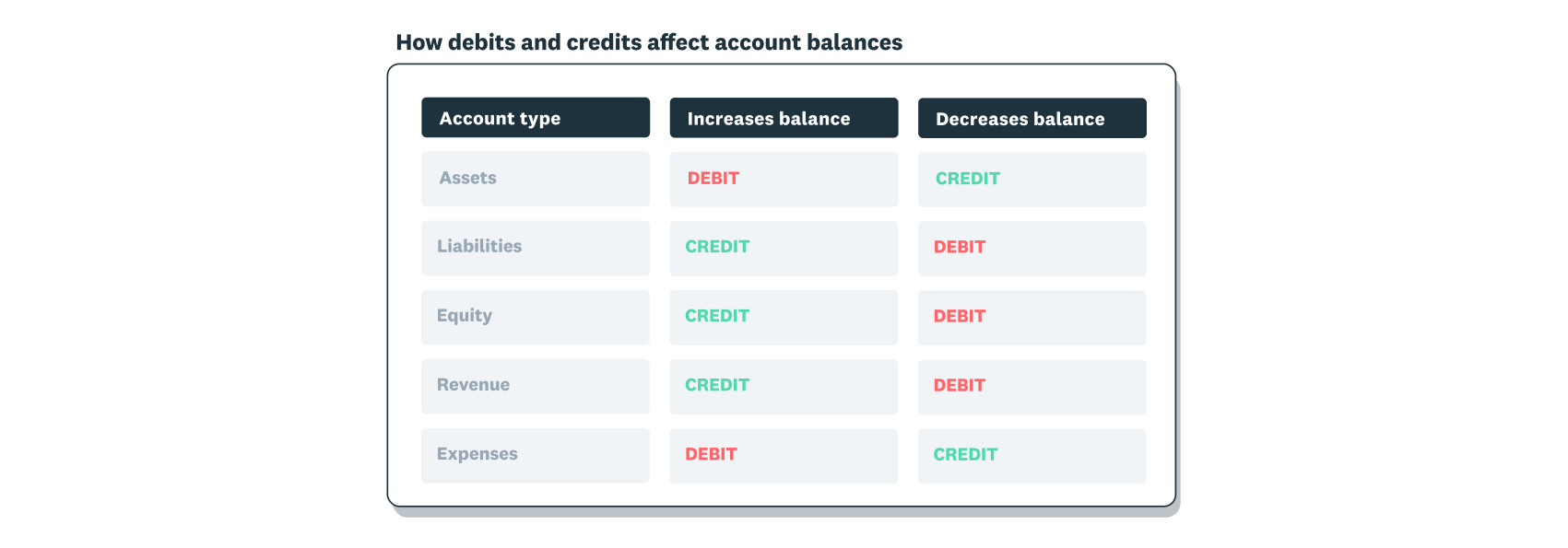
Here's how debits and credits affect different account types:
- Asset accounts: debits increase the balance, credits decrease it
- Liability accounts: credits increase the balance, debits decrease it
- Equity accounts: credits increase the balance, debits decrease it
- Revenue accounts: credits increase the balance, debits decrease it
- Expense accounts: debits increase the balance, credits decrease it
The key rule: total debits must always equal total credits in every journal entry. This keeps your books balanced and your financial statements accurate.
The table below shows how debits and credits affect each account type:
To classify a transaction, ask yourself: 'Which account gains value and which loses it?' Your bookkeeper or accountant can help clarify complex scenarios. Use this directory to find an accountant near you.
Understanding debits and credits is essential, but you also need to know why journal entries matter for your business.
The purpose of journal entries
Journal entries create a complete, chronological record of every financial transaction in your business. They serve as the foundation for accurate financial reporting and informed decision-making, with the revised Conceptual Framework becoming effective for annual reporting for periods beginning on or after 1 January 2020.
Here's why journal entries matter for your business:
- Accurate record-keeping: capture every transaction with dates, amounts, and account details
- Audit trail: provide documentation for tax compliance and financial reviews
- Financial reporting: feed directly into your balance sheet, profit and loss statement, and cash flow reports
- Error detection: make it easier to spot and correct mistakes before they compound
- Business insights: help you track where money comes from and where it goes
Without proper journal entries, your financial statements won't reflect reality, and you'll struggle to make confident business decisions.
Once you understand why journal entries are important, you need to know how they function in your accounting system.
How journal entries work
Journal entries record changes to your account balances using the double-entry system. Every transaction requires at least two entries: a debit to one account and a credit to another.
Here's how the process flows:
- A transaction occurs (such as a sale or purchase)
- You identify which accounts are affected
- You record the debit and credit amounts
- The entry posts to your general ledger
- Your financial statements update automatically
The double-entry system ensures your books stay balanced. When one account increases, another decreases by the same amount, keeping the accounting equation (Assets = Liabilities + Equity) in check.
Knowing how journal entries work helps you recognise the right moments to create them.
When to use journal entries
You'll create journal entries whenever a financial transaction affects your business accounts. Some entries happen daily, while others occur at specific times during the accounting cycle.
Common scenarios requiring journal entries:
- Sales and purchases: recording revenue from customers or expenses from suppliers
- Payroll: capturing wages, taxes, and deductions
- Bank transactions: documenting deposits, withdrawals, and transfers
- Asset changes: recording depreciation, purchases, or disposals of equipment
Period-end journal entries:
- Adjusting entries: updating accounts for accrued expenses, prepaid items, or unearned revenue
- Closing entries: transferring temporary account balances to retained earnings at year-end
- Correcting entries: fixing errors discovered after the original entry was posted
Accounting software like Xero automates many routine journal entries, so you can focus on exceptions and adjustments rather than manual data entry.
Different situations call for different types of journal entries, each serving a specific purpose.
What are the different types of journal entries in accounting?
Journal entry types vary based on the transaction and timing. Understanding each type helps you record transactions correctly and keep your books accurate.
The seven main types of journal entries are:
- Simple entries: affect only two accounts
- Compound entries: involve three or more accounts
- Adjusting entries: update balances at period-end
- Reversing entries: undo previous adjustments
- Recurring entries: repeat regularly for consistent transactions
- Closing entries: reset temporary accounts at year-end
- Correcting entries: fix errors in prior entries
Here's a closer look at each type.
Simple journal entry
A simple journal entry records a transaction that affects exactly two accounts: one debit and one credit. When one account increases, the other decreases by the same amount.
Use simple entries for straightforward transactions like cash purchases, single payments, or basic sales.
Compound journal entry
A compound journal entry records a transaction that affects three or more accounts. It captures multiple debits and credits in a single entry while keeping totals balanced.
Payroll is a common example. One entry might include debits for gross wages and employer taxes, plus credits for net pay, tax withholdings, and benefit deductions. Despite the complexity, total debits still equal total credits.
Adjusting journal entry
An adjusting journal entry updates account balances at the end of an accounting period to ensure your financial statements reflect accurate figures.
Common uses for adjusting entries include:
For example, a construction company working on a three-month project would record an adjusting entry each month for one-third of the total revenue, even if they invoice only at completion.
Reversing journal entry
A reversing journal entry undoes an adjusting entry from the previous period to simplify recording the actual transaction when it occurs.
For example, if you accrued wages at month-end for work performed but not yet paid, you'd reverse that entry at the start of the next month. When you process the actual payroll, you can record it normally without manually adjusting for the accrual.
Recurring journal entry
A recurring journal entry records transactions that repeat on a regular schedule, such as monthly rent, loan payments, or subscription fees.
Most accounting software lets you automate recurring entries. Set them up once, and the system posts them automatically each period, saving time and reducing manual errors.
Closing journal entry
A closing journal entry transfers balances from temporary accounts to permanent accounts at the end of a fiscal period.
Temporary accounts include revenue and expense accounts, which track activity for a single period. Closing entries reset these balances to zero and move the net result to retained earnings, preparing your books for the next period.
Correcting journal entry
A correcting journal entry fixes errors discovered after the original entry was posted. Use it when a transaction was recorded to the wrong account or with an incorrect amount.
Rather than deleting the original entry, you post a correction that reverses the error and records the transaction correctly, maintaining a clear audit trail in line with standards like the Conceptual Framework for Financial Reporting.
Seeing real-world examples makes these concepts clearer and helps you apply them to your own business.
Journal entry examples
Seeing real examples helps you understand how journal entries work in practice. Here are two common scenarios.
Example 1: Purchasing supplies with cash
The Cosy Cake Shop buys baking supplies worth $300 on 15 January 2025. The bookkeeper records a simple journal entry:
- Debit: Baking Supplies account (+$300) — increases the asset
- Credit: Cash account (-$300) — decreases the asset
Here's what the journal entry looks like:

Example 2: Recording a service sale on credit
A consulting firm completes a $1,500 project for a client who will pay in 30 days. The journal entry:
- Debit: Accounts Receivable (+$1,500) — increases the asset
- Credit: Service Revenue (+$1,500) — increases revenue
Both entries balance, with total debits equalling total credits.
Now that you've seen examples, let's walk through the practical steps to record your own journal entries.
How to record journal entries
Recording journal entries correctly keeps your financial records accurate and your books balanced. Follow these five steps for each transaction.
1. Identify the transaction and accounts involved
Determine which transaction you're recording and which accounts it affects, such as cash, revenue, or expenses.
Tip: Ask yourself, 'Which account gains value and which loses it?' This helps clarify which accounts to debit and credit.
2. Classify the transaction as a debit or credit
Determine whether each account receives a debit or credit based on the account type and whether its balance increases or decreases.
3. Record the date and transaction details
Enter the transaction date and a brief description, such as 'office supplies purchase.' Clear descriptions make it easier to review entries later.
4. Enter debit and credit amounts
Record the amounts in your debit and credit columns. Verify that total debits equal total credits before proceeding.
5. Post to your general ledger and review
Post the balanced entry to your general ledger. Run a final check to confirm amounts are accurate and accounts are correctly updated.
If you discover an error later, use a correcting journal entry to fix it while maintaining your audit trail.
With the right tools, you can simplify the entire journal entry process and reduce errors.
Streamline your journal entries with Xero
Managing journal entries manually takes time and leaves room for error. Xero automates routine entries, keeps your records organised, and generates financial statements so you can see your business's financial health at a glance.
Spend less time on bookkeeping and more time running your business. Get one month free to see how Xero simplifies your accounting.
FAQs on journal entries
Here are answers to common questions about journal entries.
How do I fill out a journal entry?
Enter the transaction date, account names, a brief description, and the debit and credit amounts. Verify that total debits equal total credits before posting. Accounting software like Xero automates this process and reduces manual errors.
What's an example journal entry?
Here's a simple journal entry for purchasing office supplies:
- Date: 25 October 2024
- Description: Purchased office supplies for cash
- Debit: Office Supplies $300
- Credit: Cash $300
The debit increases your supplies (an asset), while the credit decreases your cash by the same amount.
What are the three rules of journal entry?
The three fundamental rules are:
- Debits must equal credits: every entry must balance
- Record in chronological order: enter transactions by date
- Use the correct accounts: classify each transaction to the appropriate account type (asset, liability, equity, revenue, or expense)
What are the most common types of journal entries for small businesses?
The most common types for small businesses are:
- Simple entries: recording basic sales, purchases, and payments
- Adjusting entries: updating accounts at month-end or year-end
- Recurring entries: capturing regular transactions like rent or subscriptions
Most accounting software automates these routine entries, so you only need to handle exceptions manually.
Can I use accounting software to track journal entries?
Yes. Accounting software like Xero automates routine journal entries, reduces manual errors, and generates accurate financial reports, freeing you to focus on running your business.
Disclaimer
Xero does not provide accounting, tax, business or legal advice. This guide has been provided for information purposes only. You should consult your own professional advisors for advice directly relating to your business or before taking action in relation to any of the content provided.