Accumulated depreciation: definition, calculation and example
Learn what accumulated depreciation is, how to calculate it and how it shows on your balance sheet.

Written by Jotika Teli—Certified Public Accountant with 24 years of experience. Read Jotika's full bio
Published Tuesday 6 October 2026
Table of contents
Key takeaways
- Track accumulated depreciation as the running total charged on a fixed asset, held in a contra asset account on your balance sheet
- Subtract accumulated depreciation from the asset’s original cost to find its net book value
- Use straight-line depreciation to spread the cost evenly: cost minus residual value, divided by useful life
- Claim capital allowances for tax in Ireland, as accounting depreciation isn’t deductible
What is accumulated depreciation?
Accumulated depreciation is the running total of depreciation charged on a fixed asset since you started using it. It’s held in a separate contra asset account that reduces the asset’s cost on the balance sheet.
Say you run a plumbing business and buy a van for €30,000. If you charge €4,000 of depreciation each year, the running total reaches €12,000 after three years. The van still shows at its €30,000 cost, with the €12,000 set against it.
The balance behaves the same way for every fixed asset. It:
- builds up each period as you record depreciation
- sits against the asset’s cost instead of inside the asset account
- stops growing once the asset reaches its residual value
- comes off the balance sheet when you sell or scrap the asset
Land usually keeps its value, so it isn’t depreciated at all. For everything else, the balance lets you work out net book value, which is what the asset is worth in your accounts today.
Net book value = cost − accumulated depreciation
For the van, that’s €30,000 − €12,000 = €18,000 after three years.
Depreciation vs accumulated depreciation
Depreciation is the expense you record for a single period, such as one year’s share of an asset’s cost. Accumulated depreciation is the sum of every period’s charge to date.
Each time you post a depreciation charge, the accumulated balance rises by the same amount. In the van example, depreciation is €4,000 a year, while the running total is €12,000 after year three.
If you’re still picking a method, read up on how depreciation methods and schedules work before you set your rates.
How accumulated depreciation works
The balance grows each accounting period until the asset is fully depreciated or you dispose of it. The process follows the same pattern every time:
- Record the asset at its original cost when you buy it.
- Charge a depreciation expense each period, whether monthly, quarterly or yearly.
- Add that expense to the contra asset account.
- Check that the asset’s net book value has fallen by the same amount.
Every depreciation charge is a two-sided entry under double-entry bookkeeping. If a café charges €1,080 a year on its coffee machine (worked through below), the yearly journal is:
- Debit depreciation expense: €1,080
- Credit accumulated depreciation: €1,080
The debit goes to the profit and loss statement as an expense. The credit builds the contra asset balance, so you can see the original cost and the value used up side by side.
Is accumulated depreciation an asset or a liability?
Accumulated depreciation is neither an asset nor a liability. It’s a contra asset account, which means it offsets the value of an asset on your balance sheet.
A liability is money you owe, and this balance involves owing nobody. It sits in the fixed assets section, directly under the asset it relates to.
The asset carries a debit balance and its contra account carries a credit balance. Together they show net book value, a more realistic picture of what your fixed assets are worth.
How to calculate accumulated depreciation
The example below uses straight-line depreciation, a common choice for small businesses because it spreads the cost evenly. The formula is:
Annual depreciation = (cost − residual value) ÷ useful life
Residual value is what you expect to get for the asset at the end. Useful life is how many years you’ll use it. Say your café buys a coffee machine for €6,000, expects to sell it for €600 after five years, and depreciates it yearly.
1. Work out the depreciable amount
The depreciable amount is the part of the cost you’ll write off over the asset’s life. Subtract the residual value from the cost: €6,000 − €600 = €5,400.
2. Work out the annual charge
Divide the depreciable amount by the useful life in years. That gives €5,400 ÷ 5 = €1,080, so you record €1,080 of depreciation each year.
3. Add up the charge each year
Add each year’s €1,080 charge to the running total. Here’s the full schedule for the coffee machine:
- Year 1: charge €1,080, accumulated depreciation €1,080, net book value €4,920
- Year 2: charge €1,080, accumulated depreciation €2,160, net book value €3,840
- Year 3: charge €1,080, accumulated depreciation €3,240, net book value €2,760
- Year 4: charge €1,080, accumulated depreciation €4,320, net book value €1,680
- Year 5: charge €1,080, accumulated depreciation €5,400, net book value €600
At the end of the useful life, net book value equals the €600 residual value, so the charges stop.
4. Work out the net book value
Subtract the running total from the cost at any point in the schedule. After three years, the coffee machine’s net book value is €6,000 − €3,240 = €2,760.
Compare straight-line with diminishing-value depreciation
Diminishing-value depreciation, also called the reducing balance method, applies a fixed percentage to net book value each year. It puts more of the charge into the early years, which suits assets that lose value quickly.
At a 40% rate, the coffee machine’s first-year charge is €2,400 (40% of €6,000). The second-year charge is €1,440 (40% of €3,600), so the running total reaches €3,840 and net book value falls to €2,160.
Straight-line gives a total of €2,160 over the same two years. The units-of-production method is another option, linking the charge to how much you use the asset, such as the number of coffees brewed.
Example: Balance sheet for accumulated depreciation
Here’s how the coffee machine appears in the fixed assets section of the café’s balance sheet after three years. The contra balance sits directly under the cost, and net book value is the figure that counts towards total assets.
- Coffee machine at cost: €6,000
- Less accumulated depreciation: (€3,240)
- Net book value: €2,760
Showing both figures tells anyone reading your accounts what you paid and how much of the machine’s value you’ve used up.
How does accumulated depreciation affect financial statements?
Depreciation shows up in all three of your main financial statements, each in a different way. Here’s what to look for in each one.
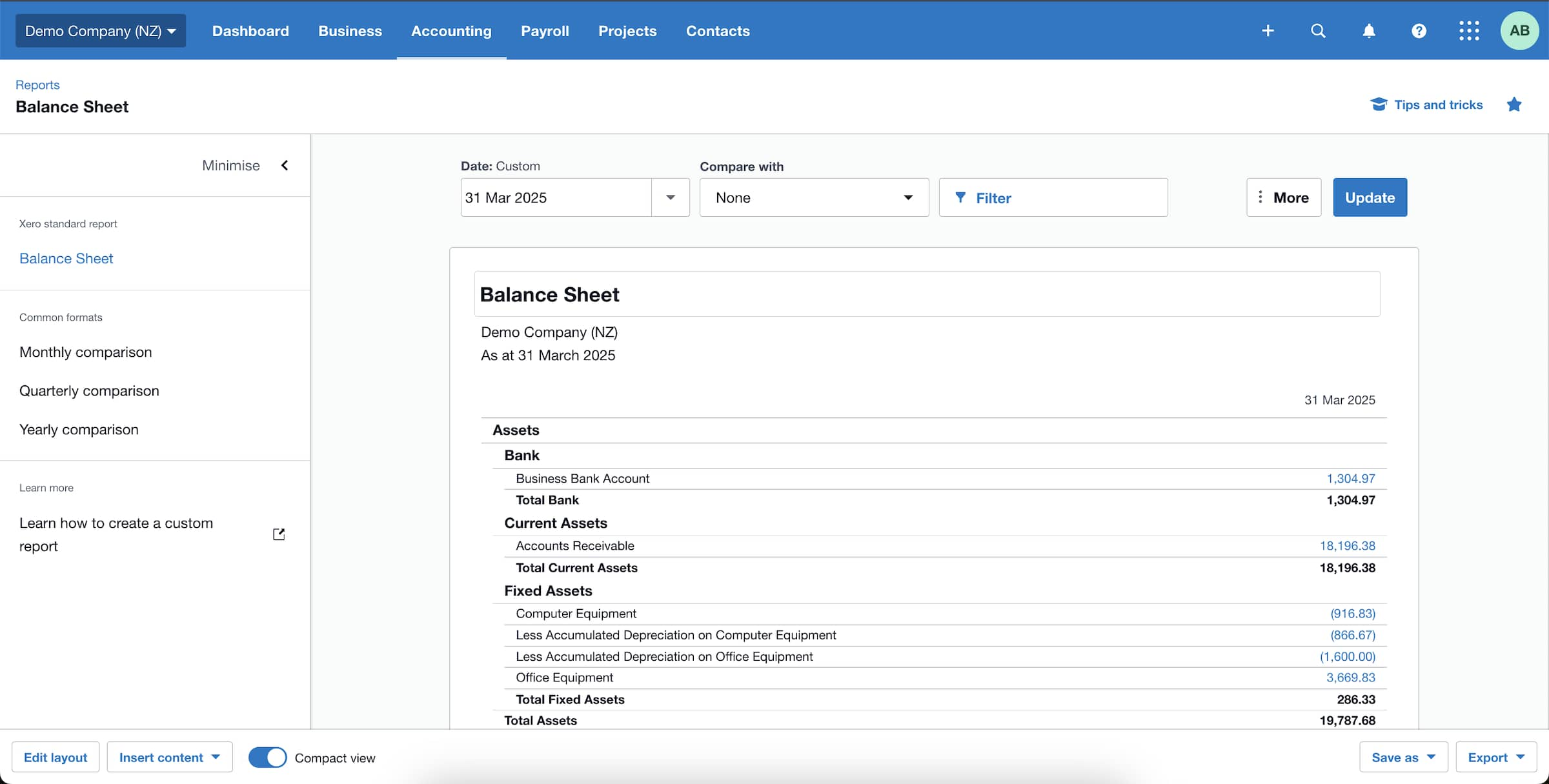
Accumulated depreciation on the balance sheet
The balance sheet shows the asset’s cost, less the contra balance, to give net book value. As the balance grows, the asset’s carrying value falls towards its residual value.
Depreciation on the profit and loss statement
Each period’s depreciation charge appears as an expense on your profit and loss statement, reducing reported profit. It’s a non-cash expense, so profit falls without money leaving the business.
Irish tax rules treat it differently. Revenue doesn’t allow a deduction for accounting depreciation, so you add it back and claim capital allowances on qualifying assets instead. For plant and machinery, the wear and tear allowance is 12.5% a year over eight years.
Depreciation on the cash flow statement
Under the indirect method, the cash flow statement starts with profit and adds depreciation back. That adjustment reverses a charge that lowered profit without any cash going out.
Why understanding accumulated depreciation matters for a business
Knowing this figure shows you what your fixed assets are worth and when they’re likely to need replacing. It helps you:
- plan replacements before key equipment wears out, and build the cost into your cash flow forecast
- report realistic asset values when you apply for a loan or meet investors
- value your business accurately if you plan to sell or bring in a partner
- keep your tax computation accurate by adding back depreciation and claiming capital allowances
Simplify your depreciation tracking with Xero
Keeping depreciation records up to date is quicker when your software does the maths for every asset, useful life and method. With Xero, you can register each asset and run depreciation automatically, so your balance sheet and profit and loss statement stay current.
You’ll spend less time on spreadsheets and more time running your business. Try it for yourself and get one month free.
FAQs on accumulated depreciation
These answers cover the questions that come up most once you start recording depreciation.
How does accumulated depreciation affect cash flow?
Recording depreciation moves no cash, so your bank balance stays the same. The cash leaves when you buy the asset, and that payment appears under investing activities in your cash flow statement.
What happens to accumulated depreciation when you sell an asset?
Remove the asset’s cost and its contra balance from the balance sheet, then record sale price minus net book value as a gain or loss. Selling the coffee machine for €3,000 after three years, for example, gives a €240 gain.
Is accumulated depreciation a debit or a credit?
It carries a credit balance, which offsets the debit balance of the asset it relates to. You only debit the account when you dispose of the asset and clear the balance.
Is accumulated depreciation a current liability?
It isn’t a liability at all, because it’s a contra asset and involves no money owed. Debts due within 12 months are current, and this glossary entry on liability types explains how they differ from longer-term debts.
Disclaimer
Xero does not provide accounting, tax, business or legal advice. This guide has been provided for information purposes only. You should consult your own professional advisors for advice directly relating to your business or before taking action in relation to any of the content provided.
Start using Xero for free
Access Xero features for 30 days, then decide which plan best suits your business.