How to choose dropshipping suppliers for your store
Find trusted dropshipping suppliers fast, cut admin, and protect your margins.
Written by Jotika Teli—Certified Public Accountant with 24 years of experience. Read Jotika's full bio
Published Wednesday 1 April 2026
Table of contents
Key takeaways
- Research potential suppliers thoroughly by requesting product samples, checking customer reviews, and verifying shipping times before committing to any partnership.
- Choose between manufacturers for lower prices with bulk requirements or wholesalers for lower risk with no minimum orders, with wholesalers being safer for new dropshippers.
- Evaluate suppliers based on six key criteria: product quality and consistency, shipping speed and reliability, communication and support, pricing and fees, platform integration, and return policies.
- Consider using multiple suppliers to offer a wider product range and reduce dependency on a single source, though this requires more coordination and quality control.
What are dropshipping suppliers and companies?
Understanding the difference between suppliers and companies helps you choose the right partners for your business.
- Dropshipping suppliers: Provide products directly and ship them to your customers on your behalf
- Dropshipping companies: Connect you to multiple suppliers through a single platform or directory
Your supplier acts as your behind-the-scenes partner, handling storage, packaging, and delivery so you can focus on growing your store.
Here's how the dropshipping process works:
- A customer purchases a product from your online store.
- You forward the order details to your supplier.
- The supplier packages and ships the product directly to the customer.
- The customer receives the product with your branding.
This hands-off fulfilment model lets you sell products without holding inventory.
Companies that dropship
Dropshipping companies like SaleHoo and Spocket act as supplier directories, connecting you to thousands of products and vetted suppliers in one place.
Suppliers fall into two main categories:
- Manufacturers: produce and sell products directly, often at lower prices but typically require bulk purchases upfront
- Wholesalers: buy from manufacturers and resell to retailers, offering lower risk with no minimum orders but higher per-unit costs
For new dropshippers, wholesalers are often the safer choice because you can test products without committing to large inventory purchases.
What to look for in a dropshipping supplier
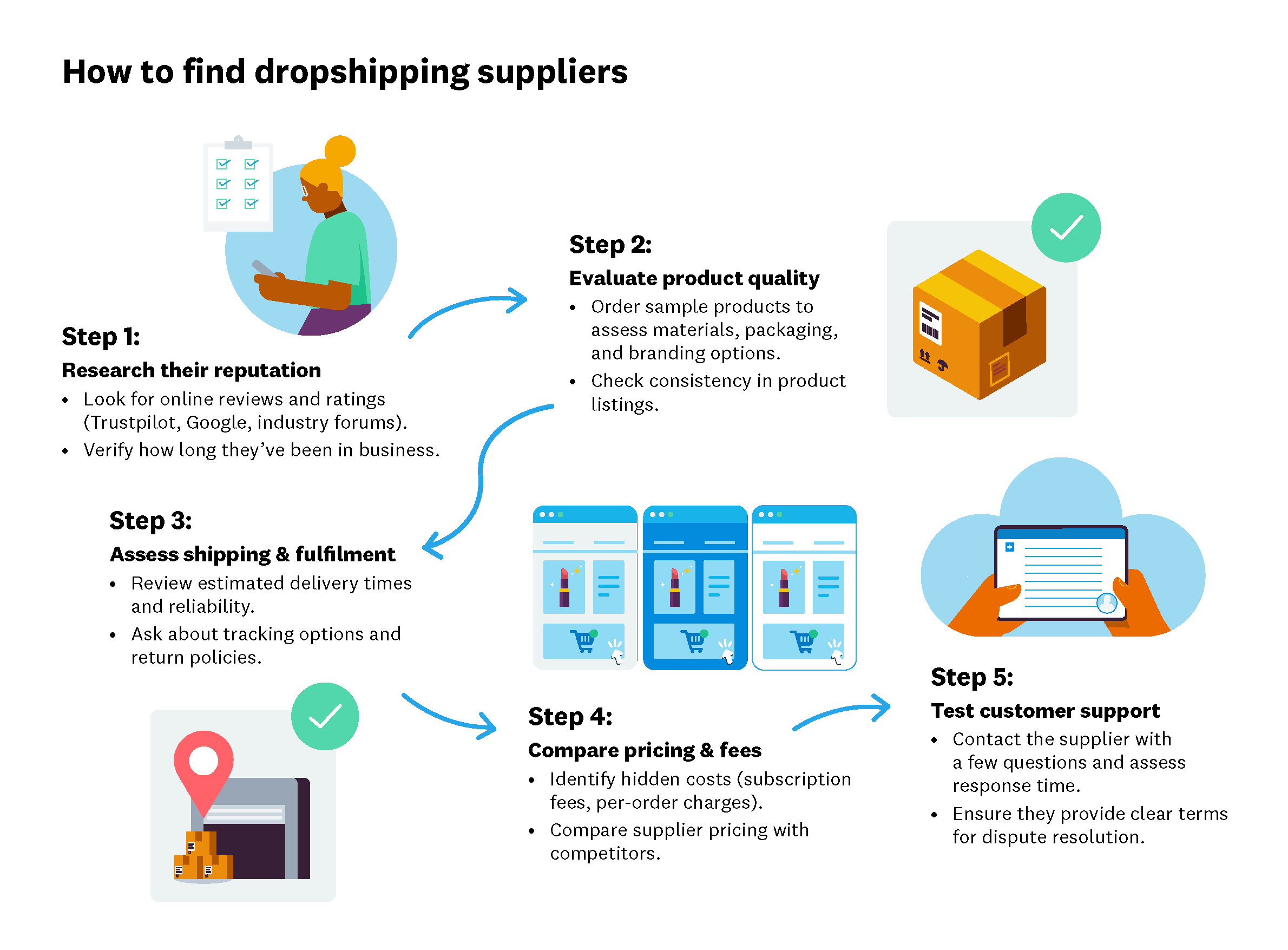
Choosing the right supplier affects your product quality, delivery times, and customer satisfaction. Research from Baymard Institute shows 21% of shoppers abandon their cart if delivery times look slow. Evaluate potential suppliers against these criteria before committing.
Product quality and consistency
Assess these factors when evaluating product quality:
- Request samples before listing products in your store
- Check customer reviews for quality complaints, as they are trusted 12 times more than a manufacturer's product descriptions
- Ask about quality control processes
Shipping speed and reliability
Check these shipping factors:
- Confirm average delivery times to your target markets
- Ask about tracking capabilities and shipping partners
- Check policies for lost or damaged shipments
Communication and support
Evaluate supplier communication:
- Test response times before signing up
- Confirm available support channels and hours
- Ask about order status updates and notifications
Pricing and fees
Review pricing structures:
- Compare per-unit costs across similar suppliers
- Check for hidden fees like handling or packaging charges
- Understand minimum order requirements
Platform integration
Confirm technical compatibility:
- Verify compatibility with your ecommerce platform
- Check if inventory syncs automatically
- Ask about order automation capabilities
Return and refund policies
Clarify return procedures:
- Understand who handles customer returns
- Check refund timelines and restocking fees
- Confirm policies for defective products
Best dropshipping companies
The best dropshipping companies offer vetted suppliers, reliable shipping, and easy integration with your ecommerce platform. Before choosing a supplier, check online reviews for product quality, delivery times, and customer service.
Here's a breakdown of top dropshipping companies, including their pros, cons, and platform compatibility.
SaleHoo
SaleHoo offers two services for dropshippers: a supplier directory with over 8,000 pre-vetted suppliers, and a Shopify integration for direct product imports.
Here are the advantages of using SaleHoo:
- Product selection: Access to 2.5 million products across multiple categories
- Supplier vetting: SaleHoo verifies all suppliers before listing
- Import flexibility: 500 products on the Basic plan or unlimited on Premium
Consider these drawbacks:
- Limited plans: Only Basic or Premium options available
- No onboarding support: Basic plan lacks a dedicated account manager
- No free trial: You must commit before testing the platform
Spocket
Spocket connects you to suppliers you can filter by location, with no commission fees. You pay only for products sold plus a monthly subscription.
Here are the advantages of using Spocket:
- Sample ordering: Test product quality before committing to a supplier
- Platform integrations: Works with Shopify, BigCommerce, WooCommerce, and Wix
- Supplier vetting: Spocket verifies all suppliers before listing
- Support access: 24/7 chat support included on all plans
Consider these drawbacks:
- Product limits: Starter plan restricts you to 25 unique products
- No direct contact: Spocket manages all supplier communication on your behalf
AliExpress
AliExpress is a marketplace owned by Alibaba, offering over 100 million products from suppliers worldwide. It's a popular choice for dropshippers seeking variety and low upfront costs.
Here are the advantages of using AliExpress:
- No subscription fees: Pay only for products you order
- Platform compatibility: Integrates with Shopify, WooCommerce, and DSers
- Low wholesale prices: Potential for higher profit margins on each sale
Consider these drawbacks:
- Research required: Finding quality products takes significant time
- Longer shipping times: Many suppliers are based in Asia, which dominated the dropshipping market with a share of over 35% in 2024, potentially extending delivery windows
- Supplier verification: You must vet suppliers yourself to avoid scams
Worldwide Brands
Worldwide Brands is a supplier directory established in 1999, offering access to verified wholesalers and over 16 million products.
Here are the advantages of using Worldwide Brands:
- Supplier verification: Worldwide Brands vets all suppliers before listing
- Product range: Access to 16+ million verified wholesale products
- One-time fee: Lifetime membership with no recurring subscription costs
FAQs on dropshipping suppliers
Here are answers to common questions about choosing and working with dropshipping suppliers.
How do I find reliable dropshipping suppliers?
Start by researching supplier directories like SaleHoo, Spocket, or Worldwide Brands. Request product samples, check customer reviews, and verify shipping times before committing to any supplier.
What's the difference between dropshipping suppliers and companies?
Dropshipping suppliers provide and ship products directly to your customers. Dropshipping companies connect you to multiple suppliers through a single platform or directory.
How much does it cost to work with dropshipping suppliers?
Costs vary by supplier. Some charge monthly subscription fees, while others operate on a per-order basis. Check for hidden fees like handling charges, packaging costs, or minimum order requirements.
Can I use multiple dropshipping suppliers?
Yes, using multiple suppliers lets you offer a wider product range and reduces dependency on a single source. However, managing multiple suppliers requires more coordination and quality control.
How long does dropshipping delivery take?
Delivery times depend on supplier location and shipping methods. Domestic suppliers typically deliver within 3-7 days, while international suppliers may take 2-4 weeks or longer.
Disclaimer
Xero does not provide accounting, tax, business or legal advice. This guide has been provided for information purposes only. You should consult your own professional advisors for advice directly relating to your business or before taking action in relation to any of the content provided.
Start using Xero for free
Access Xero features for 30 days, then decide which plan best suits your business.