Profit margin: definition, types, and how to calculate
Learn how profit margin guides pricing and costs, and see simple steps to calculate and improve yours.
Written by Jotika Teli—Certified Public Accountant with 24 years of experience. Read Jotika's full bio
Published Monday 23 February 2026
Table of contents
Key takeaways
- Calculate all three profit margin types (gross, operating, and net) to get a complete picture of your business performance, as each reveals different insights about production efficiency, operational effectiveness, and overall profitability.
- Track your profit margin trends monthly rather than focusing on single numbers, since rising or falling patterns reveal more about your business health than any standalone percentage.
- Increase your profit margins by controlling costs through supplier negotiations and subscription audits, improving operational efficiency with automation and staff training, and adjusting pricing strategically with gradual increases or premium tiers.
- Compare your margins against industry benchmarks to understand your competitive position, as good margins vary significantly by sector (retail averages 2-5% while professional services achieve 15-30%).
What is a profit margin?
Profit margin is the percentage of revenue your business keeps after paying expenses. While the average gross profit margin for businesses worldwide is around 36.56%, the higher your profit margin, the more money you retain from each sale.
This metric shows whether your pricing covers costs and leaves room for growth.
A strong profit margin signals your business earns enough to cover costs and generate surplus. Use your profit margin to:
- Assess financial health: See if revenue outpaces expenses.
- Spot performance gaps: Identify which products or services underperform.
- Guide cost decisions: Determine where to cut spending without hurting growth.
Profit margins vs net profit
Net profit is the dollar amount left after subtracting all expenses from revenue. Profit margin expresses that profit as a percentage of revenue.
For example, if you earn $10,000 in revenue and keep $2,000 after expenses, your net profit is $2,000 and your profit margin is 20%.
Types of profit margins
Three main types of profit margin help you understand different aspects of your business's profitability.
Gross profit margin
Gross profit margin measures the percentage of revenue remaining after subtracting the direct costs of producing your goods or services (cost of goods sold).
- What it shows: How efficiently you produce or source what you sell.
- When to use it: Setting prices, comparing product profitability, tracking production efficiency.
Operating profit margin
Operating profit margin measures the percentage of revenue left after paying production costs and operating expenses (wages, rent, utilities) but before taxes and interest.
- What it shows: How profitable your core business operations are.
- When to use it: Evaluating operational efficiency, attracting investors or lenders.
Net profit margin
Net profit margin measures the percentage of revenue remaining after all expenses, including taxes and interest.
- What it shows: Your true bottom-line profitability.
- When to use it: Assessing overall financial health, comparing performance across periods.
For a deeper dive, learn more about net profit margin.
How the three margins work together
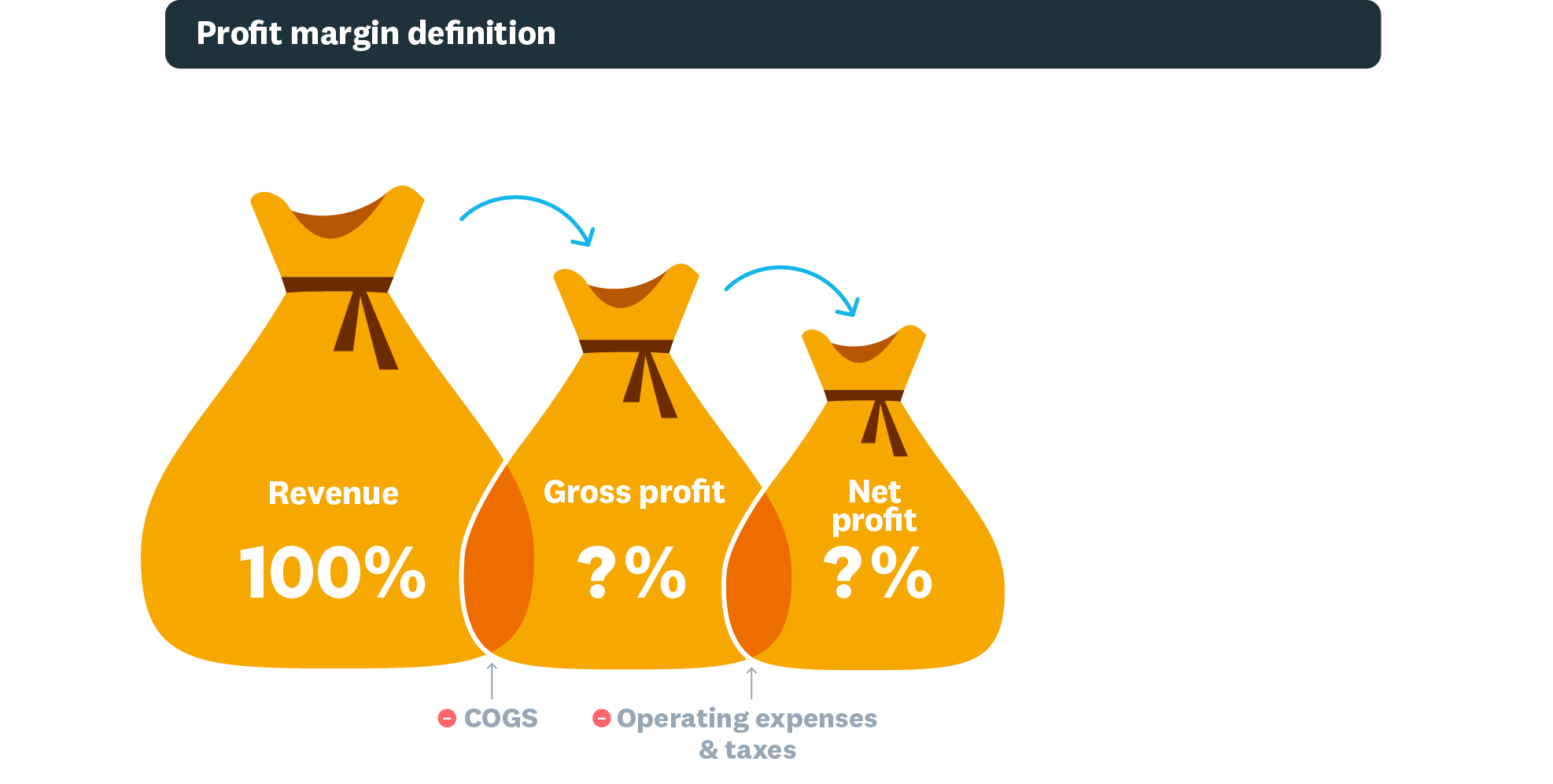
The three margin types build on each other, giving you progressively deeper insight into profitability.
Gross margin shows production efficiency. Operating margin reveals how well you run day-to-day operations. Net margin shows your true bottom line.
If your gross margin is healthy but net margin is weak, look at operating expenses or tax efficiency. If gross margin is low, focus on production costs or pricing.
How to calculate profit margins
Calculate any profit margin using this formula:
Profit margin = (Profit ÷ Revenue) × 100
The result is a percentage that makes it easy to compare performance across periods or against competitors.
Gross profit margin calculation
Formula: (Revenue − Cost of goods sold) ÷ Revenue × 100
Example: Your cleaning business earns $20,000 in revenue. It costs $8,000 to provide those services.
- Gross profit: $20,000 − $8,000 = $12,000
- Gross profit margin: $12,000 ÷ $20,000 × 100 = 60%
Net profit margin calculation
Formula: (Revenue − All expenses) ÷ Revenue × 100
Example: Using the same cleaning business with $20,000 revenue, $8,000 in service costs, and $4,000 in taxes:
- Net profit: $20,000 − $8,000 − $4,000 = $8,000
- Net profit margin: $8,000 ÷ $20,000 × 100 = 40%
Operating profit margin calculation
Formula: (Revenue − Cost of goods sold − Operating expenses) ÷ Revenue × 100
Example: Your cleaning business has $20,000 revenue, $8,000 in service costs, and $3,000 in operating expenses (wages, supplies, utilities):
- Operating profit: $20,000 − $8,000 − $3,000 = $9,000
- Operating profit margin: $9,000 ÷ $20,000 × 100 = 45%
Note: Operating profit margin excludes taxes and interest, showing how well your core operations perform.
Why do profit margins matter?
Profit margins reveal your business's financial health by showing how much income you keep relative to what you spend. They matter because they directly influence key business decisions.
Use profit margins to:
- Set prices: Ensure your pricing covers costs and delivers target returns.
- Control costs: Identify where expenses eat into profits.
- Allocate resources: Prioritise products or services with stronger margins.
- Secure funding: Banks and investors evaluate margins when deciding to lend or invest.
What is a good profit margin?
A "good" profit margin varies by industry, business model, and margin type. Here are typical net profit margin ranges:
- Retail: 2–5%
- Restaurants and hospitality: 3–9%, as full‐service restaurants average 3–5% while fast-casual concepts can reach 6–9%
- Professional services (consulting, accounting): 15–30%, as a healthy net profit margin for this sector typically falls within this range
- Software and technology: 15–25% (net profit), though gross margins are much higher, as software makers average about 71.52%
- Manufacturing: 5–10%
Your gross profit margin will always be higher than your net margin because it doesn't include operating expenses or taxes. Net profit margin gives you the clearest picture of overall financial health.
Compare your margins to industry averages and track changes over time rather than focusing on a single "ideal" number.
Benefits of high profit margins for growth
High profit margins typically mean a business:
- Attracts investment more easily: Strong margins signal financial stability to lenders and investors.
- Reinvests in growth: Surplus funds can go toward hiring, equipment, or expansion.
- Experiments with pricing: Healthy margins give you room to test discounts or premium offerings.
Benchmark your margins against competitors in your industry to see where you stand. Track your margins monthly to spot trends before they become problems.
Do high profit margins guarantee growth?
High profit margins alone won't guarantee growth. Research from Yale Insights found that margins don't necessarily rise as businesses expand. An analysis of U.S. companies that have gone public since 1974 revealed that even during periods of high growth, firms kept profit margins flat.
Rapid growth can actually shrink margins if short-term costs spike. Prioritise sustainable growth and factor profit margins into every strategic decision.
Factors affecting profit margins
Several factors influence your profit margins, some within your control and others not.
External factors:
- Industry type: Retail and hospitality typically have thinner margins than consulting or software businesses.
- Economic conditions: Inflation and rising interest rates increase costs across the board.
- Interest rates: If you've borrowed to fund operations, rate increases directly reduce margins.
- Location: Rent and local taxes vary significantly and affect your cost structure.
Internal factors:
- Pricing strategy: How you price products relative to costs.
- Operational efficiency: How well you manage labour, inventory, and overhead.
- Product mix: Which products or services you emphasise.
Analyse your profit margins for better business decisions
Use profit margin data to make smarter business decisions:
- Adjust pricing: Identify which products deliver strong margins and which need price increases.
- Allocate budget: Direct resources toward higher-margin products or services.
- Guide investments: Expand the most profitable parts of your business.
- Evaluate performance: Compare margins across products, services, or time periods.
What profit margin trends reveal
Profit margin trends show how your profitability changes over time. Tracking trends matters more than any single number.
What different trends indicate:
- Rising margins: Improving efficiency, successful price increases, or falling costs.
- Falling margins: Rising costs, pricing pressure, or operational inefficiencies.
- Stable margins: Consistent performance, though may signal missed improvement opportunities.
Compare your trends against industry benchmarks and competitors to understand your market position. A 10% margin that's growing is often healthier than a 15% margin that's shrinking.
How to increase your profit margins
Increasing your profit margin means keeping more of each dollar you earn. Focus on three main levers: reducing costs, improving efficiency, and adjusting pricing.
Control your costs
Reducing expenses directly increases your profit margin. Start with these tactics:
- Audit subscriptions: Cancel software or services you no longer use.
- Negotiate with suppliers: Request better rates or explore alternative vendors.
- Review labour costs: Match staffing levels to demand and reduce overtime, which is critical since labour is often the second-largest expense for a business.
- Cut waste: Identify materials, inventory, or processes that drain resources.
Make your operations more efficient
Improving efficiency means producing more value with the same resources. Try these approaches:
- Automate repetitive tasks: Use software to handle invoicing, scheduling, or inventory tracking.
- Train your team: Skilled employees work faster and make fewer costly mistakes.
- Streamline processes: Identify bottlenecks that slow production or service delivery.
- Reduce errors: Mistakes cost time and money to fix.
Adjust your pricing
Strategic pricing directly impacts your margin. Consider these approaches:
- Raise prices gradually: Small increases (2–5%) add up over time and are a common strategy to combat inflation, with one survey finding 82% of operators were raising menu prices.
- Use dynamic pricing: Adjust prices based on demand, season, or inventory levels.
- Create premium tiers: Offer upgraded versions at higher price points.
- Bundle products or services: Combine offerings to increase average transaction value.
- Review pricing regularly: Costs change, so your prices should too.
Learn more about pricing strategies.
Learn from high-profit-margin businesses
Some businesses consistently achieve higher margins than their competitors. Three factors set them apart:
- Clear value proposition: Customers understand exactly why they should buy.
- Operational efficiency: Streamlined processes minimise waste and overhead.
- Customer loyalty: Repeat customers cost less to serve than acquiring new ones.
Industries with high profit margins
Industries with typically high profit margins include:
- Software and technology: Low marginal costs after development (15–25% net margins).
- Luxury goods: Premium pricing supports strong margins despite lower volume.
- Professional services: Minimal inventory and low overhead costs.
- Online businesses: No physical storefront reduces rent and staffing costs.
Your business model matters as much as your industry. Online businesses often outperform bricks-and-mortar competitors on margins because they have lower fixed costs.
Tips for maintaining high profit margins
Apply these practices from high-margin businesses, regardless of your industry:
- Communicate your value clearly: Help customers understand why you're worth the price.
- Streamline operations: Eliminate waste and use resources efficiently.
- Build customer loyalty: Repeat customers cost less to acquire and often spend more over time.
Learn more about creating a value proposition and building loyalty programmes.
Use Xero for comprehensive profitability insights
Understanding your profit margins puts you in control of your business's financial future. Whether you're setting prices, cutting costs, or proving your value to lenders, your margins tell the story.
Xero gives you real-time visibility into your profit margins through automated reporting and easy-to-understand dashboards. Track performance over time, spot trends early, and make confident decisions backed by accurate data.
Get one month free and see how Xero simplifies profit tracking for your small business.
FAQs on profit margin
Here are answers to common questions about profit margin and what your numbers mean.
What does a 20% profit margin mean?
A 20% profit margin means you keep 20 cents as profit from every dollar of revenue. On $100,000 in sales, you'd have $20,000 in profit after expenses.
What does a 30% profit margin mean?
A 30% profit margin means you retain 30 cents from every dollar earned. This is generally considered strong for most industries, though benchmarks vary.
What's the difference between profit margin and markup?
Profit margin is profit as a percentage of revenue (selling price). Markup is profit as a percentage of cost. A 50% markup on a $10 item means you sell it for $15, but your profit margin is only 33%.
How often should I calculate my profit margin?
Calculate profit margins monthly to spot trends early. Review quarterly and annually for bigger-picture analysis. Accounting software like Xero can automate this tracking.
Can I have a high profit margin but still run out of cash?
Yes. Profit margin measures profitability on paper, while cash flow tracks actual money in your bank. You can be profitable but cash-poor if customers pay slowly or you've invested heavily in inventory. Track both metrics together.
Disclaimer
Xero does not provide accounting, tax, business or legal advice. This guide has been provided for information purposes only. You should consult your own professional advisors for advice directly relating to your business or before taking action in relation to any of the content provided.