How to recession-proof your business
Practical strategies to protect your small business from economic downturns and build lasting resilience.
Published Friday 5 June 2026
Table of contents
Key takeaways
- A recession-proof business isn't immune to downturns, but it has the cash reserves, diversified income, and operational discipline to weather them. Building resilience starts well before conditions worsen.
- Cash flow visibility is the single most important factor in surviving a downturn. Forecasting regularly, chasing receivables promptly, and maintaining three to six months of reserves can mean the difference between closing and recovering.
- Cutting costs during a slowdown requires precision. Trim discretionary spending first and protect the people, services, and relationships that generate revenue.
- Downturns create openings for prepared businesses. Those that invest in technology, deepen customer loyalty, and keep financial data up to date tend to emerge stronger than competitors who freeze.
What is a recession-proof business?
No business is truly immune to an economic downturn, but some are far more resilient than others. A recession-proof business is one that can maintain stable demand and healthy cash flow even when broader economic conditions deteriorate.
Certain sectors historically hold up well during recessions. Healthcare, education, essential food retail, and home maintenance tend to see consistent demand. Accounting and financial services also remain steady. These industries sell necessities that people and businesses can't easily defer.
But what if you already run a business outside those sectors? Resilience isn't only about what you sell. It's also about how you manage your finances, serve your customers, and adapt your operations. The strategies below apply to any industry.
What's the difference between a recession and a slowdown?
Understanding the difference helps you calibrate your response. A slowdown is a period of reduced economic growth where output is still expanding, just at a slower pace. A recession is more severe: it typically involves two or more consecutive quarters of negative gross domestic product (GDP) growth, rising unemployment, and falling consumer spending.
Marc Cowling, Professor of Economics and Productivity at Oxford Brookes University, puts the broader cycle in perspective:
"Recessions, for example, are felt for about 12-18 months, then they're followed by a 2-year recovery, a 4-year boom, a year of overheating, and then a new recession."
For Hong Kong's trade-dependent economy, external shocks can accelerate this cycle. In 2025 and 2026, global trade tensions and tighter monetary policy have kept growth subdued across Asia-Pacific. Shifting supply chains add further pressure. Hong Kong's GDP growth has remained modest, and small businesses face compressed margins alongside cautious consumer spending.
Whether you're facing a full recession or a prolonged slowdown, the strategies below apply. The key difference is urgency: in a slowdown you have time to prepare; in a recession you need to act immediately.
What happens to small businesses during an economic downturn?
Downturns hit small businesses harder than large corporations. With thinner margins, fewer reserves, and less access to capital, small business owners often feel the impact before official data confirms a recession.
Louise Southall, Xero Economist, notes that the effects show up quickly in day-to-day operations:
"Sales drop. Customers delay purchases. Existing orders are cancelled or scaled back."
The knock-on effect is that cash dries up fast. Grant Anderson, a small business advisor, explains the reality on the ground:
"Cash dries up very quickly for small businesses. The customers who owe you money start paying slower, but your own bills don't stop."
In Hong Kong, where many small businesses operate with tight working capital and rely on cross-border trade, these pressures compound. Data from the Hong Kong Census and Statistics Department shows that small and medium enterprises account for over 98% of local business establishments. Their collective resilience is critical to the broader economy.
Late payments from overseas buyers, rising rents, and reduced foot traffic can all converge at once. The businesses that survive are those that spot the warning signs early and take action before the squeeze becomes critical.
How to recession-proof your business
Recession-proofing is about combining financial discipline with strategic decisions and flexible operations. Here are 10 practical strategies to strengthen your business against economic uncertainty.
1. Strengthen your cash flow and build reserves
Cash flow is the lifeblood of any business, and it becomes even more critical during a downturn. Start by building a rolling cash flow forecast that projects your inflows and outflows over the next 13 weeks at minimum. This gives you an early warning system for gaps before they become emergencies.
Most small businesses operate with dangerously thin buffers. As Marc Cowling observes:
"Most small businesses only hold enough cash to run for 2-3 months."
Industry data underscores the challenge. A 2025 Federal Reserve Small Business Credit Survey found that 51% of small businesses struggle with uneven cash flows. A further 56% report difficulty meeting operating expenses.
Aim to build reserves covering three to six months of essential operating expenses. That may sound ambitious, but even one additional month of runway can give you time to adjust rather than react in crisis mode.
Grant Anderson recommends making forecasting a habit, not a one-off exercise:
"Review your cash flow forecast weekly. And make sure you've got flexibility in your debt arrangements so you can draw down if things tighten."
Xero's cash flow monitoring tools can help you track receivables, payables, and cash position in real time, so you're never guessing where you stand.
2. Diversify your revenue streams
Relying on a single product, service, or customer segment is one of the biggest risks a small business can carry into a downturn. When that one source contracts, everything contracts with it.
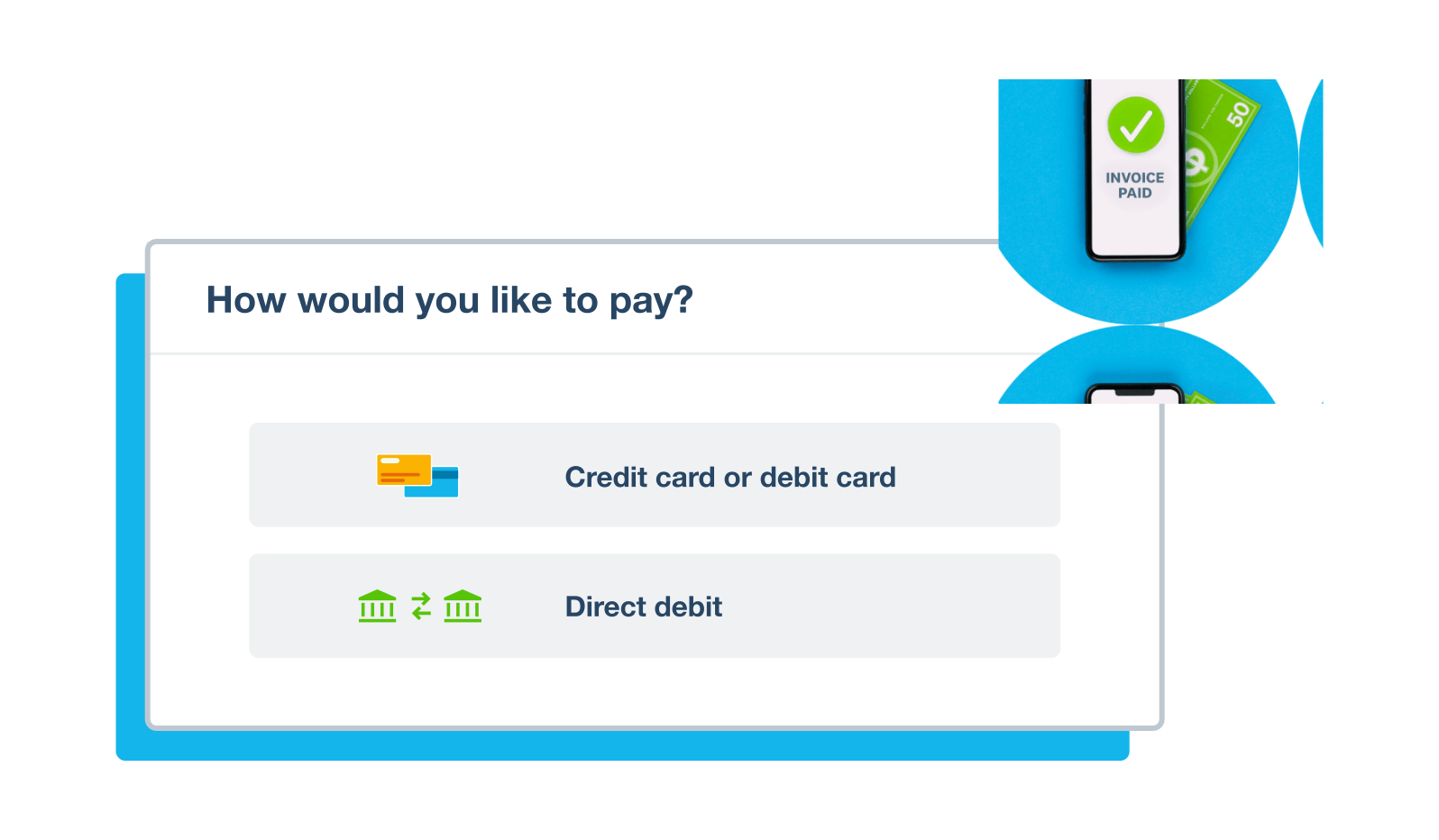
Online invoices allow customers to click straight through and pay instantly, which can reduce wait times for the vendor.
Look for complementary products or services you can offer to your existing customer base. A design agency might add templated packages alongside bespoke work. A food supplier might add direct-to-consumer options alongside wholesale. The goal is to create multiple paths to revenue so that a drop in one area doesn't bring the entire business to a halt.
Resources like the Trade and Industry Department can help you identify new markets and customer segments. Recurring revenue models are especially valuable during uncertainty. Subscriptions, retainers, and maintenance contracts provide predictable cash flow that makes forecasting more reliable. If any single customer accounts for more than 20% of your revenue, actively work to reduce that concentration risk.
3. Protect and deepen customer relationships
Your existing customers are your most valuable asset during a downturn. Acquiring new customers costs significantly more than retaining current ones, and loyal customers are more likely to stick with you when they're cutting their own spending.
Reach out proactively to ask how their business is going. Show genuine interest in their challenges, not just their purchase orders. Small gestures build the kind of loyalty that survives economic pressure.
Mark Koziel, CEO of the American Institute of Certified Public Accountants (AICPA) & the Chartered Institute of Management Accountants (CIMA), suggests practical ways to strengthen those bonds:
"Introduce locals packages or customer appreciation days. Find small, meaningful ways to show your existing customers they matter. That loyalty pays back many times over during tough periods."
Loyalty programmes, personalised service, and responsive support all contribute to retention. The businesses that keep their customers close during a downturn are the ones that grow fastest when conditions improve.
4. Manage costs and protect margins
When revenue dips, the instinct is to slash costs across the board. But indiscriminate cutting can do more harm than good. The goal is to protect your margins while preserving the capabilities that generate revenue.
Louise Southall emphasises the importance of watching the right metrics:
"Watch your profitability measures, not just your top-line revenue. Revenue can mask declining margins if costs are rising at the same time."
Use a simple prioritisation framework. First, cut discretionary spending: non-essential subscriptions, travel, events, and marketing channels that aren't delivering measurable returns. For a deeper look at practical ways to reduce business costs, see the full cost-saving guide. Second, renegotiate fixed costs where possible: rent, insurance, supplier contracts. Third, protect customer-facing spending and your core team.
Grant Anderson warns against cutting too deep:
"I've seen people cut off the muscle with the fat. They let go of the people who actually generate revenue, or they stop marketing entirely, and then they can't recover when things pick up."
5. Address delayed payments
Late payments are one of the most common causes of small business failure during downturns. When your customers slow their payments, your own cash flow tightens immediately.
The pattern is well documented. Xero data shows that payment wait times leapt 11% after 2018 US-China trade tensions, and 15% after the first Covid outbreak. A 2025 survey of more than 2,000 small businesses found that 47% had invoices overdue by more than 30 days. Research suggests one in four business bankruptcies is linked to late invoice payments.
In Hong Kong, where many small businesses rely on cross-border receivables, those delays can be especially painful.
Tighten your invoicing process. Send invoices promptly, follow up before due dates, and make it as easy as possible for customers to pay. Louise Southall recommends reducing friction:
"Online payment options make a real difference. The easier you make it for customers to pay, the faster they do."
Xero customers who use online invoice payments get paid up to twice as fast. Xero's invoicing features let you add online payment links directly to invoices, set up automated reminders, and track outstanding amounts in real time.
6. Manage debt and secure financing early
Access to credit shrinks during downturns. Banks tighten lending criteria, and interest rates may remain elevated. The time to secure financing is before you need it, not when you're already under pressure.
Mark Koziel stresses the importance of acting early:
"Get your loan security in place now while banks are still lending. Once a recession hits, credit conditions tighten and the terms get worse."
If you already carry debt, review your terms. Look for opportunities to consolidate high-interest borrowing or renegotiate repayment schedules. The Hong Kong Monetary Authority tracks US Federal Reserve movements closely. Staying informed about rate direction helps you time refinancing decisions.
Grant Anderson recommends using your financial data as a negotiating tool:
"Share your cash flow forecast with your lender. Show them you understand your numbers and have a plan. That builds confidence and gives you better access to credit when you need it."
7. Right-size your pricing strategy
Pricing is one of the fastest ways to protect margins, yet many small business owners avoid adjusting prices during a downturn out of fear of losing customers. The reality is that well-communicated price changes are usually accepted better than you expect.
Louise Southall recommends a measured approach:
"Businesses need to right-size that increase. Don't try to absorb everything, but don't overcompensate either. Small, regular adjustments are better than one large shock."
Consider tiered pricing or bundled packages that give customers options at different price points. This lets price-sensitive customers stay with you while preserving your profit margins on premium services.
Mark Koziel points out that transparency works in your favour:
"Customers understand inflation is happening. They know costs are going up. If you explain why your prices are changing and show the value you deliver, most customers will stay."
8. Use technology to reduce costs and grow reach
Technology is one of the most effective tools for doing more with less during a downturn. Automating routine tasks frees up your time for higher-value work and reduces the cost of operations.
Cloud accounting software like Xero can help you automate bank reconciliation, invoice reminders, and expense tracking. Xero Analytics Plus provides cash flow dashboards and financial forecasts that give you real-time visibility into your business health.
AI-assisted tools are also becoming more accessible for small businesses. Xero's JAX, an AI financial superagent, can handle routine tasks, deliver insights from your financial data, and automate communications like quotes and invoices across channels including WhatsApp and email.
Beyond accounting, look at your entire technology stack. Could you replace manual processes with digital tools? Could you reach new customers through online channels you haven't explored? Downturns often accelerate digital adoption because the cost of not automating becomes harder to justify.
9. Speed up decision-making
Fast, informed decisions separate businesses that adapt from those that stall. During a downturn, conditions change quickly, and waiting for perfect information can mean missing the window to act.
The foundation of fast decision-making is reliable, up-to-date financial data. If your accounts are months behind or scattered across spreadsheets, you're making decisions in the dark.
Louise Southall highlights the role of professional advisors:
"A good accountant doesn't just do your tax return. They help you frame decisions: should I hire, should I invest, should I cut? Having someone who can interpret your numbers in context is incredibly valuable during uncertain times."
If you don't already work with an advisor, consider connecting with one through the Xero advisor directory. A qualified accountant or bookkeeper who understands your financial position can help you respond to changing conditions with confidence rather than guesswork.
10. Look for opportunities in the downturn
Downturns are difficult, but they also create openings that don't exist during boom times. Competitors may exit, asset prices may fall, and talented people may become available. The businesses that come out strongest are often those that invest strategically while others retreat.
Marc Cowling encourages business owners to look beyond survival:
"A recession is actually a good time to reorganise your business. Rethink your processes, your products, your market position. The pressure forces clarity."
Mark Koziel sees downturns as a training opportunity:
"Use the quieter periods to train your people. Upskill them. When the recovery comes, you'll have a more capable, more motivated team."
Grant Anderson points to the financial upside:
"Everything is cheaper in a downturn. Equipment, property, even acquiring competitors. If you've got the cash reserves, you can invest at a lower cost and come out ahead."
Louise Southall reinforces this with data:
"The businesses that survive recessions tend to be the most productive, most efficient ones. They come out of it leaner and better positioned than before."
Manage your business finances with Xero
Economic uncertainty demands financial clarity. Xero gives you real-time visibility into your cash flow, automates invoicing and bank reconciliation, and provides reporting tools that help you spot trends before they become problems.
Whether you're building reserves, chasing late payments, or forecasting for the months ahead, Xero keeps your finances in clear view. That means you can focus on the decisions that matter most. To see how Xero can support your business through any economic climate, get one month free.
FAQs on recession-proofing your business
Here are some frequently asked questions about recession-proofing your business.
What is a recession-proof business?
A recession-proof business is one that can maintain stable demand and healthy cash flow during an economic downturn. No business is completely immune, but those with diversified revenue, strong reserves, and loyal customer bases tend to withstand downturns far better than those reliant on a single income stream.
What types of businesses do best in a recession?
Businesses that sell essential goods and services tend to perform best. Healthcare, education, food and grocery, accounting services, and home maintenance typically see steady demand regardless of economic conditions. However, any business can improve its resilience through strong financial management and operational flexibility.
How much cash reserve should a small business keep?
Aim for three to six months of essential operating expenses. Many small businesses hold only two to three months of cash, which leaves little room to adjust if revenue drops. Even building one additional month of reserves can provide meaningful breathing space during a downturn.
What expenses should a small business cut first?
Start with discretionary spending: non-essential subscriptions, travel, events, and low-performing marketing channels. Renegotiate fixed costs like rent and supplier contracts before reducing headcount. Protect customer-facing roles and activities that directly generate revenue.
How do I retain customers during a recession?
Communicate proactively and consistently. Reach out to check how your customers are doing, not just to sell. Offer loyalty incentives, flexible payment terms, and exceptional service. Customers who feel valued during difficult times are far more likely to stay with you long term.
What's the difference between a recession and a slowdown?
A slowdown is a period of reduced economic growth where the economy is still expanding, just at a slower rate. A recession involves sustained economic contraction, typically defined as two or more consecutive quarters of negative GDP growth. Both require attention, but a recession demands faster, more decisive action.
Disclaimer
Xero does not provide accounting, tax, business or legal advice. This guide has been provided for information purposes only. You should consult your own professional advisors for advice directly relating to your business or before taking action in relation to any of the content provided.
Start using Xero for free
Access Xero features for 30 days, then decide which plan best suits your business.