How to calculate marginal cost: formula and examples
Knowing your marginal cost helps you price smarter and grow profitably. Here's how to calculate it.

Written by Lena Hanna—Trusted CPA Guidance on Accounting and Tax. Read Lena's full bio
Published Friday 27 March 2026
Table of contents
Key takeaways
- Calculate marginal cost using this formula: change in total costs divided by change in quantity produced — if the result is lower than your average cost per unit, expanding production will reduce your cost per unit and can improve your profit margins.
- Compare your marginal cost to your marginal revenue to find your most profitable production level — once the cost of producing an extra unit exceeds the income it brings in, each additional unit chips away at your profit rather than adding to it.
- Track both fixed and variable costs when calculating marginal cost, since producing more units spreads fixed costs across a larger output, which lowers your cost per unit, while variable costs rise with every unit you add.
- Spot the warning signs that expansion will hurt rather than help — if your marginal cost climbs above your selling price, you can restore profitability by renegotiating prices, cutting production or delivery costs, or shifting focus to sales channels with better margins.
What is a marginal cost?
Marginal cost is the additional expense of producing one more unit of a product or service. This metric helps you understand whether increasing production will boost or hurt your profits.
When you're considering expansion, marginal cost reveals the true financial impact. You can assess short-term cash flow needs and weigh longer-term factors like market demand and pricing.
Calculating your marginal cost is the first step in any growth decision.
Why is marginal cost important to grasp?
Marginal cost matters because it guides two key business decisions: how much to produce and what price to charge.
Understanding this metric helps you:
- Set optimal production levels: Grow too little and you miss the chance to spread fixed costs across more units. Grow too much and your costs may outpace your revenue.
- Build smarter pricing strategies: Knowing your cost per additional unit helps you price products to maximise revenue.
- Plan for sustainable growth: You can weigh expansion opportunities against real cost data instead of guessing.
What are the main components of marginal cost?
To calculate marginal cost, you need to track all production expenses. These fall into two categories:
- Variable costs: expenses that rise or fall with output levels. Examples include raw materials, hourly wages, and energy bills. When you produce more units, these costs increase.
- Fixed costs: expenses that stay the same regardless of output. Examples include machinery, rent, and salaries. Producing more units spreads these costs across a larger output, which lowers your cost per unit.
Understanding both cost types helps you accurately measure how your total costs change when production increases.
What is the formula for marginal cost?
The marginal cost formula shows how your total costs change when you produce one additional unit.
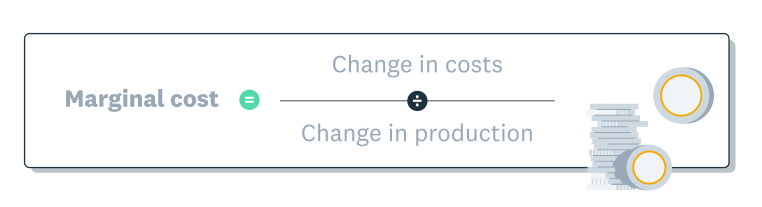
Marginal Cost = Change in Total Costs ÷ Change in Quantity
Here's what each part means:
- Change in total costs: The difference between your production costs at two output levels.
- Change in quantity: The number of additional units produced (often just one).
For example, if producing 101 units costs $1,010 and producing 100 units costs $1,000, your change in total costs is $10. Divide by the one extra unit to get a marginal cost of $10.
The benefits of calculating marginal cost
Comparing marginal cost to your average cost of production reveals whether expanding output makes financial sense.
- Marginal cost is lower than average cost: Producing more units will reduce your overall cost per unit and can increase profit margins.
- Marginal cost is higher than average cost: Producing more units will raise your overall cost per unit. In this case, maintaining current production levels is usually the better choice.
Marginal cost example
Here's how the formula works in practice.
Mohammed runs a bakery and wants to know if he should increase production. He currently makes 100 cakes at a total cost of $1,000 ($10 per cake). Producing 101 cakes would cost $1,005.
- Calculate the change in total costs: $1,005 – $1,000 = $5.
- Calculate the change in quantity: 101 – 100 = 1 cake.
- Apply the formula: $5 ÷ 1 = $5 marginal cost.
The result: Mohammed's marginal cost of $5 is lower than his average cost of $10 per cake. Expanding production would reduce his cost per unit and potentially increase his profit.
How to calculate marginal cost
Follow these steps to calculate your marginal cost and apply it to production decisions.
- Determine your current total production costs: Add up all fixed and variable costs at your current output level, including materials, labour, utilities, and any other expenses tied to production.
- Calculate total costs at a higher production level: Estimate what your costs would be if you produced one or more additional units, factoring in any extra materials, labour hours, or equipment usage.
- Find the change in total costs: Subtract your current total costs from the projected total costs at the higher output level.
- Determine the change in quantity: Note how many additional units you're considering producing.
- Divide the change in costs by the change in quantity: This gives you your marginal cost per unit.
- Compare to your selling price and average cost: If your marginal cost is below both, increasing production could boost profits. If it exceeds your selling price, producing more units would reduce your margins.
Why you should calculate your marginal cost accurately
Accurate marginal cost calculations help you make smarter business decisions. Here's how:
- Set profitable prices: Find the price point where customers will buy and your margins stay healthy.
- Choose optimal production levels: Determine whether producing additional units will increase or decrease your profit per unit.
- Allocate resources wisely: Decide which products to prioritise, when to invest in equipment, and how to use capacity most effectively.
- Avoid costly mistakes: Spot when expansion would push costs higher than revenue before committing resources.
Marginal cost and marginal revenue
Understanding both marginal cost and marginal revenue helps you find your most profitable production level. Here's how the two concepts differ:
- Marginal cost: The additional expense of producing one more unit.
- Marginal revenue: The additional income from selling one more unit.

Marginal Revenue = Change in Total Revenue ÷ Change in Quantity
The profit-maximising point: Your profits are highest when marginal cost equals marginal revenue. Beyond this point, each additional unit costs more to produce than it brings in, reducing your overall profit.
When marginal cost exceeds marginal revenue, each additional unit reduces your profit. For example, if selling an extra wallet brings in $20 but costs $22 to produce and deliver, the transaction reduces your profit by $2.
To restore profitability, you can:
- Negotiate higher selling prices
- Reduce production or delivery costs
- Focus on sales channels with better margins
Simplify cost tracking with Xero
Tracking the costs you need for marginal cost calculations is easier with the right tools. Xero accounting software gives you real-time visibility into your expenses, so you always have accurate data for production decisions.
With Xero, you can:
- Track variable and fixed costs automatically: See exactly where your money goes without manual data entry.
- Generate custom reports: Break down costs by product, project, or time period.
- Collaborate with your accountant: Share data in one central place for faster insights.
Try Xero free for one month and see how easy cost management can be. Get one month free
FAQs on marginal cost
Here are answers to common questions about calculating and applying marginal cost in your business.
What causes marginal cost to increase?
Marginal cost increases when the expense of producing additional units rises faster than expected. Common causes include:
- Rising labour costs: Overtime pay or hiring temporary staff at premium rates.
- Production inefficiencies: Using more expensive suppliers or experiencing equipment slowdowns.
- Capacity limits: Needing new equipment, larger premises, or additional staff to expand beyond current output levels.
What's the difference between marginal cost and average cost?
Marginal cost measures the expense of producing one additional unit. Average cost measures your total production costs divided by the number of units produced.
Use marginal cost to decide whether to increase output. Use average cost to assess overall production efficiency and set baseline pricing.
When should I calculate marginal cost?
Calculate marginal cost any time you're weighing a production decision. That includes expanding output, adjusting prices, planning a capacity investment, or deciding whether to take on a large order. If the question is whether producing more makes financial sense, marginal cost gives you the answer.
How does marginal cost affect profitability?
Marginal cost directly shapes your profit margins on every additional unit you produce. When your marginal cost stays below your selling price, each extra unit adds to your profit. When it climbs above your selling price, each extra unit chips away at it, which is why tracking this number regularly matters as your production levels change.
Disclaimer
Xero does not provide accounting, tax, business or legal advice. This guide has been provided for information purposes only. You should consult your own professional advisors for advice directly relating to your business or before taking action in relation to any of the content provided.
Start using Xero for free
Access Xero features for 30 days, then decide which plan best suits your business.