Online business ideas: how to choose and get started
Learn practical online business ideas to start today and grow revenue with less admin.

Written by Lena Hanna—Trusted CPA Guidance on Accounting and Tax. Read Lena's full bio
Published Monday 30 March 2026
Table of contents
Key takeaways
- Validate your business idea by researching existing demand through online marketplaces, social media trends, and crowdfunding platforms before investing time or money into development.
- Choose a business model that matches your current situation by considering your available time, startup budget, existing skills, and risk tolerance rather than chasing the most popular options.
- Compete with larger brands by focusing on authenticity and personal connection, including your unique story in your branding and adding personal touches like handwritten notes in packaging.
- Target niche markets to reduce competition and serve specific customer needs, as the internet allows you to reach customers worldwide who share particular interests or requirements.
Where to find online business ideas and inspiration
Online business inspiration comes from observing what people are already buying, creating, and talking about. These sources help you spot trends, validate demand, and find gaps in the market:
- Online marketplaces: Browse trending items on Amazon, Etsy, eBay, and AliExpress to see what people are buying right now
- Social media platforms: Search hashtags on Instagram, Facebook, and Pinterest to discover popular products and emerging niches
- Crowdfunding sites: Explore Indiegogo and Kickstarter to find validated ideas and spot opportunities to improve on existing concepts
- App stores: Review top sellers and new releases to identify problems people are willing to pay to solve
- Video and podcast platforms: Watch YouTube and listen to podcasts to learn what creators are selling and what topics attract audiences
Why start an online business?
Online businesses offer advantages that traditional businesses often cannot match. Consider whether these benefits align with your goals.
Key benefits of starting an online business:
- Lower startup costs: Start with minimal upfront investment compared to physical shops
- Flexibility: Work from anywhere with an internet connection and set your own schedule
- Global reach: Sell to customers worldwide and expand beyond your local area
- Scalability: Grow efficiently with digital products and automated systems while maintaining your workload
- Test before committing: Validate ideas with minimal risk before investing significant time or money
Online businesses reward those who embrace competition, develop self-discipline, and invest time in building an audience or customer base. Small Business Administration data shows that while 80% of small businesses survive their first year, only about half of these businesses see their fifth anniversary. But for many people, the flexibility and potential make these trade-offs worthwhile.
What type of online business could you set up?
Online businesses fall into four main categories, each with different startup costs, skills required, and income potential. Choose the model that fits your situation:
- Retail: Sell physical or digital products through an online shop or marketplace
- Services: Provide remote services such as training, teaching, consulting, or creative work
- Apps and SaaS: Build software or apps that customers purchase or subscribe to
- Content and media: Create podcasts, videos, blogs, or courses that generate income through sales, subscriptions, or advertising
Online retail business ideas
Online retail lets you sell products without the overhead of a physical shop. Popular online retail categories show where demand is strongest. According to Xero research on small online businesses, the most common product categories include:
- Fashion and clothing: 25% of online retailers
- Electronics: 21% of online retailers
- Hair and beauty: 18% of online retailers
- Groceries, food, toys, hobbies, crafts, and health products: 17% each
These categories attract high traffic but also face more competition. Consider whether your product offers something unique within these spaces or targets a specific niche.
Sell handmade or craft products
Handmade products let you turn hobbies and creative skills into income with minimal startup costs. This model works well if you enjoy making things and want to sell directly to customers.
Examples of handmade online businesses:
- Photography: Sell prints, cards, calendars, or digital downloads featuring your images
- Crafts: Create custom items like knitted pet clothing, jewellery, or home décor
- Art: Offer original artwork, commissioned pieces, or print-on-demand reproductions
Work with manufacturers
Contract manufacturing lets you sell products without making them yourself. You design or customise a product, and a manufacturer produces it for you.
This approach works well if you have a product idea and want to focus on design rather than production. Many manufacturers offer small-batch production at reasonable costs, so you can test your idea before committing to large orders.
Resell products
Reselling means buying products wholesale and selling them at a markup. This traditional retail model works online when you differentiate yourself from competitors.
Ways to stand out as a reseller:
- Build a strong brand: Create a memorable shop identity that attracts your target customers
- Focus on a niche: Specialise in specific product types to become the go-to source
- Improve the experience: Offer better customer service, faster shipping, or curated selections
Try dropshipping
Dropshipping is a retail model where suppliers hold and ship inventory on your behalf. When customers order from your store, you pass the order to a supplier who ships directly to them.
Key benefits of dropshipping:
- Low startup costs: Start selling immediately, as suppliers hold inventory for you
- Minimal logistics: Suppliers handle storage, packing, and shipping
- Flexibility: Test different products without financial risk
Dropshipping works best if your strengths lie in marketing and customer acquisition.
Online services business ideas
Online service businesses let you sell your skills and expertise remotely. Many successful service businesses grow from existing professional experience or personal strengths.
Popular online service business ideas:
- Virtual assistant: Provide administrative support to businesses remotely
- Online tutoring: Teach students in subjects you know well
- Consulting: Advise businesses or individuals in your area of expertise
- Freelance writing or design: Create content or visuals for clients
- Bookkeeping: Manage financial records for small businesses. This is a well-established service area, with a 2018 survey finding 50% of small and medium-sized practices were providing management accounting to clients.
- Social media management: Handle content and engagement for brands
Growing an online service business
Starting with existing clients is a common path to build an online service business. Many successful owners begin by moving current relationships online, then expand from there.
Olivia Park took this approach when she moved her personal training business online. After relocating from Taiwan to South Korea, she began training existing clients virtually while building her social media presence. This combination helped her grow Olivia Park Coaching and reach more customers.
"It's allowed me to create more products with different tiers of service," she says. "Some people are happy to do the online courses on their own. Others ask for customised routines. And others want one-to-one time. But the upshot is that I'm able to deliver twice as much service online as I could when limited to in-person training."
Building your reputation online
Referrals and word of mouth drive growth for online service businesses just as they do for traditional ones. Deliver quality work and ask satisfied clients to recommend you. This remains the most reliable way to attract new customers.
Michael Yared built his fully online app development agency, Echobind, primarily through referrals.
"We spun off with one anchor client and built up from there," he says. "It was tough for the first couple of years because we never knew if the projects would keep coming. But we just kept asking for referrals and it's still our biggest source of new work."
Echobind eventually grew to 40 fully remote staff, demonstrating how referral-based growth can scale.
Online app and software business ideas
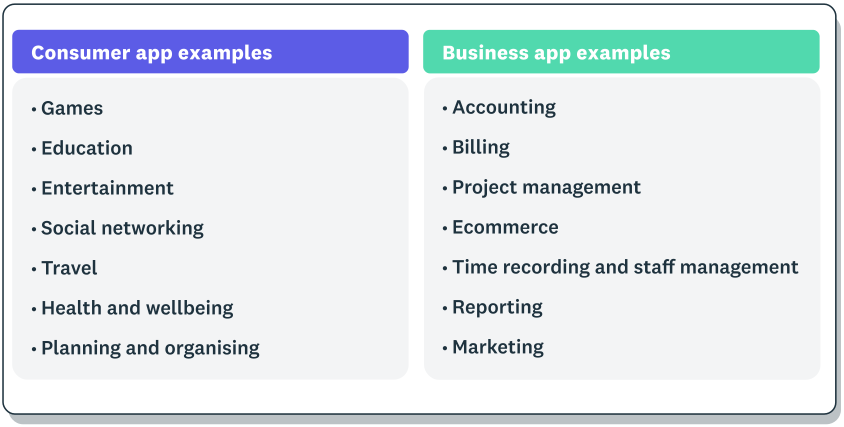
App and software businesses create digital tools that solve problems for consumers or businesses. Successful apps can reach millions of users and generate significant recurring revenue through subscriptions or one-time purchases.
Common types of apps and software:
- Consumer apps: Develop games, productivity tools, fitness trackers, and lifestyle apps sold through app stores
- Business software (SaaS): Build tools that help companies manage operations, from accounting to customer relationships
- Niche solutions: Create specialised software for specific industries or use cases
To build apps, you typically need technical skills or the budget to hire developers. Marketing is essential because app stores contain thousands of competing products.
Online content and media business ideas
Content and media businesses generate income by creating videos, podcasts, blogs, or other content that attracts an audience. Revenue typically comes from advertising, sponsorships, subscriptions, or affiliate marketing.
Common content business models:
- YouTube: Create videos that earn advertising revenue and sponsorship deals, particularly in popular categories like gaming and tutorials
- Podcasting: Build an audience and monetise through sponsorships, subscriptions, or listener support
- Blogging: Write content that generates income through advertising, affiliate links, or selling related products
- Online courses: Package your expertise into educational content that customers purchase
Content businesses reward consistent effort as you build an audience that generates meaningful income over time. Success depends on finding a compelling niche, developing strong marketing skills, and cultivating a distinctive personality that attracts followers.
How to compete with big brands
Competing with big brands requires differentiation through authenticity and personal connection. Small businesses win by offering authenticity, personal connection, and unique stories.
Ecommerce consultant Marc McKeown of FortBrave recommends building your brand around what makes you different.
"Put as much of your own story into your product and branding as you can," he says. "Customers will gravitate to you because of your authentic story, even if they have to pay a little bit more."
"And continue that through into your packaging and shipping. Differentiate yourself from the corporate experience. Package products nicely and put a personal note in. Amazon can't compete with that."
This personal touch can also generate organic marketing when customers share unboxing experiences on social media.
Niche down
Niche businesses focus on specific products, audiences, or interests to serve a targeted market. The internet makes niche ideas viable because you can reach customers worldwide who share that specific interest.
McKeown explains: "Niche shopping has been enabled by the internet. It's much easier to find out-of-the-ordinary products online than to traipse around town for it, so that's what people do."
A product that seems too specific for your local market may have strong demand when you can reach customers globally.
How to choose the right online business for you
The best online business idea depends on your specific situation. Consider these factors when evaluating your options:
- Available time: Consider whether you can commit full-time or prefer a side project
- Startup budget: Assess your available funds, as service businesses cost less to start than product businesses
- Existing skills: Choose a model that uses strengths you already have or skills you want to develop
- Income goals: Consider whether you need immediate income or can invest time building something larger
- Risk tolerance: Consider your comfort level with financial uncertainty as you build your business
- Technical comfort: Assess your technical skills, as some models require more expertise than others
Match your choice to your current circumstances to find a business model that fits your life. You can always expand or pivot once you've gained experience and resources.
How to start your online business
Once you've chosen an idea, follow these steps to launch your online business:
- Validate your idea: Research demand, competition, and pricing before investing time or money
- Create a simple business plan: Outline your target customers, revenue model, and initial costs
- Register your business: Set up the legal structure and any required licences for your location
- Set up your financial systems: Open a business bank account and choose accounting software to track income and expenses from day one. To simplify this, you can look into globally recognised standards like the IFRS for SMEs, which is designed to be straightforward for smaller businesses.
- Build your online presence: Create a website or set up shop on a marketplace platform
- Launch and test: Start selling, gather customer feedback, and refine your approach
- Monitor and improve: Track your results and adjust your strategy as you learn what works
Read more in the guide to starting an online business.
Manage your online business finances with confidence
Starting an online business is exciting, but staying on top of your finances from day one sets you up for long-term success. Tracking income, expenses, and cash flow helps you understand what's working and make informed decisions as you grow.
You can simplify your financial management with Xero. You can send invoices, track expenses, connect your bank accounts, and see your cash position in real time, all from one platform.
Get one month free and see how Xero helps you focus on growing your business with streamlined financial management.
FAQs on online business ideas
Here are answers to common questions about starting an online business.
Which online business is easiest to start?
Service-based businesses like freelancing, virtual assistance, and consulting are typically easiest to start because they require minimal upfront investment and use skills you already have.
How much money do I need to start an online business?
Startup costs vary widely. Service businesses can start with almost nothing, while product businesses may need a few hundred to several thousand dollars for inventory, website setup, and marketing.
Can I start an online business while working full-time?
Yes. Many online businesses work well as side projects. Service businesses with flexible schedules and passive income models like digital products are particularly suited to part-time operation.
How long does it take to make money from an online business?
Timeline varies by business type and effort. Some service businesses generate income within weeks, while content or product businesses may take months to build an audience or customer base.
Do I need technical skills to run an online business?
Basic digital literacy is essential, and many business models work well with just foundational technical skills. Website builders, ecommerce platforms, and online tools handle most technical requirements for you.
Disclaimer
Xero does not provide accounting, tax, business or legal advice. This guide has been provided for information purposes only. You should consult your own professional advisors for advice directly relating to your business or before taking action in relation to any of the content provided.
Start using Xero for free
Access Xero features for 30 days, then decide which plan best suits your business.