United Kingdom Small Business Insights
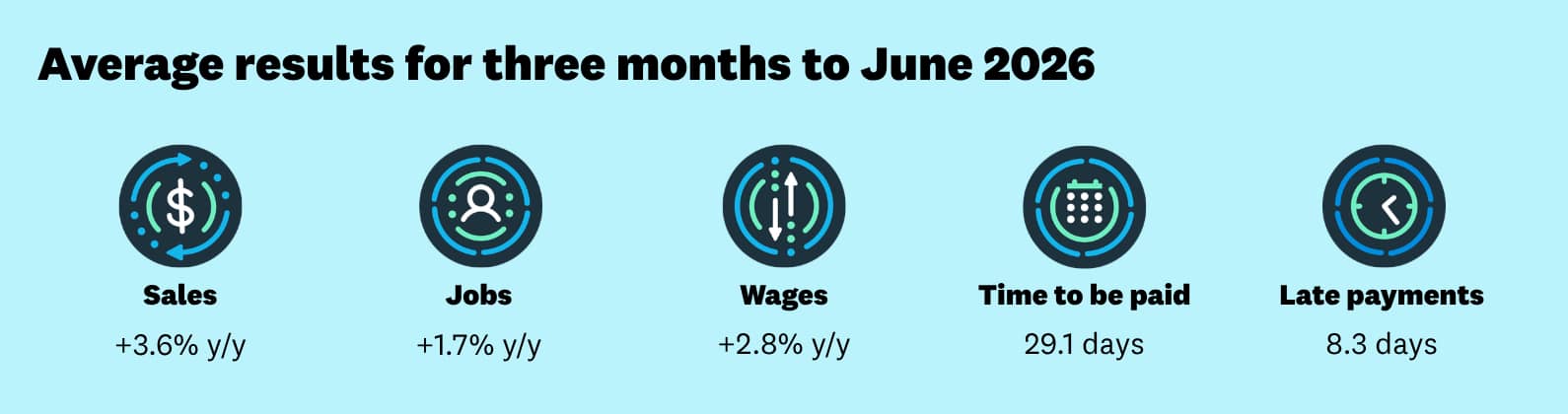
This analysis focuses on core performance metrics of sales growth, jobs growth, wages growth, late payments and time to be paid.

Sales growth slows as fuel price impacts bite
Published: 30 July 2026
The latest Xero Small Business Insights (XSBI) data for the UK shows sales growth slowed further in the June quarter as higher-than-normal fuel prices started to hit household budgets and discretionary spending. Sales grew 3.6% year-on-year (y/y) and jobs growth was only 1.7% - both measures were slower than in the March quarter. Payment times were slightly longer than in the March quarter, but both better than the 2025 averages.
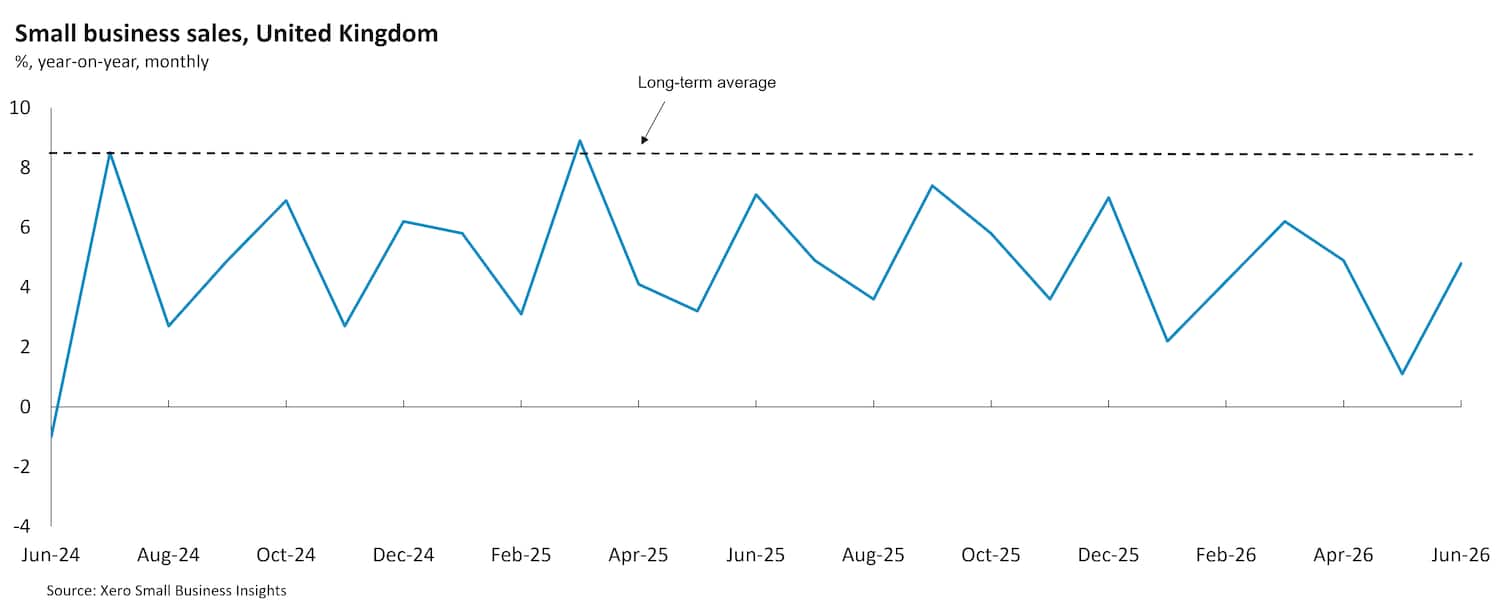
Small business sales grew 3.6% y/y in the June quarter, an ongoing slowdown from the 4.2% y/y rise in the March quarter and a 5.5% y/y rise in the December quarter. Sales growth is now well below its historical average of 8.5% y/y. Breaking down the monthly movements over the quarter, sales rose 4.9% y/y in April but then slowed sharply to 1.1% y/y in May before improving to 4.8% y/y in June. This pattern mirrors fuel prices which rose through April, to peak in May and then dip again in June as hopes of a ceasefire between the US and Iran emerged, although these were short lived.
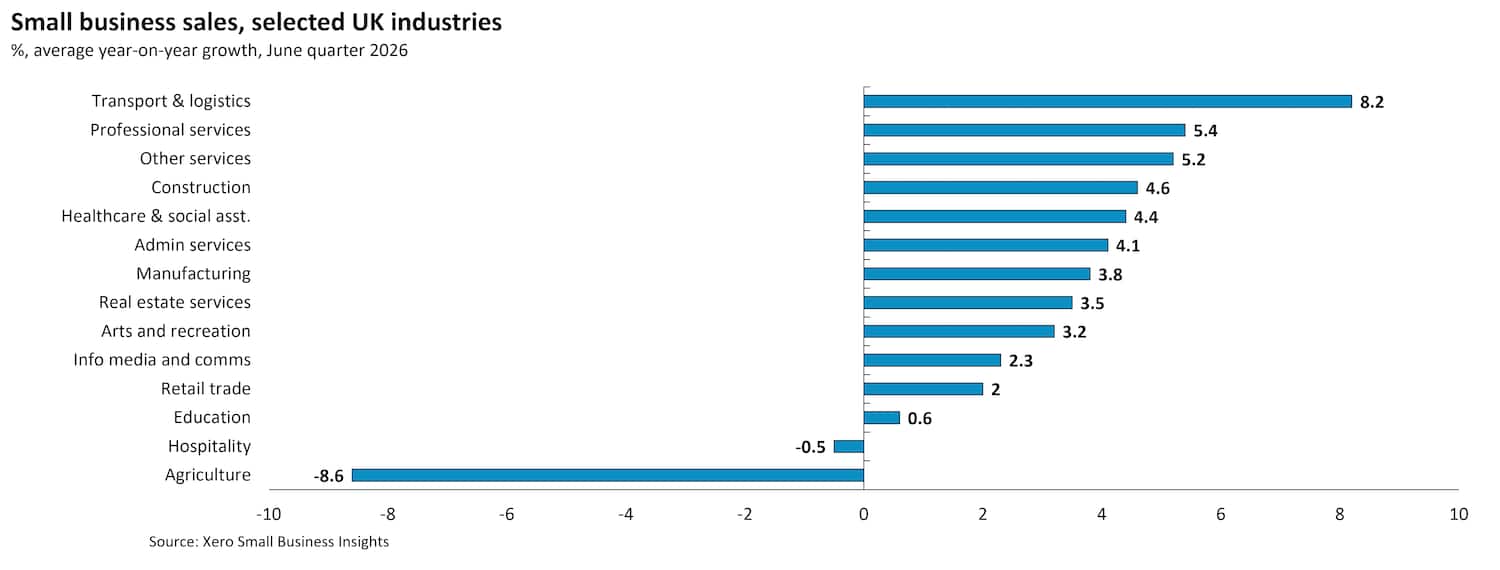
The industry breakdown of sales shows some variation between the best and worst performers, with those exposed to discretionary consumer spending recording some of the smallest sales rises and sharpest slowdowns in spending growth between the March and June quarters. This includes retail trade (+2.0% y/y), hospitality (-0.5% y/y), arts & recreation (+3.2% y/y) and education (+0.6% y/y). Agriculture (a new XSBI industry) was the weakest sector, with sales 8.6% lower than a year ago. During the quarter the industry was impacted by lower prices for some commodities, such as dairy, beef and pork, and above-average temperatures, which have reduced crop quality in some areas. Transport & logistics (+8.2% y/y) - also a new XSBI industry - had the strongest growth, which likely reflected higher prices being charged for freight movements, due to elevated fuel prices, rather than increased demand.
The variation across regions was less pronounced. Wales (+1.4% y/y) and the South West (+2.4% y/y) were the softest regions and Yorkshire & the Humber (+ 4.7% y/y) was the strongest. All other regions were similar to the national average and between 3.1% y/y and 4.1% y/y.
Sales growth slowed further in the June quarter as higher-than-normal fuel prices started to hit household budgets and discretionary spending
XSBI UK April 2026 - June 2026 data
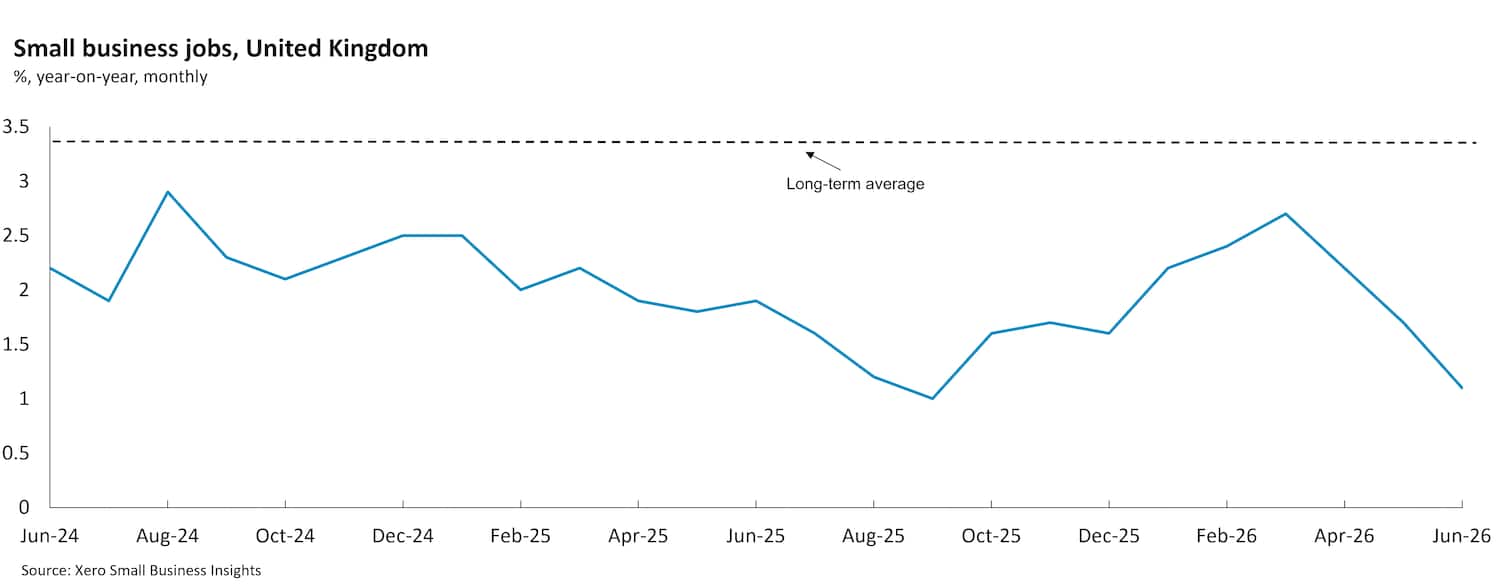
Jobs growth slowed in the June quarter, to 1.7% y/y after a 2.4% y/y rise in the March quarter. This pace is about half the historical average for this series and likely reflects small business owners' reluctance to commit to growing their workforce when it isn't clear what the impact on ongoing elevated fuel prices will be on customer spending. The largest jobs rises in the quarter were in healthcare (+3.8% y/y), real estate services (+3.5% y/y) and, surprisingly, retail trade (+3.5% y/y). Hospitality (-0.7% y/y) and information, media and communications (-0.2% y/y) had fewer jobs than a year ago in small businesses. For the regions, the gains were led by the North West (+3.7% y/y) and Northern Ireland (+3.1% y/y) - a new region for the XSBI program. West Midlands (-0.7% y/y) and the North East (-1.5% y/y) had fewer jobs than a year ago.
Wages in small businesses grew 2.8% y/y, and have been growing at, or just below, 3% for over a year now.
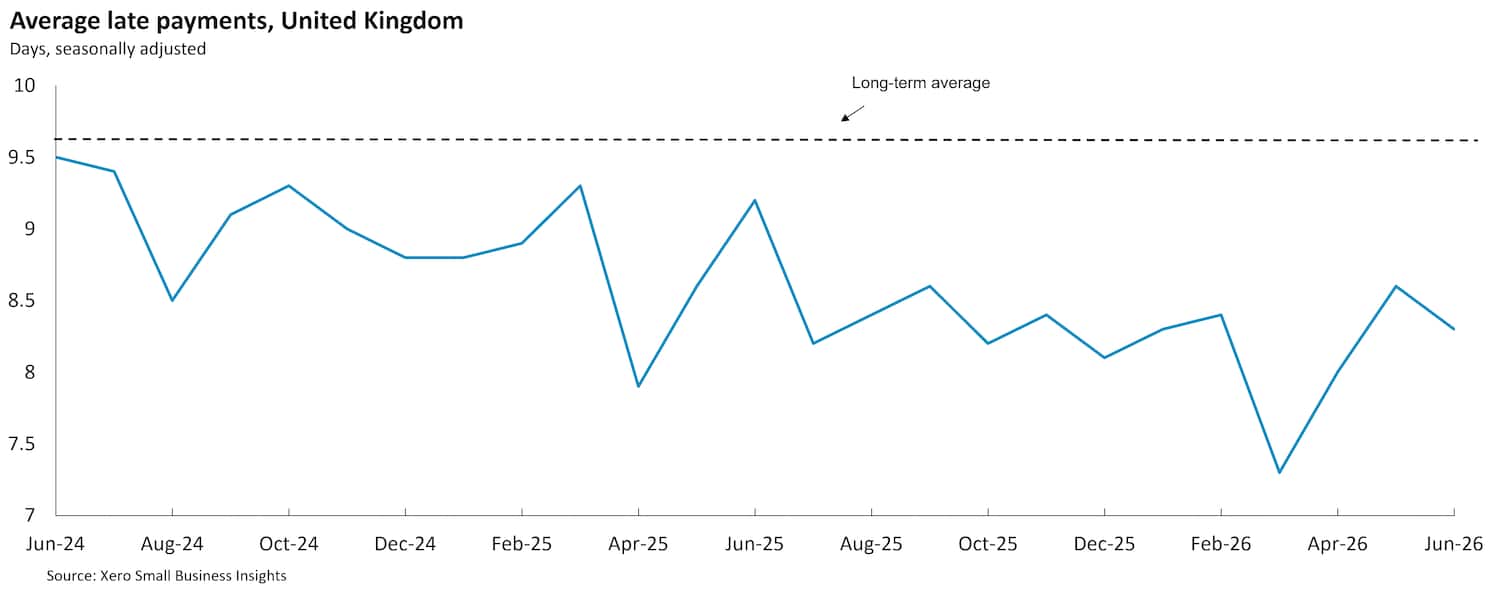
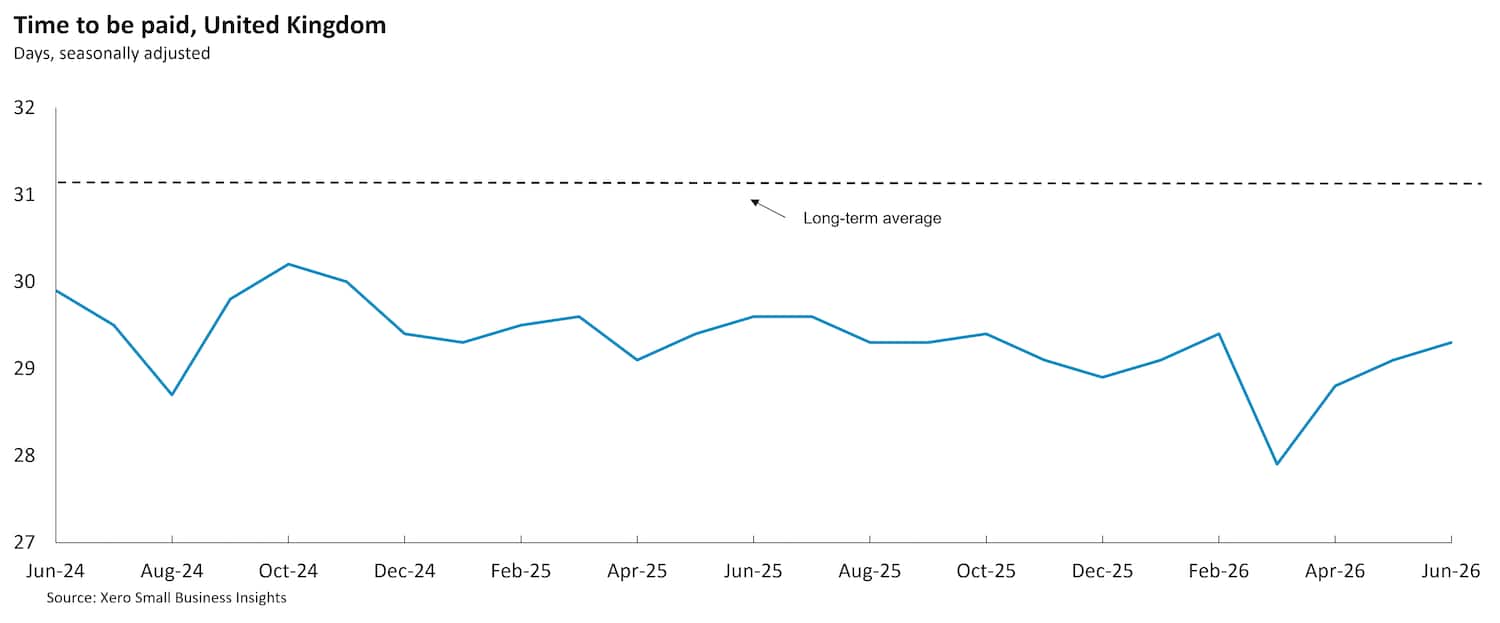
Both payment time metrics were slightly longer in the June quarter, but both better than the 2025 averages. The average length of time small businesses waited to be paid, after issuing an invoice, was 29.1 days - after 28.8 days in the March quarter and 29.3 days in 2025. Small businesses were paid, on average, 8.3 days late in the June quarter, up from 8.0 days in the March quarter but better than the 8.6 days in 2025.
Overall, small business sales and jobs growth remain below their historical averages and softened further in the June quarter. This is likely, at least in part, to stretched household budgets as fuel prices remain higher-than-normal. The UK economic recovery wasn't able to gain sustainable momentum before events in the Middle East pushed the fuel price higher, potentially diverting household spending and making it even harder for small business owners to generate profits and cash flow.
Looking ahead, in its latest forecast the OECD expects UK GDP growth to weaken to 0.9% in 2026, as renewed inflationary pressures squeeze real incomes and exacerbate uncertainty, weighing on private consumption and investment.
The return of hostilities between the US and Iran in July introduces renewed uncertainty about economic growth in the second half of the year. In addition, profit margins and cash flow will continue to be under-pressure as small businesses are squeezed between rising input costs (including, and potentially beyond, fuel) and increasingly hesitant customers.
For more information on the XSBI metrics, see our methodology page.

Disclaimer
This report was prepared using Xero Small Business Insights data and publicly available data for the purpose of informing and developing policies to support small businesses.
This report includes and is in parts based on assumptions or estimates. It contains general information only and should not be taken as taxation, financial, investment or legal advice. Xero recommends that readers always obtain specific and detailed professional advice about any business decision.
The insights in this report were created from the data that was available as at the date it was extracted. Data used was anonymised and aggregated to ensure individual businesses can not be identified.
Find out more about XSBI
If you have any questions about Xero Small Business Insights, reach out to us.