New Zealand Small Business Insights
This analysis focuses on core performance metrics of sales growth, jobs growth, wages growth, late payments and time to be paid.

Small business performance around historical average
Published: 29 October 2026
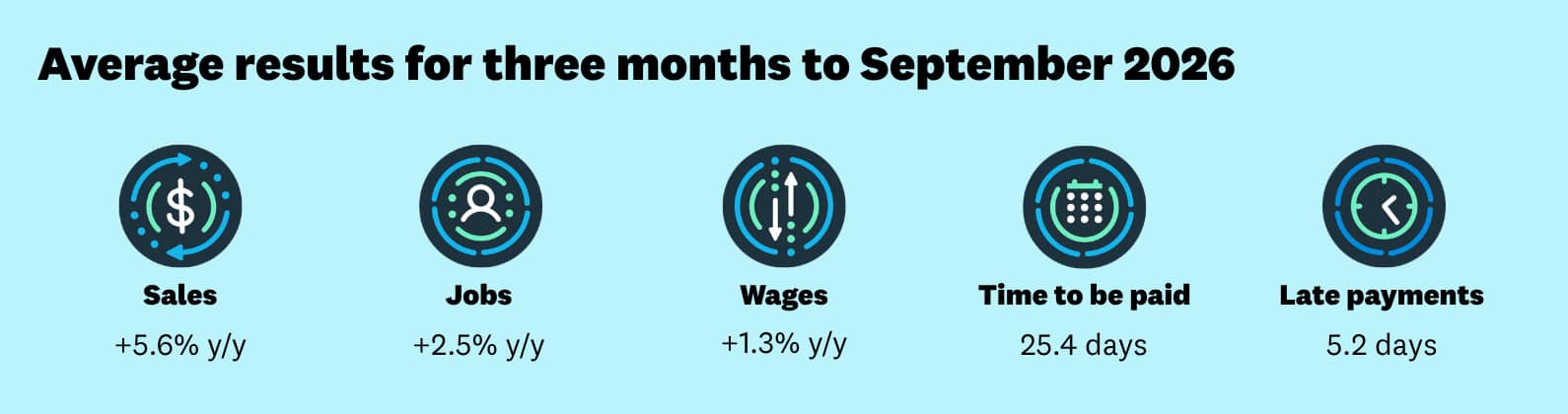
The latest Xero Small Business Insights (XSBI) data for New Zealand shows some pullback in the September quarter, after an exceptional June quarter performance. Sales rose a still solid 5.6% year-on-year and jobs increased 2.5% y/y, both around their historical averages. This easing back in sales momentum most likely reflects the impact of ongoing higher-than-normal fuel prices, which is also flowing through to other prices, low wage growth and two cash rate rises in the quarter. A more worrying trend was evidence of cash flow coming under pressure, as average late payments rose by around a day to 5.2 days.
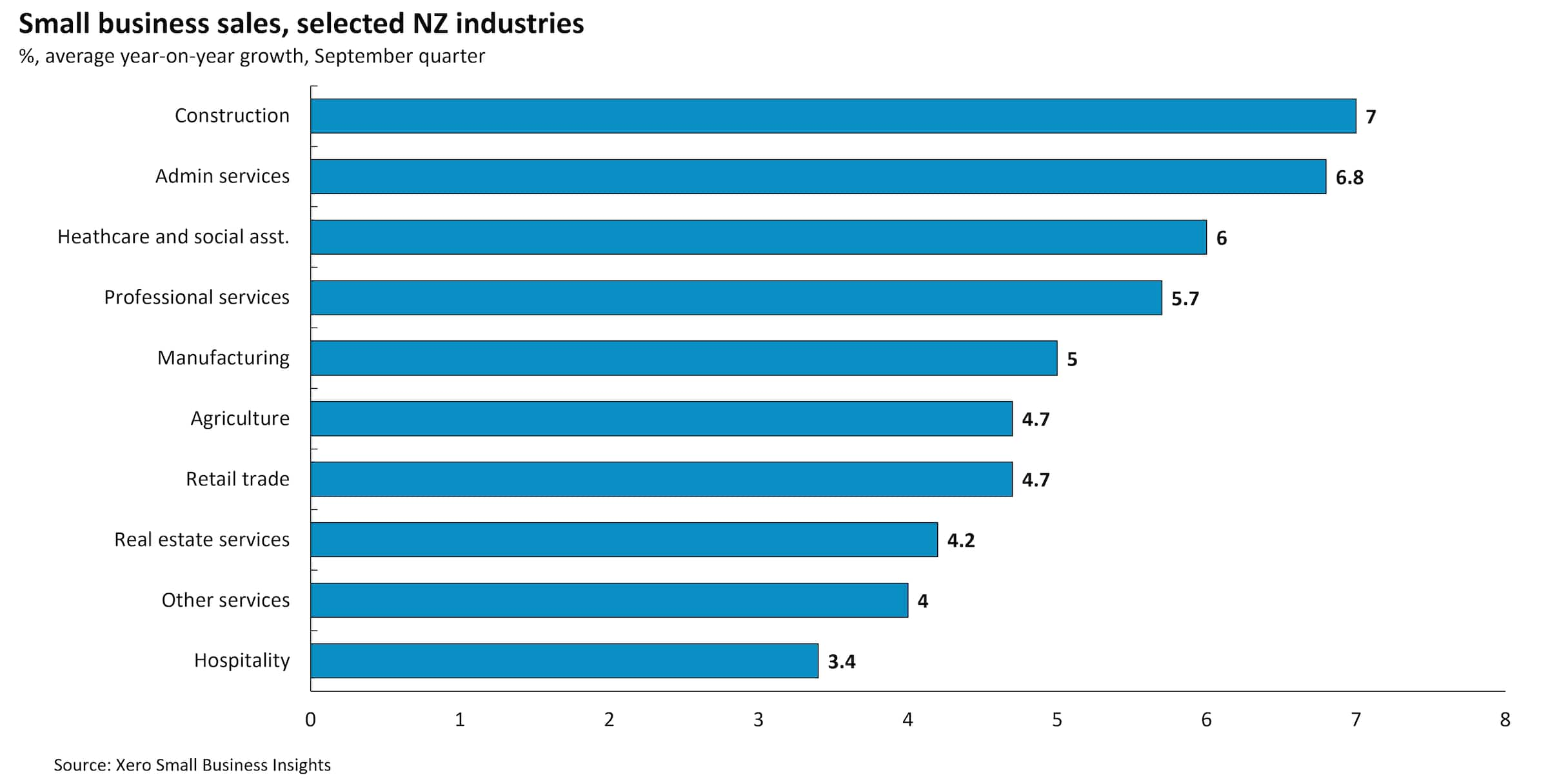
Small business sales rose 5.6% (y/y) in the September quarter, after an impressive 9.1% y/y rise in the June quarter. The monthly pattern of sales showed a sharp slowdown between June (+12.1% y/y) and July (+5.2% y/y) followed by some stabilisation, with a 6.1% y/y rise in August and a 5.6%y/y rise in September. Over the quarter, sales were a little below the historical average of 6.2% y/y, but this is still a solid result in the face of growing macroeconomic headwinds and in the context of sales trends in 2024 and 2025.
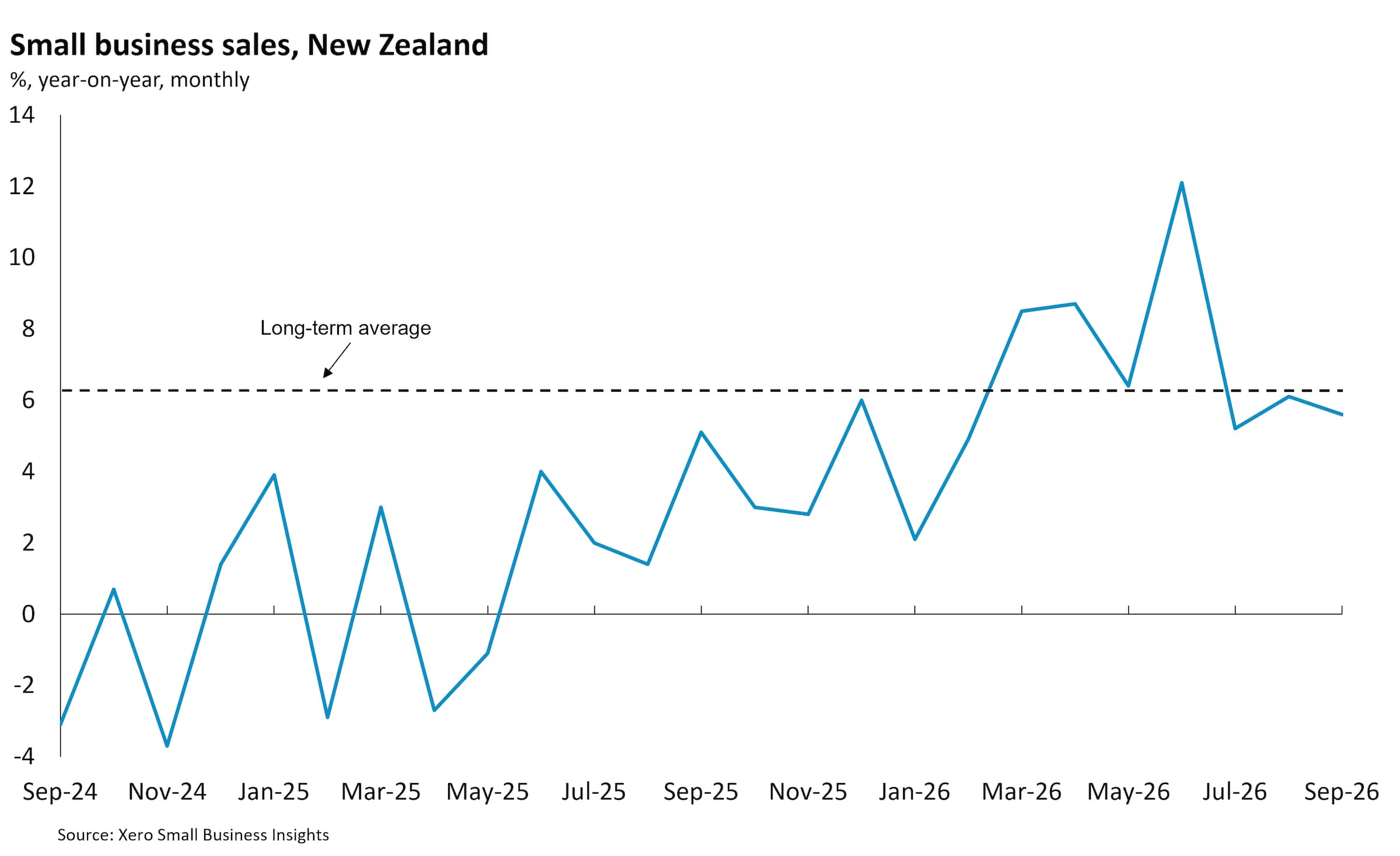
There was less variation in sales performance across industries in the latest quarter. After surging (+14.3% y/y) in the June quarter, agriculture sales growth eased in the September quarter (+4.7% y/y). This pullback simply reflects this sector has been performing well for so long, rather than being a concerning trend. The best performer in the latest quarter was construction (+7.0% y/y), followed by administrative services (+6.8% y/y), healthcare (+6.0% y/y) and professional services (+5.7% y/y). Hospitality (+3.4% y/y) and other services (+4.0% y/y) had the smallest sales gains, likely reflecting households pulling back on spending in these two sectors as they are forced to spend more on fuel and other goods, and after two cash rate increases.
There was more variation in sales performance across regions. Manawatu-Whanganui (+7.8% y/y), Canterbury (+6.6% y/y) and Otago (+6.6% y/y) led the gains. Marlborough, Nelson & Tasman (+1.4% y/y) and Southland (+1.7% y/y) managed only small sales increases over the year.
This is still a solid result in the face of growing macroeconomic headwinds and in the context of sales trends in 2024 and 2025.
XSBI NZ July 2026 - Sept 2026 data
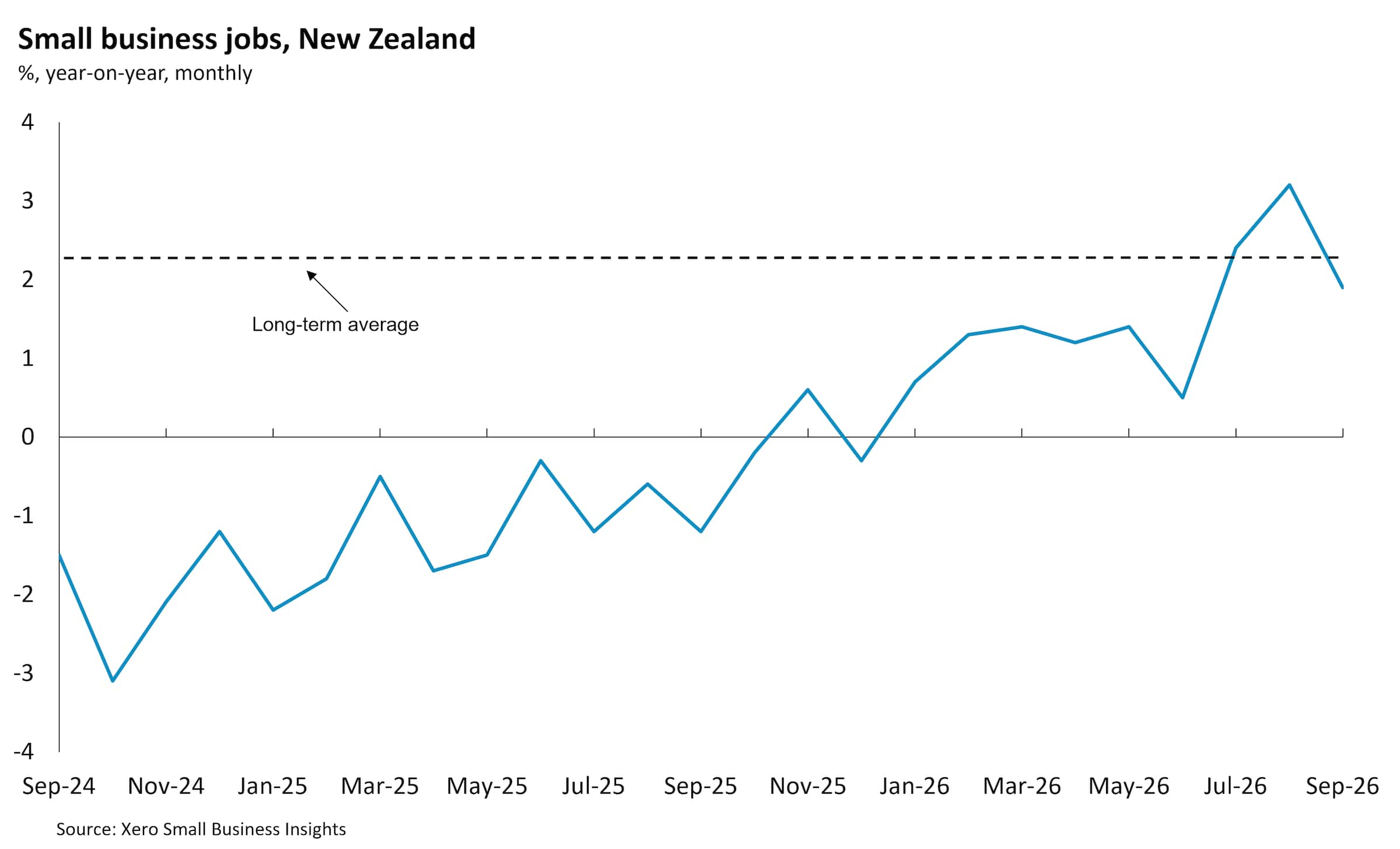
The improvement in sales performance during 2026 has started to flow through to jobs, which rose 2.5% y/y in the September quarter. This was more than double the 1.0% y/y rise in the June quarter. The latest result is just above the historical average for the series (+2.3% y/y). These national results mask different experiences across industries. Real estate services (+7.0% y/y), administrative services (+6.4% y/y) were by far the best performers. Professional services (+3.9% y/y) and construction (+2.8% y/y) both recorded results above the national average. Hospitality (-1.4% y/y) continues to employ fewer people than a year ago and agriculture (+0.6% y/y) and health care (+0.9% y/y) had minimal growth. Northland (-0.5% y/y) and Marlborough, Nelson & Tasman (-0.3% y/y) small businesses have fewer jobs than a year ago. Canterbury (+5.4% y/y) was by far the best performer for jobs, followed by Waikato (+3.2% y/y).
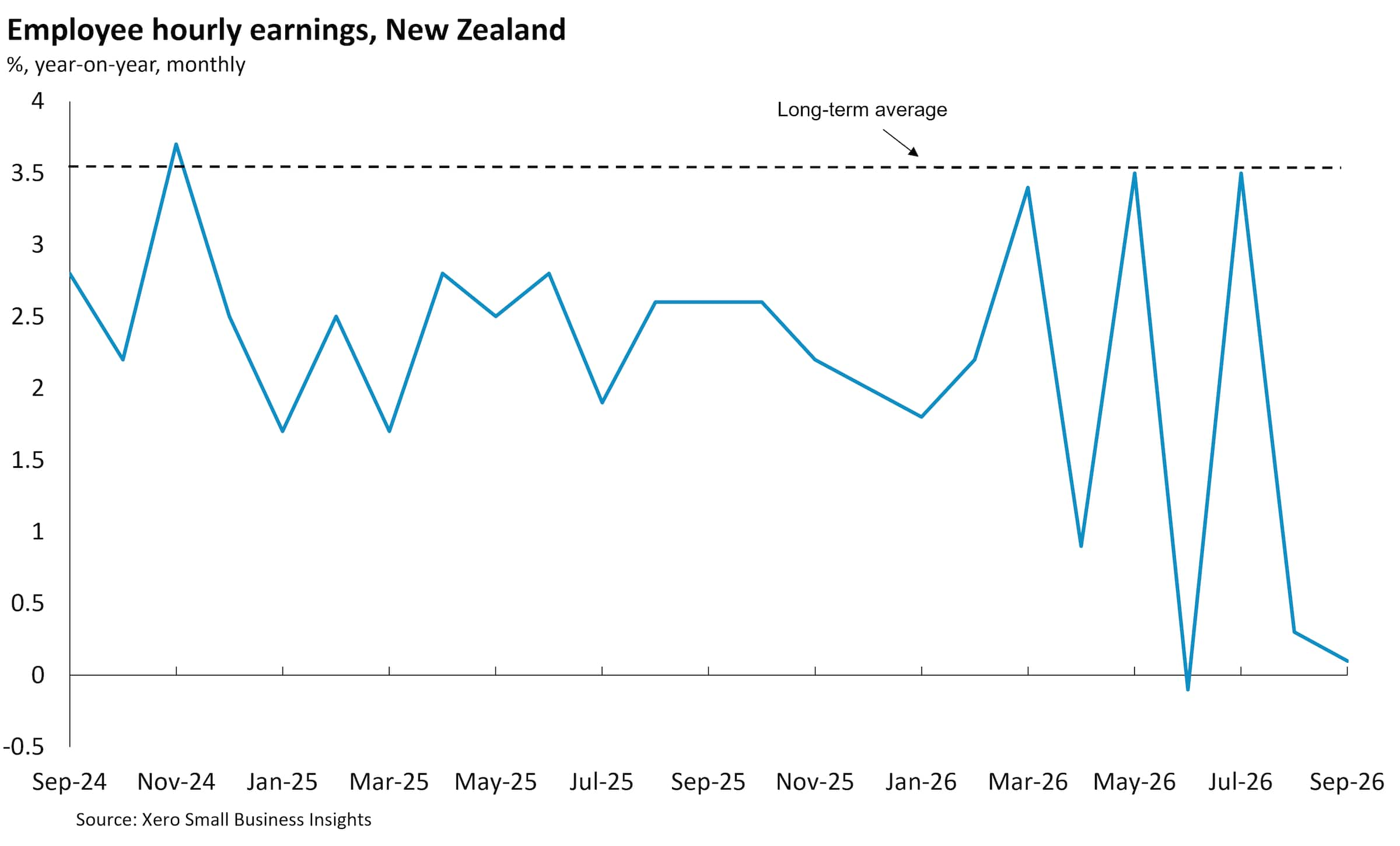
Wages rose only 1.3% y/y, similar to the June quarter (+1.4% y/y) and well below the historical average (+3.5% y/y). This, when combined with renewed inflation and rising interest rates, is why cost of living pressure is a major concern for many households. This weakness is across all industries and regions. Wage gains ranged from 1.6% y/y in construction down to just 0.4% y/y in healthcare. Hawke's Bay (+0.7% y/y) and Marlborough, Nelson & Tasman (+0.7% y/y) both had the lowest wage rises of the regions. Southland (+1.7% y/y) had the largest wage increase.
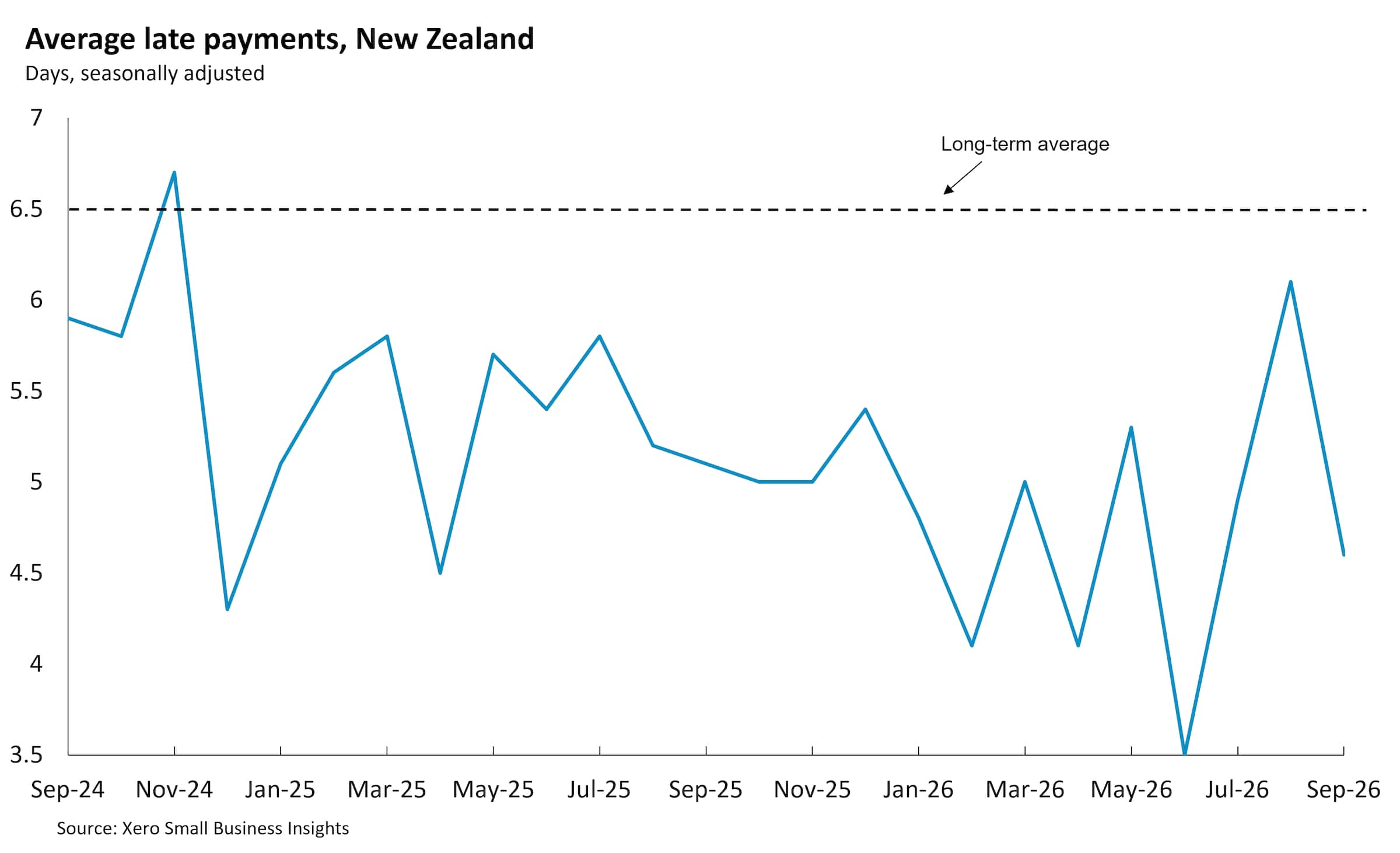
Both measures of payment times increased this quarter, suggesting pressure on cash flows may have increased. Small businesses waited an average of 25.4 days to be paid in the September quarter, 0.3 days longer than in the June quarter. Of more concern is the 0.9 day increase in average late payment times, to 5.2 days. While disappointing, and something that needs to be closely monitored in the coming months, it's important to recognise that New Zealand continues to have the shortest late payment times of the five countries tracked by XSBI.
Overall, the latest XSBI data shows small business performance is around its historical average. This is a solid outcome given the considerable macroeconomic headwinds, many of which are external, facing the economy.
Looking ahead, the Reserve Bank of New Zealand expects the economy to continue to gradually recover, despite the dampening effects of renewed inflation pressures. After its September meeting, the Monetary Policy Committee noted that "strength in the external sector and the effects of accommodative monetary policy will continue to support and broaden the recovery". The September Monetary Policy Statement forecasts suggest small business owners should prepare themselves for 1-2 more cash rate increases, either later this year or early in 2027. At the time of finalising this summary, a few days ahead of the October 28 RBNZ meeting, financial markets and economists at most of the major banks expect the cash rate to be lifted for a third time at this meeting due to increased concerns around fuel-price induced inflation.
For more information on the XSBI metrics, see our methodology page.

Disclaimer
This report was prepared using Xero Small Business Insights data and publicly available data for the purpose of informing and developing policies to support small businesses.
This report includes and is in parts based on assumptions or estimates. It contains general information only and should not be taken as taxation, financial, investment or legal advice. Xero recommends that readers always obtain specific and detailed professional advice about any business decision.
The insights in this report were created from the data that was available as at the date it was extracted. Data used was anonymised and aggregated to ensure individual businesses can not be identified.
Find out more about XSBI
If you have any questions about Xero Small Business Insights, reach out to us.